

By Helga Abraham
In today’s social network-centered world, most people keep in touch with far-flung friends from high school and university via Facebook or Instagram, as in-person reunions happen less frequently. AMIT is working to reverse that trend by undertaking three large-scale reunions of graduates around the country this summer and establishing alumni communities at several of its schools.
AMIT’s three inaugural alumni events in May and June drew a huge response and great excitement: 1,100 graduates of AMIT Ginsburg Bar Ilan Gush Dan gathered in Tel Aviv; 240 graduates of AMIT Kennedy Junior and Senior High School came together in Acco; and 700 alumni of AMIT’s Frisch Beit Hayeled reunited in Jerusalem, at the place they called home during the formative early years of their lives All three events underscored the unique impact of an AMIT education on Israel’s children from diverse socioeconomic and religious backgrounds—and demonstrated that AMIT graduates make up the fabric of Israeli society and contribute to the country in different ways. They are academics, security experts, doctors and psychologists, politicians, leaders in the army and at top yeshivot, musicians, comedians, entrepreneurs, and lawyers in prestigious firms.
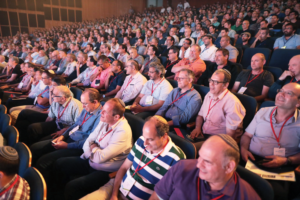
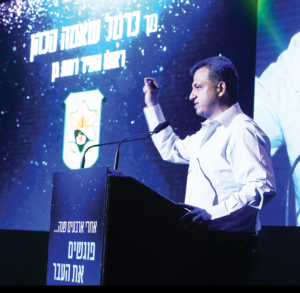 At the largest of the three reunions, 1,100 graduates of AMIT Ginsburg Bar Ilan Gush Dan high school for boys filled Tel Aviv University’s elegant Smolarz Auditorium to capacity, along with current 11th and 12th-grade students. Alumni greeted each other with laughs, hugs, and handshakes and the sense of camaraderie and excitement was palpable. Some 200 teachers past and present, past principals, and dignitaries who are affiliated with the school also attended. Many had not seen each other for three, even four decades, but few had difficulty identifying each other. If they did, a neck tag hanging from a colorful ribbon identified them not only by name but also by decade — red for the school’s first decade, purple for the second, yellow for the third, and orange for the fourth.
Ronen Jacobson, 48, who graduated in 1988 and went on to become a renowned psychologist with his own radio show, wore a red ribbon. He had come from Jerusalem to see old colleagues and former staff, citing his math teacher Sarah Grazutis as “amazing.” More than just a reunion, the alumni event celebrated the school’s 40th birthday, and many graduates nostalgically recalled the school’s beginnings, as it squatted in caravans on the campus of Bar-Ilan University.
“It was pretty chaotic,” recalled Yaron Kenigsberg, who graduated in 1983. “One class was in one building, another in another, but we forged a good name for ourselves.” So much so that Kenigsberg’s son Roee has continued in the family tradition and will graduate from the school this year. “I love it,” he said enthusiastically. “There are 500 students but it feels like a family. I don’t much like studying but I arrive at the school with a smile.”
The evening’s program was funny, engaging, and meaningful, with graduates recalling inside jokes and pranks, watching footage from years back, and paying tribute to the fallen soldiers who were graduates of the school.
Among former staff attending the event was 53-year-old Gideon (Gidi) Sapir, a brilliant law professor who taught Talmud at Gush Dan in the early 1990s. “I consider my term there as one of the highlights of my life,” he said. “It was a privilege to touch the souls of brilliant young kids.” One such student was Roee Klein, the heroic IDF commander who died during the 2006 Lebanon War after jumping on a grenade to save his fellow soldiers. “Even at a young age, Klein was impressive,” recalled Sapir. “He was tough but very spiritual at the same time.”
Two very different alumni, Lior Ben Yair, who studied electronics and graduated in 1995, and Rav Oren Eliahu, who also studied electronics but went on to become a rabbi, both cited their teachers as excellent role models and remembered history teacher Tzipi Spiegel in particular. “She was the teacher,” recalled Ben Yair. “I didn’t like history, but I loved her class and I even remember her birthday!” Rav Eliahu, for his part, credited Spiegel for encouraging him to succeed not only in his studies but also in life.
As Randi Gelman, chairperson of AMIT’s Israel amutah who cites four generations of AMIT involvement in her family, looked round the hall, she exclaimed: “This has been a dream. It’s the first event of its kind that we have held, and the turnout was amazing.”
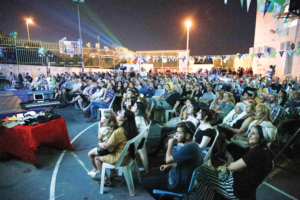
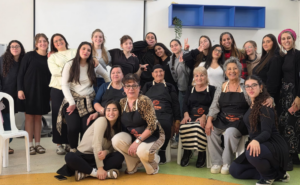
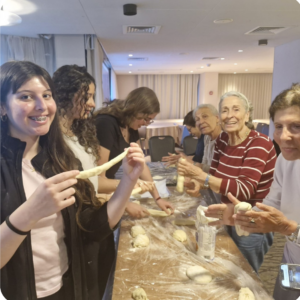
A few days later, in Acco, AMIT Kennedy Junior and Senior High School — which recently won the national educational excellence award — held its own alumni event on the school’s premises, attended by 240 graduates from across the country. Students baked cookies for the guests and student ambassadors led guided tours of the school. “The graduates were amazed by what they saw,” said Principal Eti Zabary. “We have state-of-the art labs and a high-tech hub where courses are given by start-up companies. It simply is no longer the same school.” After touring the school and mingling, graduates and students joined together in a “kululam” sing-along program, which had the entire school rehearse and perform a song by renowned Israeli singer Shlomo Artzi.
The final graduate event of the summer took place in Jerusalem at AMIT Frisch Beit Hayeled (“home of the child”), a unique surrogate family residence and school for disadvantaged children aged 5-15. (The current student body there is aged 8-15.) At Beit Hayeled, the children live in groups of 12 in apartments with a family unit called a “mishpachton” headed by young couples that act as surrogate parents to the children. Most of these children come from disadvantaged or dysfunctional homes, and they often learn what it means to be part of a warm, caring family at Beit Hayeled, where social workers, therapists, counselors, national service girls, and seminary girls from Midreshet AMIT all offer them support and attention. Currently the school caters to 52 resident and 27 external children; the latter also enjoy their own apartments and surrogate parents at Beit Hayeled but return, at night, to sleep in their own homes.
Niva Ament, head of the school’s therapeutic staff, said that the whole of Beit Hayeled is in fact therapeutic: “We have a huge therapeutic staff, which means that the children here receive much more personal attention than in foster care.” This approach has been quite successful, as evidenced by the 700 graduates of Beit Hayeled who turned up for the reunion, many with their spouses and children in tow. Many described how they would not have achieved what they have in life without the loving care and support that they got from Beit Hayeled.
Among the first to arrive was Ofer Dahan, 48, who came from a broken home and was one of the first boarders at the school. “We were looked after very well,” he said. “It was like a family.” As we talked, former Principal Motti Asraf came over to greet Dahan. “He was at my wedding,” Dahan noted with a smile. Soon Dahan was joined by two former co-boarders Orly Ohana and Yaffa Knafo, both of whom came from large families: Orly from a family of 15 and Yaffa from a family of 11. The two women, now married with children, recalled how Beit Hayeled took them in when their parents could no longer cope and gave them an education and a home. “We learned what it means to be a ‘family’ and to respect one another, no matter how different we were,” said Yaffa.
As the guests mingled in the school’s lobby and reception hall, others felt compelled to visit the apartments they grew up in. Michal Boadana, a mother of four and already a grandmother, was almost in tears as she stood in the apartment where she lived from age 5 until 12. “Beit Hayeled shaped me,” she recalled. “It gave me clothes, shoes, books, and a lot of support.” Pointing to the kitchen she exclaimed: “That’s where I used to bake cookies, and now baking is my profession!”
Among former staff attending the event was AMIT Director General Amnon Eldar, whose mother, Nitzchiya, served as principal of Beit Hayeled for 20 years. Amnon also began his career as an educator at Beit Hayeled. In the early 1980s, Eldar and his wife, Michal, served as surrogate parents to 12 children. “It was a challenge and a huge life experience that took over our lives completely,” recalled Michal. “Even when I was in labor, I worried about the children back at Beit Hayeled.” Nitzchiya and Amnon both spoke at the event. “It is here where I learned what would become the basis of AMIT’s educational philosophy, which is to give each child the specific attention he or she needs,” said Amnon.
Exemplifying the success of this approach is Tal Avitan, 36, who attended the event with two of his four children and was thrilled to reunite with old dorm pals again. Avitan boarded at Beit Hayeled in the early ’90s because his hometown of Sderot was constantly battered by rockets and his father was in jail. “Beit Hayeled was even better than home,” Avitan recalled. “I could sleep peacefully for the first time and, even more importantly, this is where I began to dream.” After dreaming of becoming a soccer star, Avitan studied soccer at the Wingate Institute and went on to establish the first religious professional soccer school in the country (in Sderot), which now boasts 150 members.
What’s Next?
As much as the alumni events were hugely successful in themselves — inspiring all those who attended and arousing great emotion — the network’s broader goal is to see them evolve into graduate communities that will enable AMIT alumni not only to keep in touch but also to play a role in connecting students with the “wider” world of business and employment. Graduates will be invited to give lectures at their former school, act as mentors to individual students, and offer professional consulting and career guidance. In this way, the wide-ranging expertise of the older generation will be harnessed for the benefit of the next generation.