
By Michele Chabin
RA’ANANA – AMIT GOGYA CENTER Ordinarily, June 23 would not be the optimal time to hold a full-day teachers’ workshop, what with final grades to input and end-of-the year activities, but for the dozens of AMIT network teachers who have spent the past year in a new, groundbreaking program called GOGYA, skipping the workshop never crossed their minds.
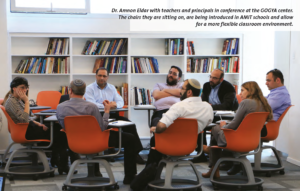
During the 2014-2015 school year, the participants—groups of five to seven teachers from 13 AMIT schools—traveled once a month to the impressive state-of-the-art GOGYA learning center, the network’s hub for educational innovation and collaboration, to learn how to teach in a startlingly new way.
Much of the teachers’ training took place at the learning center on AMIT’s Kfar Batya campus in Ra’anana. Refurbished from the inside out, the GOGYA building has the look and energy of a high-tech start-up. Ultramodern, with glass-walled classrooms, an abundance of natural sunlight, creative workrooms, and swiveling modular furniture, the building is the glass-and-concrete embodiment of GOGYA’s philosophy and spirit.
“This is a place to study, to collaborate, for peer study, for groups to develop new methodology and pedagogical ideas,” Eilat Deutsch, AMIT’s deputy director of research and assessment, explained as she gave a tour of the center during the June 23 “Teachers’ Day” workshop. “It can be the R&D teams from our own 38 AMIT schools or other groups of educators.”
Deutsch said AMIT’s pedagogical and R&D teams began searching for a new teaching/learning model more than three years ago, and that GOGYA, whose name comes from the word “pedagogy,” is the result.
“The decision to change the way we teach isn’t an Israeli idea or an AMIT idea,” she emphasized. “The whole world is going through the realization that education must undergo a major change.”
The frontal-teaching mode employed by most schools since the 18th century isn’t working very well today, Deutsch said, GOGYA was developed to bring the network’s educational practices into the 21st century. As recently as a decade ago, she noted, students who wanted to learn about a subject either consulted a teacher or headed to the nearest library or encyclopedia.
Today, thanks to the electronic information revolution, the majority of information is as close as the nearest computer, smartphone, or tablet. Students don’t really need teachers to impart the information they can find on the internet. “Deutsch cautioned that students don’t know how to evaluate what they see on Google, and they lack the tools and skills to differentiate between one answer and another. “They don’t know how to gather the information and take it to the next level. That’s where teachers come in,” she said.
What students need, she said, are teachers who encourage them to seek out information, individually or in groups, teach them the tools to interpret it, and to take this information in exciting and fun directions.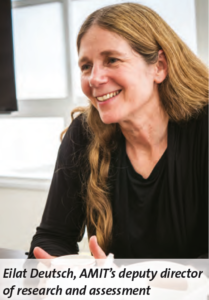
Computers can provide many of the answers, she noted, but students just don’t know how to ask the right questions.
GOGYA, Deutsch said, is built on the realization, born out by brain MRIs, that “the more active students are in obtaining knowledge, the better they retain it. Instead of being passive receivers, they know how to dig it out of their minds and experiences, where they are stored.”
At the schools affiliated with GOGYA, for example, students are asked to prepare a lesson plan and teach their fellow students. In the process, they hone their research and presentation skills and thoroughly learn the material.
“Without the proper tools,” Deutsch emphasized, “our kids won’t be able to find jobs and navigate their way in the new world.”
“GOGYA, is a comprehensive cultural change,” she said. “Rather than change one piece of a puzzle, it deals with all of a school’s components, from the method of teaching and assessment to how to organize daily life at the school and which programs to teach, and how.”
AMIT KAMAH YERUCHAM – GOGYA AT WORK
In June, a pair of tenth-graders from the AMIT Kamah School in Yerucham stood before a dozen seventh-graders in a classroom and asked them to sit in a circle. Then one of the older girls asked the younger girls some questions:
“How can we be sure the world knows about Israel and the Jewish people?” “How do others see us, and how does our behavior influence their perceptions?
One of the tenth-graders—who, like the rest of the students in her grade, was asked to deliver a lesson related to the leadership of the biblical Judge Samuel—tapped on her computer. A moment later the PowerPoint presentation she and her “co-teacher” had prepared appeared on a wall screen.
One of the slides showed the iconic photograph of American Jewish leaders marching alongside Martin Luther King at Selma, while another showed a photo of the late Prime Minister Yitzhak Rabin with former President Bill Clinton and the late Palestinian leader Yasser Arafat.
 The presentation included a short video depicting Japanese supporters of Israel waving Israeli flags and singing Israeli songs on the streets of Tokyo, and a short segment showing Israeli Nadir Glued, Israel’s representative at the popular 2015 Eurovision Song Contest, singing “Golden Boy.” Glued placed in the top ten in the contest.
On another slide, the face of Menachem Mendel Schneerson, z”l, the late Lubavitcher Rebbe, dominated the cover of a dated New York Times magazine.
The PowerPoint completed, one of the tenth-grade student teachers asked what messages the seventh-graders understood from these images.
“That Jews and Israel are a light unto the world,” one of the younger girls said.
“That the Torah teaches us that bigotry and racism are prohibited,” replied another student.
“That it’s not only Jews who are interested in Chabad and religious Jews,” said a third.
When the clearly successful lesson was over, the young presenters sighed in relief. “We spent a couple of weeks working on this presentation,” Noy Asher, 16, said. “I think it went well.”
Renana Ashkenazi, the other presenter, said that preparing the presentation was “a good way to learn as well as teach. It’s much nicer to be active than to have to sit in your chair in classes all day, every day.”
Morag Amar, 14, one of the seventh graders, thought the lesson “was really interesting. We examined what we do as Jews and Israelis that influence others and their opinions of us. It was something I’d never thought about before.”
Student-led workshops are just one of the innovations the Kamah school has introduced during the past couple of years, thanks in part to GOGYA—one of the most ambitious initiatives the AMIT network has ever undertaken.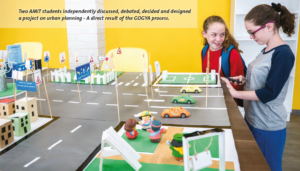
RA’ANANA – AMIT GOGYA CENTER
Determined to change the way AMIT teachers teach and students learn, the network’s pedagogical and R&D experts started laying the groundwork needed to empower the network’s teachers back in 2012.
“To build a new way of teaching has required our teachers to be students themselves,” Deutsch explained. “We needed to give them the ability to enact change in their schools. They needed to learn how to collaborate with other teachers to teach interdisciplinary subjects. And once they learned these things, they needed to learn how to assess the results of this new type of learning without using a conventional exam. How can we measure this or that project if the project is completely new?”
When the first group of GOGYA teachers began their studies last fall, the goal was to foster leaders who, by year’s end, would be prepared to teach GOGYA’s methodology to their schools’ other teachers. And that’s exactly what has happened.
Each group of five-to-seven teachers (known as their school’s R&D team) received in-school training and ongoing mentoring from a series of experts. Once a month they traveled to the GOGYA education center, where the R&D team members broke off to attend a variety of seminars and to share experiences and ideas with members of other groups.
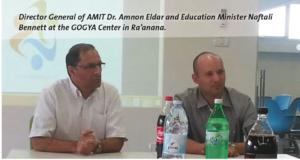 Unlike previous monthly meetings, the June 23 Teachers’ Day was an opportunity for each school’s R&D team members to formally reflect on how they integrated the GOGYA experience in their classrooms.
Standing before two other R&D teams, Ze’ev Levin, a high school teacher at the AMIT B’Levav Shalem in Yerucham, said his GOGYA team had spent much of the year “nurturing” teachers’ creativity and fostering cohesiveness between the students, who come from a wide range of backgrounds.
“Our goal in the coming year is to hold regularly scheduled faculty meetings with all the teachers where the emphasis, per GOGYA, will be on sharing ideas and listening to each other,” Levin told the group, who listened carefully to his PowerPoint presentation.
In between team presentations, Tahel Dahan, an English teacher and R&D member from the AMIT Religious High School in Sderot, said GOGYA has inspired her team to make what the students learn “more relevant” to their lives.
“Before GOGYA, I would walk into classrooms every day and teach one text after the other. Now I take a poem or a story and spend more time analyzing it with the students.”
Dahan recalled how, after teaching a poem called “Grandmother” to her class, she took the class to a nearby nursing home.
“Soon after, one of my students told me he now visits his grandfather and listens to what he has to say.”
Dahan said GOGYA “makes you aware you need a change and then facilitates that change.” The full-day she and her R&D team members devote to GOGYA every week “allows us, to think, to study, to extend our knowledge and brainstorm a host of ideas.”
Reut Aflalo, one of Dahan’s fellow team members, said she was initially fearful that the school’s other teachers, many of them with much more seniority, would balk at the GOGYAinspired innovations being suggested by the mostly young R&D team members.
“I feel a sense of satisfaction that they want to learn from us,” she said. Aflalo, also an English teacher, said GOGYA is enabling some of the educational innovations the AMIT network has been advocating for several years but without the kind of support GOGYA is now providing.
“Everyone was always telling us to teach and assess our students differently but no one really gave us the tools. Every couple of weeks we will divide up all the teachers into three working groups and teach them, work with them, and provide them with the tools and skills we’ve spent the year acquiring.”
Having benefited from the many “outside” lecturers offered to them via GOGYA, the Sderot team plans on bringing in lecturers with expertise in a variety of fields.
Yehuda David, Pedagogy Coordinator at AMIT Gwen Straus, Kfar Batya, said GOGYA encourages the collaborative give-and-take.
According to David, when two teachers get together, “you’ll see A and I’ll see B because you’re looking at it from one vantage point and I’m looking at it from another. That, in a word, is GOGYA.”
Although the principal will always have the final say on matters related to his or her school, David said, “We want teachers to be empowered and to share the great ideas they have.”
The principal described how inspired by GOGYA’s goal of making each and every subject more relevant, and therefore interesting to the students, he taught a Talmud lesson about a boat that included a YouTube clip of a storm at sea.
“I asked the students their feelings when they watched the storm scene, and when I realized they didn’t understand a word central to the text, I sent them to the Internet to learn what it means. The lesson was very interactive, and the kids and I enjoyed the entire process.”
Deutsch said the R&D members share anecdotes like this all the time, and that each anecdote reflects the unique character of that particular school.
“A school, in Sderot, is focusing on dialogue because they have a big range of students, some religious, some not religious. They’re asking themselves, how do we connect everyone?”
Meanwhile, Deutsch said, “Thanks to GOGYA the faculty at an AMIT religious girls high school in Tzfat “is connecting lessons in the Tanakh (Bible) with physics and math lessons and gender issues?”
Deutsch underscored that GOGYA is the result of trial and error by the AMIT network, which has always stayed ahead of the curve.
“Before GOGYA, we started with technology—tablets, smart boards, and project-based learning—and they accomplished things, but the focus was too narrow. The innovation came from the top down, not the bottom up. With GOGYA, the R&D teams tell us what they need, and those needs are different. It’s not one-size-fits-all.”
Today, Deutsch said, “we’re changing the environment. Teachers are being trained in how to make the most of tablets, how to collaborate with teachers of other subjects and how to teach in an open space, where classrooms have removable dividers.”
More than anything, Deutsch said, “we’re building leadership. We don’t want to send mentors to schools forever. Eventually, we want the teachers to lead themselves.”