
In The Room Where It Happens
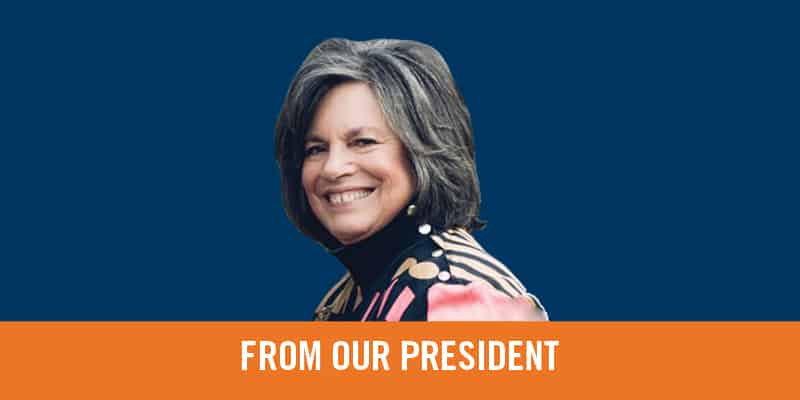
As AMIT’s president, I had the opportunity to attend the Conference of Presidents of Major Jewish Organizations (COP) mission to the UAE, Bahrain, and Israel. I am always happy to be a voice for Israel’s children in a room where important decisions are considered. I want to share with you some of my impressions from the trip.
We started with visits to Abu Dhabi, Bahrain, and Dubai, and the primary goal was to speak to senior government leaders and the Jewish community to see firsthand how the Abraham Accords are working. On the one hand, the UAE could not be more different from Israel ‒ it is a centrally controlled, authoritarian government with a population of 10 million, 90% of whom are guest workers, both very skilled and unskilled. On the other hand, it is very much like Israel ‒ there is a strong emphasis on innovation, cutting edge technology, and global partnerships to drive the economy and become a world economic leader. Trade and economics were clearly the major discussion topics, but the role of education came up in virtually every interaction, and AMIT is at the forefront of cultivating Israel’s leaders of tomorrow.
On a visit to the UAE Space Center, we learned of their planned lunar module landing scheduled for April 25. The leaders we met generally described warm relations between Israel and the UAE. Surprisingly, the relationship between the U.S. and the UAE came across as more complicated. Israelis made over 425,000 trips to the UAE last year, trade is on the upswing, and high-tech partnerships are starting. You can find kosher restaurants in many places including luxury hotels. Walking around with a kippah seemed safer than in any European capital and kosher food is easy to find and good. One of the most extraordinary experiences we had was visiting the newly opened Abrahamic House. A religious complex composed of a church, mosque, and synagogue, all with the same exact footprint and serene aesthetic, the House is a symbol of religious inclusion and harmony. This message comes straight from the Emir and is a lesson central to AMIT students’ education.
Returning to Israel, we saw firsthand the fractious, yet vibrant Israeli democracy in action. The government leaders we met all described a need for some judicial reform, but there was a wide gap between the “what” and the “how” depending on whether you were in the coalition or not. Experts describe the judicial fight because of four fault lines in Israeli society ‒ ideological, ethnic, religious, and economic. For many years, mainly secular, modern Ashkenazi, middle- and upper-class people in the center of the country, more or less controlled the levers of government. Religious/haredi, Sephardic, poorer, more right-wing people are now a large and critical group within the new governing coalition. They believe that this is their chance to redress historical injustices. Although President Herzog described his hope that he would be able to mediate a compromise resolution, it was difficult to see the two sides sitting down together anytime soon given their harsh public positions. Besides judicial reform, the leaders we met in both the Knesset and the Foreign Ministry are focused on a nuclear Iran and its proxy actors as the major regional threat. Second, was the runup to a post-Mahmoud Abbas Palestine as a serious destabilizing influence. Everyone saw the Abraham Accords as a positive game changer for Israel in the international arena with tremendous opportunity to broaden the number of partners and deepen collaborations. One highlight of the trip was visiting army bases in the Golan and meeting two graduates of AMIT schools currently serving in the engineering corps. Another was visiting the newly opened Kfar Maccabiah Hotel, meeting athletes that have and will represent Israel in the Olympics.
Despite the internal strife, Israel is still Israel, and it was great to be there. At every single meeting where I introduced myself as the President of AMIT, whoever I was speaking to, whether a member of Knesset or a political pundit, politically right or left, each person would note that AMIT is “good” or some variation on that theme. It is an honor to represent AMIT.