
By Dr. Amnon Eldar, Director General of AMIT
I was born into the world of education. As a young child, a constant source of inspiration in my home was my mother’s grandfather, Chacham Ben Tzion Ha’Levi, who was born in Jerusalem in 1873. He was a rabbi, a proficient scholar, and a community leader, but most significantly, he was the first director of the Sephardic orphanage in Jerusalem.
He raised his own 10 children while ensuring his home always served as a warm and loving family to the orphans who were not as lucky, and whom he brought in from the streets of Jerusalem. During times of drought and severe poverty, he gave these orphans his all.
The image of my great-grandfather being out from morning until night with the orphans, taking care of their every need and helping fill the large void in their hearts, was the cornerstone on which my home was built.
Over the decades I spent in the educational system, I always envisioned my great-grandfather’s commitment and dedication to the orphaned child who sought and needed warmth and love. It is in this spirit that I attempted to look at each and every child beyond the grades and standard classroom learning. First and foremost, I would see them as a human being, looking into each child’s eyes and giving them the sense that they had someone to rely on, that there was a responsible adult who would help guide them to success.
My mother followed in her grandfather’s footsteps, establishing and managing the AMIT Children’s Home (Beit Hayeled) in the Gilo neighborhood of Jerusalem—a shelter for children who were removed from their homes, who lived in mishpachton (family) units with a young couple who become a surrogate mother and father to them.
When I got married, I followed in my family’s footsteps. Together with my wife, Michal, we served as a couple at Beit Hayeled, raising children who could not live in the homes of their biological parents. When I became the director of AMIT Kfar Blatt Youth Village in Petach Tikvah, I initiated a change from dorm life to life in mishpachton units, with a young married couple serving as surrogate parents to the youth and acting as role models.
It was often difficult to deal with the stories the children brought with them. Some came with tremendous deficits in the love they had been given. Other children had been threatened and physically or emotionally hurt in ways that cannot be described. And others were exposed to terrible evils and experienced tremendous pain.
“S” was one of those children, with an alcoholic father and a mentally ill mother who was very controlling. When I visited their home, it was hard to walk inside because the mother hoarded every valueless object she found, from rolls of toilet paper to old newspapers. “S” roamed the streets until the welfare department placed him in Beit Hayeled. He later moved on to Kfar Blatt. He grew attached to the couple who served as his surrogate parents, and they accompanied him from that point forward. Today, he is married and has a wonderful family. He has a master’s degree and is a wonderful special education teacher at a local AMIT high school in his hometown. During his spare time, he volunteers his time to work with children still on the streets.
Every morning when I wake up to a new day of work, I envision “S” and his friends. In my role as Director General of AMIT, I always aim to put the student first. More than ever before, the souls of our students need attentive educators. Knowledge acquisition is important, but listening to our students, providing social interaction, and helping shape their personalities is even more important. During COVID, this became even clearer. It was not math class that students found most lacking, but rather their social lives. They needed face-to-face interactions with their homeroom teachers, a listening ear, and a warm smile.
The foundational belief that has driven AMIT’s dream over the past decade is the placement of children in the center—empowering and strengthening them, guiding them in developing a mature and values-driven personality, and ensuring they are prepared for the world of tomorrow. By acquiring 21st-century skills as well as entrepreneurial and digital skills, they gain knowledge that is relevant to the world and the workforce and have a greater chance to make a respectable living in the future.
We have been building this dream for a decade. For the past five years, AMIT has been ranked Israel’s leading educational network, highlighting our success. While AMIT is respected and recognized as the leading network in the area of educational innovation in Israel, we always remember that our ultimate goal is reaching the students, embracing them warmly, and providing them with skills for life, both emotionally and educationally.
This is the root of AMIT’s educational approach, and it is constantly developing through joint dialogue and collaboration between educational experts and teachers from the field. Our professional staff never stops searching, identifying, and adopting new trends from the global world of education, implementing them as part of an ongoing process of learning.
The Gogya initiative is a revolutionary and groundbreaking educational approach developed by AMIT, adapting content, methods, and the physical environment of students to our dynamic and rapidly changing world and to the generation of youth who will conquer it in the future. Gogya is the engine for implementing the change, transitioning classical schools of the past to educational learning communities of the present and future.
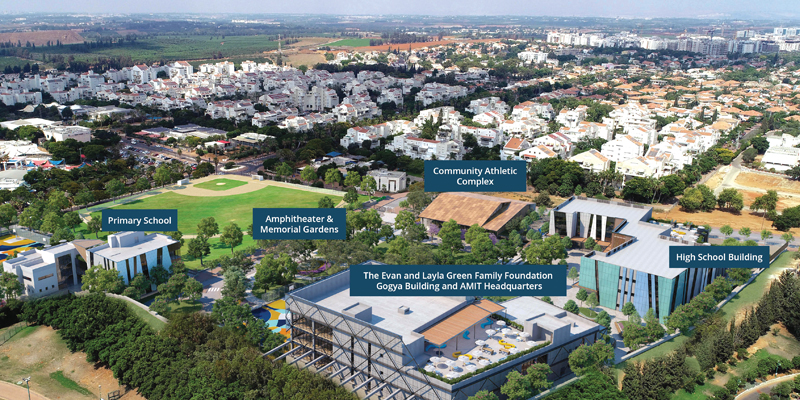
Kfar Batya has been an educational pioneer since its establishment. Having first operated as a home for youth who had survived the Holocaust, it later became a home to olim from the East, and later to those who arrived in Israel from the former Soviet Union and Ethiopia, always adapting to the changing needs of each generation. In recent years, an educational incubator was established at Kfar Batya for the development and implementation of the Gogya approach, opening its doors to principals, education teams, students, thought leaders, and practitioners from Israel’s education sector, with the goal of experiencing optimal growth, development, and personalized learning.
Until the COVID pandemic, tens of thousands of guests from all segments of Israeli society and from across the globe visited the Gogya Center in Ra’anana. Some guests even turned the Gogya Center into their professional home, which inspires and resembles entrepreneurship, values, and innovative education.
After eight years of significant work in the Gogya Center, while continuing to lead in the Ministry of Education’s “Educational Picture” method, the challenge facing us today is an important one within AMIT and for the Israeli world of education at large: transforming the Gogya Center into a revolutionary educational campus on the new Kfar Batya grounds—a campus that will embody groundbreaking educational approaches, technological developments, experimentation, and partnerships with public and private entities in Israel and around the world.
The new campus will serve as a lighthouse of education, values, entrepreneurship, and innovation, based on a vision of promoting 21st-century skills and values of entrepreneurship, and breaking the glass ceilings and walls we are familiar with today.
Kfar Batya was born as a unique educational pilot—a youth village for refugees from the Holocaust—with a special and visionary educational dream. Eighty years later, we believe a major educational change for Israeli children will come out of this very same place. The AMIT Gogya initiative combines all our learning and dreams in the areas of innovation, identity, connections in Israeli society, and leadership development, while ensuring a child-centric approach, because that is why we are here. There is one long string connecting my great-grandfather at the Jerusalem orphanage to every teacher at AMIT’s schools. It is a string of deep love for each and every student. We believe that this new path will help each student acquire values, take part in more meaningful learning, grow in a faster and more stable manner, and be better prepared to deal with the challenges of tomorrow in the very best way.
I believe that the AMIT Kfar Batya campus will change the face of education in Israel, and by acting as a global leader in education, will transition Israel from the Start-Up Nation to the Education Nation.