
By Rabbi Dov Linzer
Should we determine for ourselves what is right and wrong, or should we ask society to do it for us? Most of us probably would immediately vote for the former. We highly value our autonomy and personal freedom and do not want others making these important decisions for us. And yet, without laws that embody a sense of right and wrong, we would have chaos and anarchy. How are we to balance the needs of the society with the rights of the individual?
The Torah, unlike much of Western society, prioritizes our communal responsibilities. In Parashat Re’eh, as in much of Devarim, Moshe prepares the Children of Israel to enter into the Land and to turn it into a country. They must build the institutions, the systems, and the infrastructure to make it a well-functioning society that embodies the values of the Torah, both religious and moral.
Idolatry and idols must be abolished. There is to be one Temple, a single place where all gather to worship in a prescribed manner. On the moral front, the poor will not be left vulnerable to individuals’ decisions whether or not to give charity, but will be supported by society as a whole through obligatory tithes and the Sabbatical year.
What we have is a whole society built on the Torah. What we don’t have is a focus on, or even a concern for, the individual and his or her personal religious experience or moral convictions.
In fact, spiritual yearning could present a threat. When there was not yet a Temple, people would offer on their individual bamot, private altars. This allowed for a full subjective, personal act of worship. But it could lead to idolatry. They – the idolaters – worship “on the high mountains and the hills and under every leafy tree” (Devarim 12:3). But you “shall not do this to the Lord your God” (Devarim 12:4). A single God must be worshipped in a single place. When you follow your own path, who knows where it might lead?
In fact, spiritual yearning could present a threat. When there was not yet a Temple, people would offer on their individual bamot, private altars. This allowed for a full subjective, personal act of worship. But it could lead to idolatry. They – the idolaters – worship “on the high mountains and the hills and under every leafy tree” (Devarim 12:3). But you “shall not do this to the Lord your God” (Devarim 12:4). A single God must be worshipped in a single place. When you follow your own path, who knows where it might lead?
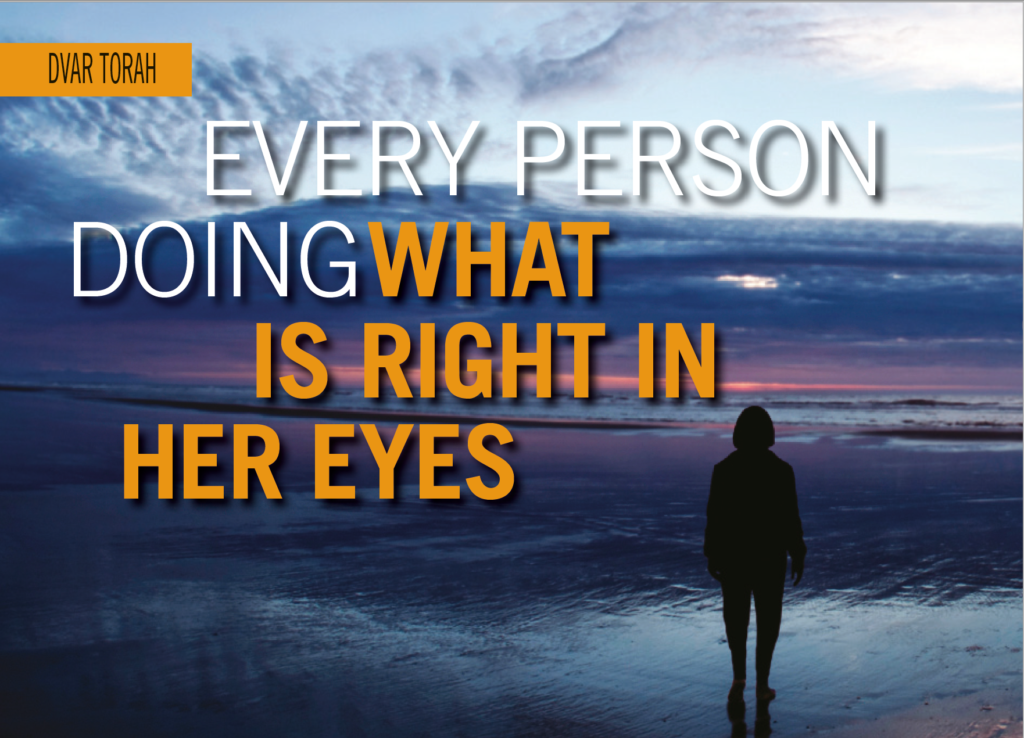
This tension exists in the moral realm as well. Prior to the creating of a structured society, it was ish kol ha’yashar be’einav, each person doing what is right in his or her own eyes (Devarim12:8). Thus, after Moshe lays out the basis for such a society, he urges the people to do “what is good and right,” ha’tov vi’ha’yashar, “in the eyes of the Lord your God” (Devarim 12:28). Doing what is right in God’s eyes, the Torah tells us, can only be achieved at the collective level once the societal structures in place.
But just as there can be religious yearning, there can also be moral yearning. It is all well and good that we live in a society of laws. But what about my own sense of morality? Should I just live in the letter of the law and no more? This autonomy can be threatening – what if my sense of morality is at odds with that of the larger society? Should I disobey unjust laws? And yet, if channeled correctly, this yearning can also lead to a more fully moral life. For it is from the verse of doing what is right and good in the eyes of God that the Rabbis derive that we must strive to live not just according to the letter of the law, but its spirit. If the yearning can be faithful to what is right in God’s eyes, then it will lead us to the most profound morality, not just of following laws, but of also being true to their values.
Different societies live out these tensions in different ways. Some may argue that we in America overemphasize individual freedoms at the expense of societal values or goals, at least as some would define them. This occurs on both ends of the political spectrum, just as an example – think gun control and gay marriage. But looking across the Atlantic, it seems that in modern-day Israel the emphasis is too often in the other direction. Is there truly no place for anything other than Haredi prayer at the Kotel? Is religious freedom to be completely denied?
Whether in the States or in Israel, we must strive to create a just, God-centered, society, that at the same time gives room for the individual and his or her deepest moral and religious yearnings. This is truly what it means to do what is right in the eyes of God.
Rabbi Dov Linzer is the Rosh HaYeshiva and Dean of Yeshivat Chovevei Torah Rabbinical School, a groundbreaking Orthodox semikha program. The four year program provides its students with rigorous talmud Torah and halakhic study integrated with sophisticated professional training, in a religious atmosphere which cultivates openness and inclusiveness.