
By Robert E. Sutton
Anti-Semitism is menacing Britain. It is guilt-free and under no constraints by historical knowledge. Despite the Holocaust is a subject that pupils in the U.K. must be taught, over sixty-three percent of students did not know that the Holocaust claimed the lives of six million Jews and many thought that Auschwitz was a type of beer. Posters at demonstrations that show a swastika within a Star of David have become so commonplace, that people believe the two are equated. With all the obstacles to ignorance being erased, the future for the Jews of England, and Europe as a whole, seems to be bleak.
England 2014
– 1,168 recorded incidents of anti-Semitism in the U.K.
– more than double the incidents recorded in 2013.
– Violent anti-Semitic assaults increased by seventeen percent.
– Damage and desecration to Jewish property increased by sixty-five percent.
– Nearly fifty percent of all Britons held an anti- Semitic view
. – One in four believes that Jews chase money more than other people.
– One in six thought that Jews had too much power in the media.
Norwich, 1144 The first documented Blood Libel
 The 12th Century was a time when many Christians were outraged that Jews refused to convert to Christianity. They saw the Jews’ refusal as a willful and obstinate denial of what they perceived as “God’s truth.” They expressed their anger in words and images that dehumanized and demonized Jews. It was in this charged atmosphere that some Christians began to accuse Jews of ritual murder. The accusation came at a time when life was precarious in Europe. And, as in other times of great fear and anxiety, many people found it all too easy to blame the Jews, the people who are not like “us”— for every tragedy, every hardship, every loss.
The Blood Libel grew out of an incident that took place in Norwich, England with the murder of a young boy named William.
The events surrounding William’s death are not entirely clear and are largely based on an account by Thomas of Monmouth, a local monk. On March 26, 1144 the body of William was discovered in heath in Norwich, bloodied and mutilated — seemingly tortured. Thomas of Monmouth, decided that the boy’s death was no ordinary murder. He declared that the Jews of Norwich ritually murdered William in the home of a Jew named Eleazar, just days before Passover. As has become the pattern with tales of blood libel, William was ritually murdered to acquire his blood for the baking of matzot.
In 1168, the accusation of ritual child murder was made among the Gloucester Jews and many of that community were killed. The lie of the Blood Libel spread throughout England. Whenever a Christian child died accidentally or in some uncertain manner, the Jews were accused; in Bury St. Edmond in 1181, in Bristol 1183, in Winchester 1192, in London 1244 and in Lincoln in 1255 – resulting in the massacre of Jews each time.
In the centuries after its first appearance in England, the Blood Libel accusation provoked instances of torture, death, and expulsion of thousands of Jews and the extermination of hundreds of communities. Although no charge of ritual murder has withstood historical scrutiny, the concept of the Blood Libel is so emotionally charged and deeply rooted in cultural memory that it endures even today.
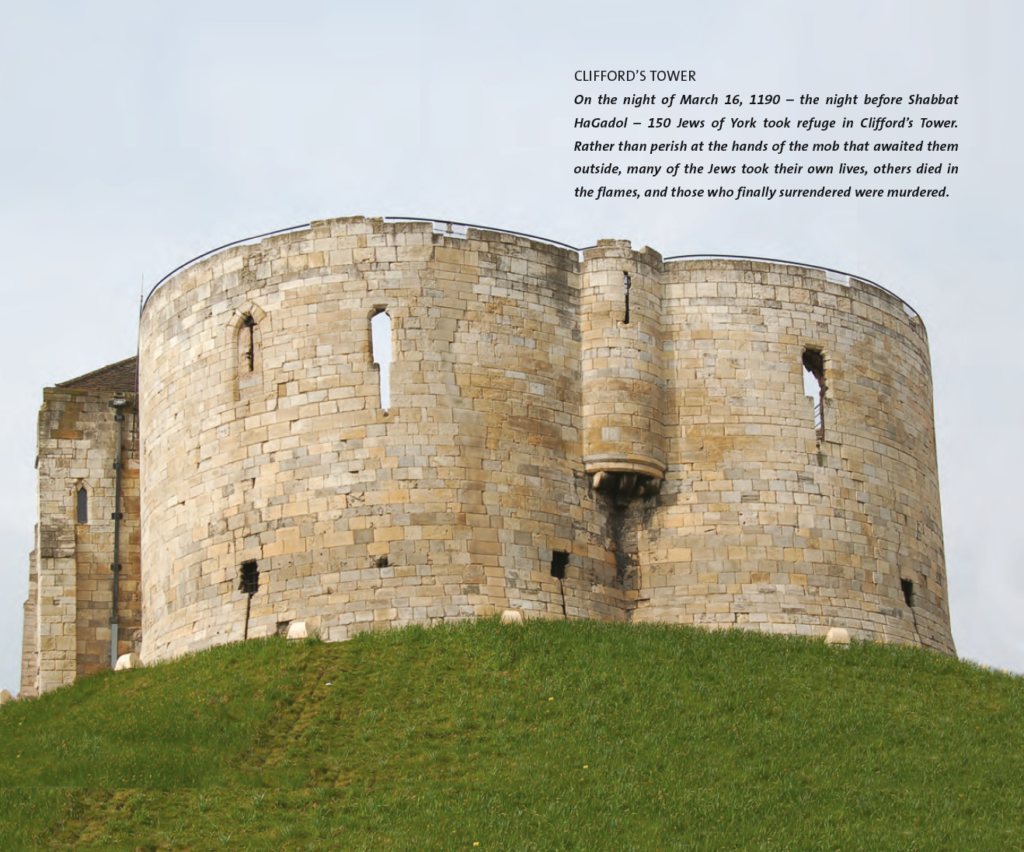
YORK 1190 The Massacre
During the 35 years of Henry II’s reign (1154-1189), Jews were encouraged by the king to settle in England’s towns. They enjoyed Royal protection but were legitimate and lucrative targets for Crown taxation. The Jews were in a precarious position, on the fringe of society and practitioners of the essential but unpopular trade of usury (money-lending). Their fragile existence was disturbed by the succession of Henry II by his son Richard and a surge in anti-Semitic feelings across the country.
The York Massacre was just one of a wave of anti-Jewish riots that began eight months earlier at the coronation banquet of King Richard I, when a group of Jews who arrived to pay their respects was forbidden entry. Two of York’s most prominent Jews, Jocenus and Benedict, did present themselves laden with gifts for the king. The bold statement was interpreted as an insult by the crowd at Westminster, who proceeded to riot and attack London’s Jews. Although Jocenus returned to York safely, Benedict died of his injuries at Northampton, after enduring forced baptism.
Despite being under the King’s protection, the Jews who had prospered for over a century as moneylenders became the target for attacks by local noblemen who were anxious to wipe out their large debts. Murderous attacks that began in London spread to other Jewish settlements throughout England.
Richard, who had initially humiliated the Jews at his coronation, was concerned that the attacks were a challenge to his own rule and had a number of the perpetrators executed while issuing orders to protect the Jews. In early 1190 the new king embarked on a crusade to the Holy Land while not taking measures to enforce his order.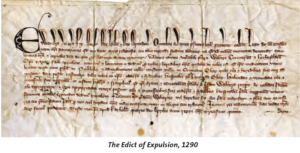
Six months after his death, a mob ransacked Benedict’s house in York, murdering his widow and children.
Fearing for his family’s safety, Jocenus sought protection in Clifford’s Tower – the royal castle. The rest of the city’s Jewish inhabitants followed and for several days the group remained safe inside the castle walls. As days passed, the castle became a place of captivity rather than a refuge.
But as there was no force defending the tower, and with the local knights and clergy leading the attack, the Jews realized their fate. Together with Jocenus, Rabbi Yomtob, a noted scholar who had come to York from Joigny in France, called upon the community to commit suicide rather than be murdered or baptized. Many followed their advice. The father of each family killed the women and children of his household. The Rabbi then took his own knife to those who remained before killing himself. Those who did not commit suicide were killed when the castle was set on fire. The massacre wiped out the city’s entire Jewish population, estimated at 150 men, women, and children.
The rioters next burned all the records of the Jews financial affairs, thereby absolving them of their debts which would have been payable to the King following the death of the Jews.
The King’s representatives held an inquest and fined the city, but none of the murderers were ever brought to trial, many of them later joining Richard on his crusade. Archaeological digs have revealed burnt remnants of the original structure beneath the tower – a chilling memorial to those who perished.
1290 Expulsion
In 1290, Edward I banished the Jews outright. The signatory date coincided with the Jewish date of Tisha b’Av. England became the first European country to expel Jews, and they remained banned for 366 years. It wasn’t until the 17th century that Jews were allowed back to Britain.
Robert E. Sutton is Editorial Director of AMIT Magazine