
By Helga Abraham
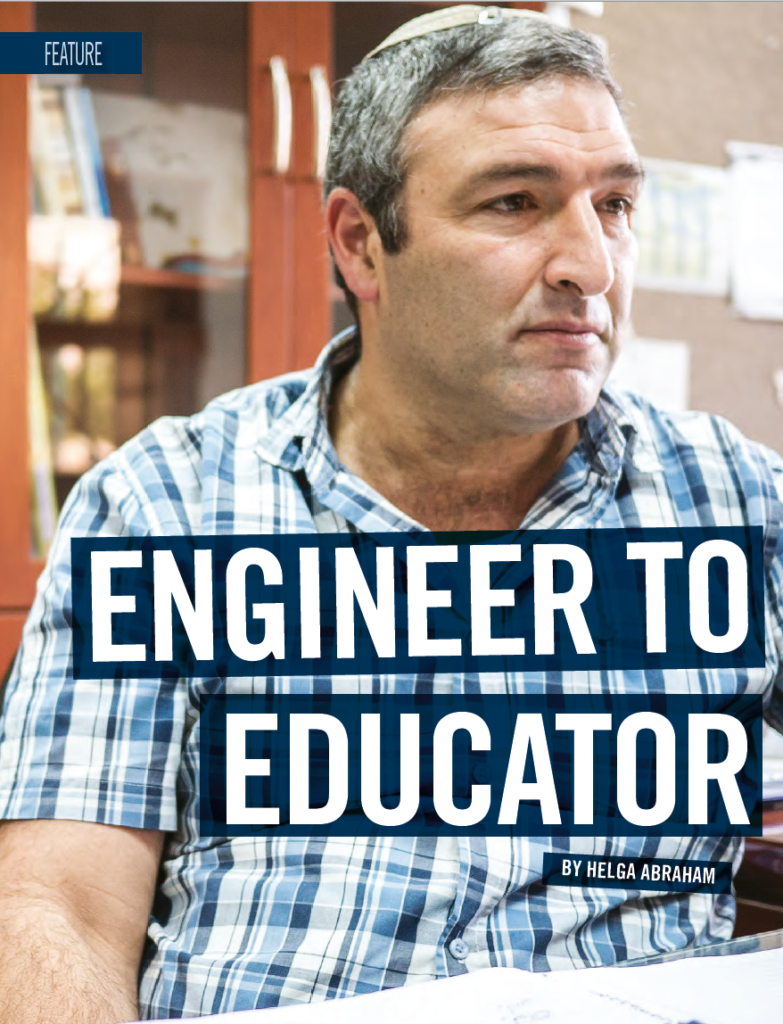
It is not every day that a high flyer from the world of start-ups and the armaments industry gives up everything to take over the helm of a small high school in a distant development town. But this is exactly what 46-year-old Guy Dekel did last year, when he resigned his position as team director at Israel’s prestigious Rafael Advanced Defense Systems in order to become the new principal of AMIT Karmiel, a co-ed high school of just 256 students. After having led the team that developed Israel’s first marine USVs (unmanned service vehicles), which are now patrolling the shores of the country from north to south, Dekel is busy dealing with class schedules, curricula, teachers and students—and, on the day I met him, ordering parquet flooring for a new hip-hop room he plans to create at the school.
The move, it turns out, was not quite as astonishing as it may appear. Dekel began his career in education, gaining a teaching certificate and B.Ed. while completing a seven-year hesder yeshiva program, which included army service in the parachute corps. He went on to gain an M.A. in math and computer studies, while working in various formal and informal positions. During this period he also served as director of the Tair Bet Midrash in Tel Aviv, which was founded in the wake of the assassination of Yitzhak Rabin in 1995. “The assassination revealed serious fractures in Israeli society,” recounts Dekel, “and our goal was to help bridge the gap between religious and secular, right and left. We conducted study days in schools and study evenings in cafés and cinemas, and we also operated a theater which is still active today.”
In 2000, Dekel entered the world of high tech, working in a number of start-ups before joining Rafael as a software engineer helping to develop top-security military systems. “The work was fascinating, challenging and important for Israel’s defense,” he says, “but at heart I remained an educator, and I even gave Torah classes and workshops to the staff at Rafael.”
 So when in 2004 Dekel received a call from Dr. Amnon Eldar, Director General of AMIT, informing him that the network was looking for a new principal at AMIT Karmiel, the call fell on receptive ears. “I was doing interesting and vital work at Rafael, but, at the same time, I felt that I was not fulfilling my social-educational aspirations. The time seemed ripe for me to make a move,” he recalls. After discussing the offer with his wife, Dekel took just one hour to respond to AMIT’s call. “I said, yes.” Following a series of interviews, Dekel was appointed to the post and had just two months to prepare for his new position, a new school year, and situations he had never dealt with before.
“The main challenge at AMIT Karmiel,” he says, “is that we have a wide variety of levels among the student population, and, because the school is small and cannot offer lots of streams, the staff is obliged to teach classes consisting both of excellent students and weak students. Many students here also come from a low socio-economic level, so, in addition to learning problems, we have to deal with all kinds of social and discipline issues.” Faced with this challenging situation, Dekel set himself one primary goal: “to give each student the attention he or she needs.”
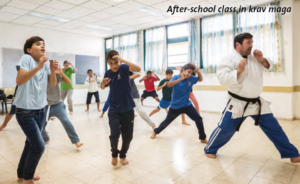
With this goal in mind, he immediately set about implementing a number of new initiatives, which included expanding the after-school extra-tuition program in math and English for weak students, and creating a new information technology track for students who are unable to receive full high school matriculation. “This track,” says Dekel “will ensure that, when these students leave school, they will have a level of technological knowledge that, with the addition of a few extra courses, will enable them to find work.” Twenty-five students, boys, and girls are already learning on this track. Dekel also introduced a long list of after-school enrichment classes at the affordable rate of NIS 60 ($15) per month. The students can choose between theatre, languages, applications, robotics, art, soccer, hip-hop, and krav maga––the “combat contact” defense system developed for the Israeli army.
In the future, Dekel wants to create learning environments that have little resemblance to the traditional classroom. An enthusiast of experiential learning, he is already building a “different learning space” in the school, which will include sofas, a kitchen, and a variety of tools aimed at encouraging students to take up crafts such as carpentry, cooking, and model-making, and he plans to build, adjacent to the school, a challenge park where students will be able to develop both physical and social skills such as teamwork and leadership abilities.
As I visited the school and spent time in Dekel’s office, it was immediately clear, from the flow of students eager to talk to him, that Dekel is a hands-on principal who enjoys personal contact with his students. “My door is always open to the students,” he says smiling. “They know they can come to me with their problems, and I will deal personally with the problem or I will refer them to the right address.” This open approach is based on a deep sense of trust and belief in the students. “I do not believe that there is such a thing as a bad student,” says Dekel. “If you give young people attention and respect, you will get good results.”
Tenth-grader Naama Dumen readily affirms this, “Guy is always ready to hear what we have to say. He carries a notebook with him and writes down everything. Before our annual trip, the girls told him that we didn’t want to sleep in tents, and he immediately organized a hostel for us to stay in. He even made sure we were given popsicles during the trip!” Her opinion was echoed by twelfth-grader Tsahala Ephraim, “Guy listens and then acts and, if he doesn’t act, he explains the reasons why.” The student group I spoke to expressed wholesale appreciation of their new principal, both on the personal and educational levels, “In his first year here,” says twelfth-grader Tarel Sulimani, “Guy reorganized the curriculum so that we could choose to study two tracks instead of just one. At the end of the year, before our computer exam, he came in to give us extra tutoring, and he drove all the way down to Eilat to visit us when we were on our school trip.”
I found similar enthusiasm for the school’s new principal among AMIT Karmiel’s teaching staff. Hebrew language teacher Shosh Arak, who has taught at the school since its inception in 1994 and was one of the first pioneers to settle in Karmiel, says that a new atmosphere reigns in the 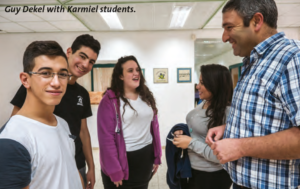 school since Dekel’s arrival. “The main difference is that we are working with a modest, kind man who is not afraid to admit that he does not know something and who is always prepared to learn,” said Arak. English teacher Michael Chernomorets says he would not have stayed on at the school had it not been for Dekel: “He is very supportive and open to new ideas,” says Chernomorets. “And he is dedicated to education and to the students,” interrupts English coordinator Osnat Dunem, adding that “Guy is not the type of principal who dictates to his staff. He gives every issue a lot of thought and does his best to help us.”
Special education teacher Osher Yitzhak, who has been with the school since its inception, neatly summed up the views of the staff and the students towards their new principal: “I have only one word to say about Guy—he is a mentsch!” <