
BY ROBERT E. SUTTON AND JEFF ZELMANSKI
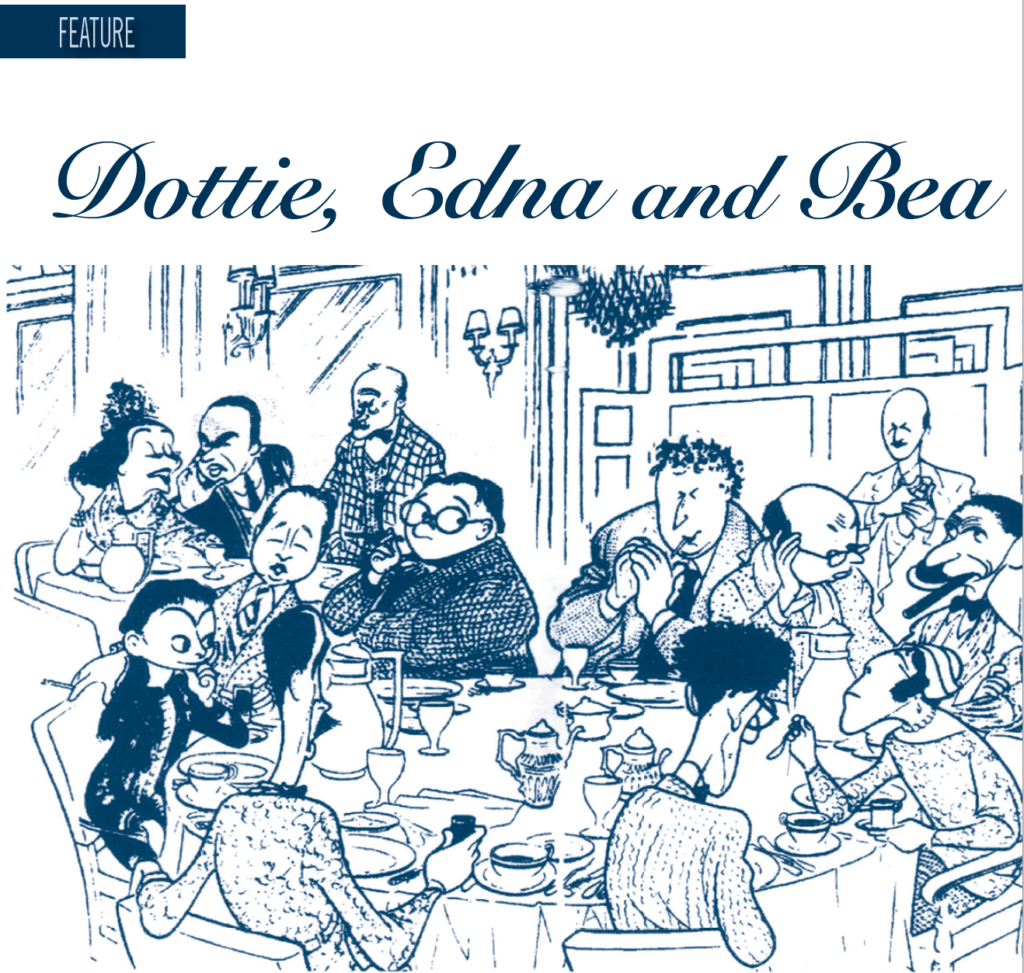
The famed and fabled Algonquin Round Table sparkled throughout the 1920s as the height of New York sophistication, a colorful cast of playwrights, authors, critics, and columnists. And in the mostly male company, that included the likes of Alexander Woollcott, Robert Sherwood, Robert Benchley, Heywood Broun, Harold Ross, George S. Kaufman, and Franklin Pierce Adams, three Jewish women sat as equals, matching wits and talent: Dorothy Parker, at the time a Vanity Fair staffer and freelance poet; Edna Ferber, novelist, and short fiction dynamo; and Beatrice Kaufman, editor, playwright, fiction writer, and wife of George S.
Truly reflecting the openness of the Roaring Twenties, these women blazed their own paths to prominence. They were followed in the press, were fearless in their stands, and were never afraid to voice their opinions on politics, art, and social change.
DOROTHY PARKER
Dorothy Parker was born Dorothy Rothschild on August 22, 1893, to a Jewish father, J. Henry Rothschild, and a Scottish mother, Eliza (Marston) Rothschild. She was an award-winning short story writer and poet whose books reached Number One on the best-seller lists and who, while in Hollywood, co-authored the original A Star Is Born.
 Her witticisms could bite, as when told of Fanny Brice’s nose operation: “She cut off her nose to spite her race.” Parker, who once identified herself as “…just a little Jewish girl trying to be cute,” was dragged into the Table’s insult wars when an anti-Semitic remark by Alexander Woollcott caused George S. Kaufman to rise in indignation, stating that he was going to leave “and I hope that Mrs. Parker will walk out with me – halfway.”
Parker spoke out for civil liberties and civil rights and helped to found the Anti-Nazi League in Hollywood in 1936, later serving as chairperson of the joint Anti-Fascist Rescue Committee. In her will, she bequeathed her entire estate to Dr. Martin Luther King, and in 1988, the NAACP designed and dedicated a memorial garden for Parker outside their Baltimore headquarters. A plaque reads, “Here lie the ashes of Dorothy Parker (1893–1967) humorist, writer, critic. Defender of human and civil rights. This memorial garden is dedicated to her noble spirit which celebrated the oneness of humankind and to the bonds of everlasting friendship between black and Jewish people.”
EDNA FERBER
Edna Ferber, as co-playwright with George S. Kaufman, wrote about the swanky and glamorous world of New York—the mannered upper class (Dinner at Eight), acting dynasties (Royal Family), and would-be starlets (Stage Door). But her greatest success came from her ambitious novels about the American experience (Giant, Showboat, Cimarron). Her novel So Big won the 1925 Pulitzer Prize, and The New York Times called her the greatest American woman novelist of her day.
Born in 1885 in Kalamazoo, Michigan, Ferber’s family moved to Ottumwa, Iowa, a town she later described as “unpaved, bigoted, anti-Semitic, and undernourished.” Her teen years were spent in Appleton, Wisconsin, a small town with a Jewish mayor and forty Jewish families, where she attended Sabbath-school classes and sang in the choir at Temple Emanu-El. In 1912, Ferber represented the George Matthew Adams Newspaper Syndicate at the Democratic and Republican conventions, eight years before women’s suffrage.
Ferber wrote of the Round Table crowd, “they were ruthless towards charlatans, towards the pompous, and the mentally and artistically dishonest. They had certain terrible integrity about their work and boundless ambition.” Ferber favored mannish suits, and upon entering the Algonquin one day, Noel Coward remarked, “Edna, you almost look like a man.” Ferber retorted, “So do you, Noel.” 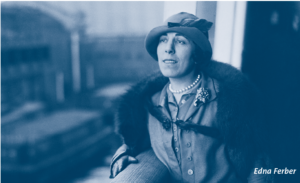
In 1939, with Europe lapsing into war, Ferber decided to publish her autobiography, A Peculiar Treasure. Early in the book, she declares, “I should like, in this book, to write about being a Jew. All my life I have been inordinately proud of being a Jew. I have felt that being a Jew was, in some ways at least, to be especially privileged.
Ferber skillfully used parts of her life story to call attention to the evil in Europe. She included in the book an excerpt from her 1917 novel Fanny Herself about attending Synagogue with her family on the Day of Atonement – then reminding those reading the book in 1939 that “it is Jewish synagogues exactly like this that have been burned, plundered, and completely destroyed by the hundreds in Germany and Austria.”
Ferber went on, “Just as we are slipping into the world mass, our identity to be forever lost, along comes a despot who singles us out as an object on which to vent his hate or to satisfy his own or his country’s psychological perversion…. any biologist or horticulturist will tell you that this is not the way to weaken or destroy a strain; that is the way to strengthen it.”
BEATRICE KAUFMAN
Beatrice Kaufman was much more than the wife of playwright George S. Kaufman. She was a press agent, a play reader, and a playwright, a book editor, a short story writer, a story editor for producer Samuel Goldwyn, and a fiction editor for Harpers’ Bazaar.
She was born Beatrice Bakrow to businessman Julius Bakrow and Sarah (Adler) Bakrow. According to her biographer Michael Galchinsky, “Although few direct references to her Jewishness found their way into her later editorial work and writings, her early life fits the description of upper-middle-class German Jews who thought of themselves as liberal, modern and forward-looking.”
Oscar Levant told the story of taking Beatrice to Carnegie Hall to hear Stokowski conduct Bach’s B Minor Mass: “We were late. ‘In heaven’s name, let’s hurry,’ said Beatrice, ‘or we’ll miss the intermission.’”
Beatrice was a general advisor on her husband’s works. Producer Max Gordon said, “[George] read everything to her, and talked to her. At Liveright and Boni Publishing, her eye for talent helped promote the careers of Clifford Odets, Ernest Hemingway, William Faulkner, Djuna Barnes, and William Saroyan. In 1942, she became an editor at PM newspaper, a left-leaning daily that published I.F.Stone’s series on European Jewish refugees attempting to run the British blockade to reach Palestine.
She was a lifelong Democrat, friends with Felix Frankfurter, and the author of a pair of speeches and articles for the new vice-president Harry Truman, whom she admired very much.”
When her husband was collaborating on a play with John P. Marquand at their country house, Beatrice discovered that Mrs. Marquand was telephoning Mrs. Charles Lindbergh, wife of the champion of the right-wing America First Committee, and asked her to stop. When Mrs. Marquand responded by asking Beatrice to invite the Colonel and Mrs. Lindbergh to enlighten her, Beatrice telephoned for a taxi and asked them to leave.
Dorothy Parker, Edna Ferber, and Bea Kaufman were in a world that was changing by the hour. They epitomized the strength, determination, intellect, and moral fiber of their gender and their generation. And, they never forgot where they came from.