

By Anat Rosenberg
When Kinneret Fensterheim reflects on her time at AMIT Renanim Science and Technology Jr. and Sr. High School, in Ra’anana, she feels fortunate that as a young religious woman she was given the opportunity to pursue high-level studies in computers and chemistry.
Years after completing high school, while working on research about young observant women and technology, she would discover that only about 10 percent of ulpanot (religious girls’ schools) in Israel offer computer studies to their students. She understood that this lack of access to computer studies creates a cycle that is difficult to break later on: Young women who aren’t exposed to computer studies early on are unlikely to pursue them as they age, which in turn prevents them from entering technology-related fields in the army, national service, and in the workforce.
“In retrospect, I can say that the fact that AMIT
Renanim, where I studied from 7th to 12th grade, allowed me to pursue two scientific tracks, especially computers, really opened many doors for me for the future,” said Fensterheim.
She debated between national service, which is often more encouraged among religious Zionist parents, and army service, and with the reassurance of her Renanim teacher decided to enlist. “My mechanechet [teacher] listened, tried to understand what I want, and supported my decision to choose army service,” she said.
After graduating, she spent a little more than a year at Midreshet Lindenbaum’s Hadas project, which encourages idealistic religious young women in Israel to enlist in the IDF by combining intensive Torah study with army service. Fensterheim, who already had a strong foundation in computers thanks to AMIT Renanim, went on to enlist in the elite Unit 8200 of the army’s Intelligence Corps, where she was in the minority as a young woman with a head covering.
“My service in 8200 ended up turning into 12 years in the army,” said Fensterheim. “I stayed on year after year, because it was extremely interesting and challenging. I became an officer and developed a great deal.”
During her service, she specialized in intelligence, technology, and cyber, and she also studied engineering at the same time. “My service was extremely intensive in terms of technology and cyber in the realm of security,” she said, adding that she finally decided to leave the army about a year and a half ago, after reaching the rank of major.
While she considered her next steps, Fensterheim was approached by Israel’s Cyber Education Center, an offshoot of the Rashi Foundation that promotes cyber and technology studies among disadvantaged populations in Israel. They asked her to research why so few young religious women are found in the world of technology. That research ultimately turned into the groundwork for Mamriot (Hebrew for “taking off” or “soaring”), an informal cyber-education program for girls from the religious Zionist sector, which she now heads.
“My research was fascinating, and it turned into a program that encourages young women, and particularly religious young women, to pursue computer and cyber studies, to convey to them that it is for them, and that it is possible for them to pursue these fields and perform significant service,” she said.
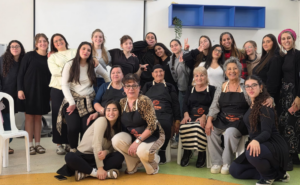
Run in cooperation with the National Cyber Directorate at the Prime Minister’s Office, Mamriot, which is now in its first year, is a three-year program running from 10th to 12th grades. It includes one-on-one study sessions with experienced staff, technological enrichment days, cyber conferences, and even summer camp for participants—all in an effort to prepare these young women to make a significant contribution to Israel and then to open doors for them in the future, much like Fensterheim’s technological studies at AMIT
Renanim did for her.
“What’s so nice about Mamriot is that beyond the extremely professional learning and training with a focus on significant service, there is also an environment that is very aware of the girls’ backgrounds, a feminine and religious one that empowers them, speaks their language, and is also technological,” said Fensterheim.
There are currently 30 young women enrolled in the program. In the first year, they learn high-level coding; in the second year, they specialize in cyber security and complete projects on the subject; and in the third year, they continue focusing on cyber security while preparing for significant national service.
“At first, they are really in shock from the difficulty of the program,” said Fensterheim, adding that participation in the program requires a great investment on the girls’ part. “Part of our work is to teach them to manage their time and their assignments, to invest in these challenges and search for solutions, not to despair when something doesn’t work the first time, and to ask for help when they need it. Those skills are a gift for life.”
Beyond serving as a launching pad to success for these young women, Fensterheim sees a higher mission in Mamriot. For her, having served at the forefront of Israel’s cyber-security defense system, she also sees the program as critical to Israel’s future.
“The State of Israel is saying, ‘We need cyber security and people who will take that on and defend the country,’” Fensterheim said. “One of the objectives of Mamriot is to explain to these girls, their families, and their communities the importance of technology for the State of Israel and to impress upon them that there is value in this pursuit.”
It is also to impress upon them that technology and Jewish family values are not mutually exclusive. As a married mother of four (her husband, Rabbi Gedalia, teaches at AMIT Ginsburg Bar Ilan), Fensterheim is a living, breathing example that young religious women in Israel can successfully balance family and work.
“That’s why we work so hard to introduce them to role models, to women who are religious and are mothers and are technological; we show them how to combine all of these things,” she said. “There is nothing in the halacha against studying technology, quite the opposite. It’s just about creating the right environment, and that’s part of the transformation that Mamriot is trying to bring about.”
She added that they are empowering the girls and presenting them with various options so that they will be able to choose the path that suits them from a place of strength. “They can choose to work full-time and bring home great salaries. They can choose to work part-time from home. They can choose to do significant things for the state.”
While the program has just gotten off the ground, Fensterheim said the hope is that it will expand from its two existing sites in Petach Tikva, where the girls come to learn, to four next year, and hopefully even more down the line.
“We aspire to bring this to as many girls in the country as possible,” she said. “We want to open this option to anyone whom G-d gave the tools and who is willing to invest. I always tell the girls, ‘G-d gave you brains and talent – now use them to do good in the world.’”