
BY MICHELE CHABIN
REHOVOT – On a good day it takes Yacov, Yitzhak, and Moshe Fatana an hour, on two buses, to travel from their home in Rishon Lezion to their school in Rehovot.
“On a not great day it can take an hour and 40 minutes,” Yacov, the oldest at 17, said with a wry smile.
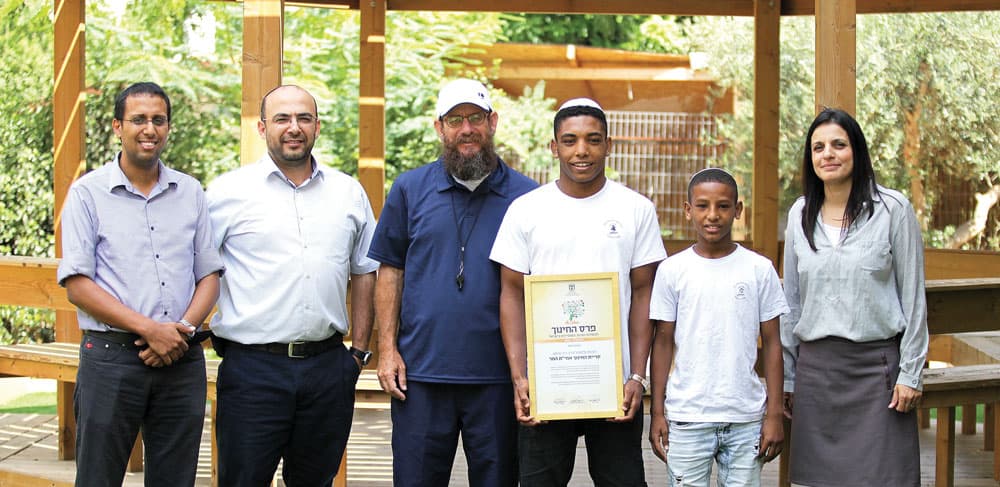
Although the Fatana brothers could attend a school closer to home, they’ve chosen to commute to the AMIT Hammer Junior and Senior High School for Boys because it offers them something no local religious boys’ school could offer: the opportunity to become world-class wrestlers.
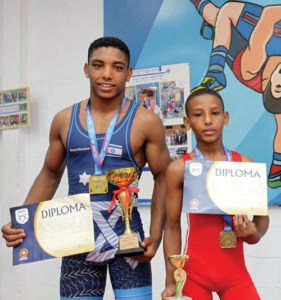
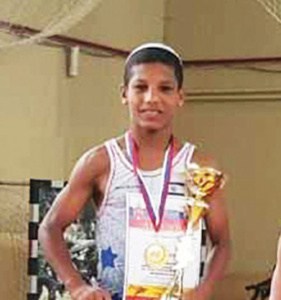
 Since enrolling in AMIT Hammer at the suggestion of their wrestling coach back in Rishon, all three boys have become Israel’s national wrestling champions in their respective weight categories.
Despite a punishing training schedule and frequent competitions both in Israel and abroad, they are excelling not only athletically but also academically and socially.
Rafi Maimon, the school’s principal, said its administrators and educators are doing everything they can to help the brothers realize their dreams.
“We see what they’re doing as a kind of shlichut, a mission, and we adapt to their schedules so their studies don’t suffer. Before every competition they receive support so they can just go out there and compete,” Maimon said.
Like many Israelis, the Fatana boys, who immigrated to Israel from Ethiopia in 2006, initially dreamed of becoming professional soccer players, not wrestlers. It took two years for Yacov’s elementary school sports teacher, Ariel Simkind, considered by many to be the top wrestling coach in Israel, to convince him to try the sport.
“My teacher started talking to me about wrestling when I was in 4th grade, but I resisted it,” Yacov acknowledged. “When I finally tried it in 6th grade I fell in love with it.”
When Yitzhak, now 14, and Moshe, now 13, saw how much Yacov enjoyed the intense workouts and wrestling competitions, they too decided to become wrestlers.
A mere five years later, the Fatana brothers dominate the Israeli youth wrestling scene.
Every day after school they head to the nearby Rehovot Wresting Club, where they train at least 15 hours a week. They rest for a short time and do their homework in a room the club has set aside for them next to the gym. Their training, which focuses on building up strength and attaining speed and flexibility, requires both natural ability and a tremendous amount of discipline.
The boys credit the administrators and teachers at AMIT Hammer for enabling them to pursue wrestling while continuing to study Torah and secular subjects, maintain good grades and a social life. “Were it not for the school we couldn’t be doing what we’re doing,” Yacov said.
In addition to providing the brothers with assignments to complete while they’re on the road, the school helps them catch up on anything they’ve missed thanks to their teachers and a tutor funded by the AMIT network’s “excellence” program, said Assaf Siri, the program coordinator.
Mira Peretz, an English teacher at the school, said she frequently speaks to the boys’ wrestling coach, to make sure they are given the time they need to study.
“Their teammates at the wrestling club help them do their homework,” Peretz noted.
 The school’s support doesn’t stop there.
Maimon recalled the time Yacov was competing in Holland – just a short while before the start of Passover.
“Yacov was worried about how he would find kosher for Passover food. Yehoshua Birman, our sports teacher and a Chabadnik, made a connection with the Chabad rabbi in Holland, who provided Yacov with kosher food and a seder.”
The principal said that when it was time to go up on stage to receive his medal, Yacov insisted on putting on his kippah, which he had removed for the wrestling match, and bringing an Israeli flag.
“He said, ‘I’m not just representing myself. I’m a Jew and I’m representing the State of Israel.’”
Maimon said the Fatanas’ commitment to living as observant Jews and their pride in being Israeli are the core values that AMIT Hammer tries so hard to instill in all its students. About 520 boys attend the middle school and high school, and 80 attend the school’s pre-IDF junior college program.
In April, AMIT Hammer received the Ministry of Education’s national award for academic excellence. Seven years ago, the school’s bagrut (matriculation) rate was just 45 percent. In 2016, that number was 94 percent.
Its students come from diverse backgrounds, at least 65 percent of them from homes facing socioeconomic hardships. To meet their needs the school creates individual learning plans for each student. More than 70 percent participate in therapies like art, music, gardening, and dog training.
Moshe, who recently completed his first year at AMIT Hammer, said he feels safe and cared for at the school. “There are really good teachers who always help me. I feel like everyone here is my family.” Yacov agreed.
“The level of education here is very good and I appreciate the private lessons, the tutoring. It’s as if the school exists to support us.”
Yitzhak, who won a bronze medal in the European championships in Hungary the day this reporter visited the school, said in a phone interview, “everyone feels accepted for who they are. You feel a personal connection between the staff and the students, so you feel comfortable asking for help when you need it.”
After learning about AMIT Hammer’s academic record and positive attitude toward star athletes, two boys, one a competitive swimmer, the other a competitive tennis player, decided to join the school come September.
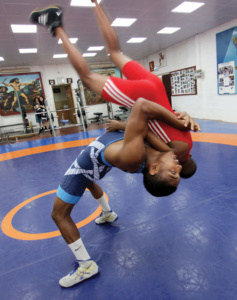
At the Rehovot Wrestling Club, located in a rundown building not far from the school, Yacov and Moshe worked out on the wall-to-wall mat that reached every corner of the gym: exercises to limber up, acrobatic somersaults, wrestling moves with life-sized wrestling dolls. And, finally, they flipped each other on to the mat.
Moshe, who hasn’t yet experienced his adolescent growth spurt, easily flipped Yacov, who seemed delighted by his younger brother’s prowess. Rising from the mat he put an arm around Moshe’s thin shoulders.
 The boys said their father is “very supportive” of their wrestling but that their mother “is a little less so, because she worries we could get hurt,” Moshe said at the end of the intense training session.
Asked whether they feel any jealousy when one brother succeeds more than another, Yacov replied, “success for one of us is a success for all of us.”
Simkind told Ynet News that the brothers are excellent athletes but also well-rounded, good people. “Today, thank G-d, they are learning well, they’re training well. They’re men.”
Watching the boys train, Birman praised their athleticism, but more so their character. “As much as they succeed as athletes, their real success is that they are remarkably humble,” Birman said.
As much as they love representing Israel at international tournaments, the brothers admitted that competing overseas as Israelis isn’t always pleasant.
“We encounter people, even judges, who are anti-Israel and act like we’re not as good as they are,” Yitzhak said. Yacov said a judge awarded him fewer points because he was competing for Israel. If anything, these experiences have spurred the Fatana brothers to train even harder.
Their dream? Speaking for himself and his brothers, Yacov said, “to win first place in the Olympics, to stand on the podium, put on my kippah and hear them play our national anthem, Hatikvah!”
Michele Chabin, an award-winning journalist based in Israel, is a frequent contributor to AMIT magazine.