
By Gloria Averbuch
Ever since God spoke his first words to Abraham—Lech Lecha (Go!)—leading to the patriarch’s journey to the Promised Land (Genesis 12:1), Israel has been a culture steeped in hiking. More than a mere walk, hiking is connected to Zionism and love of the Land. From school children to hobbyists, Israelis regularly traverse thousands of kilometers of mapped hiking trails.
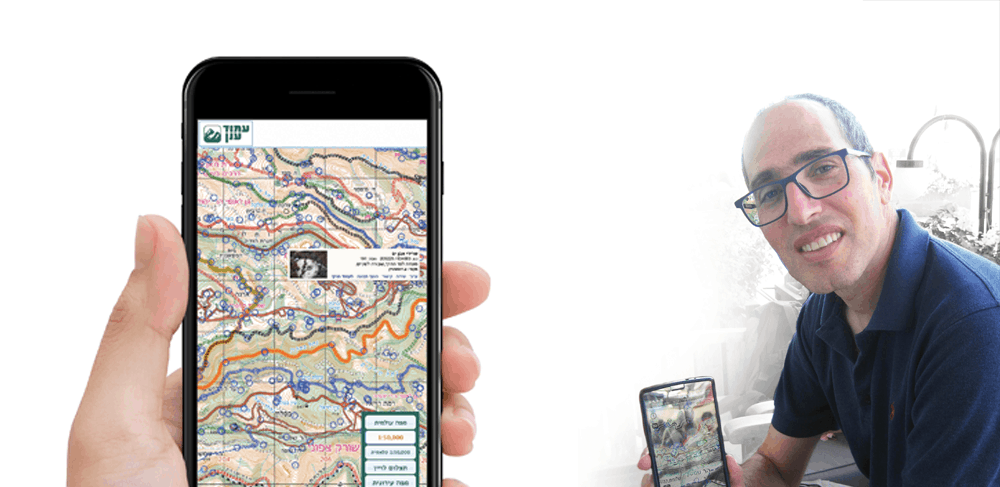
Now they have additional paths and a new way to explore them. That’s thanks to Yoav Rofe (Ro-feh), a 44-year-old entrepreneur and father of four from Tzur Hadassh and a graduate of AMIT Gush Dan. Rofe is the creator of the navigation software Amud Anan (https://amudanan.co.il/), an application (app) featuring a massive complex of maps, tips, and facts that advertises itself as being “for hikers, students, and lovers of the Land of Israel.”
The name Amud Anan, literally meaning “the pillar of clouds,” is a biblical reference to the divine cloud that guided the Israelites through the desert (the Book of Exodus 13:21). (In addition, Amud Anan, or Operation Pillar of Defense, was the name given by the IDF to the 2012 war in Gaza.)
Yoav Rofe was spurred to create his app through his own experience as a hiking enthusiast. “There weren’t any perfect maps,” he explained, “so originally, I used Soviet maps because you could find them online and they were free.” Of course, they were in Russian, which obviously wasn’t very convenient, so Rofe decided to make his own version of maps. He was instantly consumed by the task.
Amud Anan’s visual on a phone or other mobile device is striking. The three-dimensional maps pop off the screen with their series of red, blue, and yellow lines, dotted by large clusters of blue circles. Hovering on each blue circle reveals a tip or explanation on a given point on the maps. These helpful and insightful tips include photos, directions, landmarks, and a plethora of historical facts.
“It was a game-changer for hiking in Israel,” Rofe declared of Amud Anan, which he launched in 2004 in order, he said, “to connect people to the Land.” As of this writing, the app has more than 300,000 registered users and more than 50,000 tips designated by the blue circles.
“When I was young,” explained Rofe, “we went on different hikes. But the highlight for me was a two-day trip in Masada and Arad. I was 19, and the friend who took me on that hike taught me to love the desert.”
That friend and experienced hiker was Hagai Rosenbluh, still one of Rofe’s two best friends. The two met at AMIT Gush Dan where they were in the same class, a connection that proved life-changing for Rofe. “In fact,” he proclaimed, “without AMIT, there would be no Amud Anan.”
And that’s saying a lot, since the app is not only Rofe’s life work, but his full-time job. However, he acknowledges this work is more for love than money. The app is free of charge to users, and his income derives only from offline use of maps for those who want to go beyond an online view or who need use of a professional map. The charge to download those maps is $100 each.
The foundation of the skill set necessary to create Amud Anan was built and fostered in Yoav Rofe’s early education. He was born and raised in Ramat Ilan, the site of AMIT Gush Dan. “It was a very special high school,” said Rofe, noting that as a 10th grader at AMIT he began to study university-level math. In addition, “I had a good computer teacher,” he noted, crediting this course with the first and nearly only formal education that led directly to the work he does today.
There was an atmosphere of learning at AMIT Gush Dan he particularly appreciated. As he summed it up, “It wasn’t strict; there was a feeling of openness. The education worked. I learned the way things connect.”
In addition, he said, “The students there were really amazing. They liked learning.” Of his classmates’ creativity and personalities, he said, “They were shovavim (mischief-makers), but in a good way. They were mensches, and that, of course, is the most important thing in the world.”
Rofe further honed the skills that would lead to the development of Amud Anan in the Israeli Army through his duties in surveillance, analyzing photography via the use of maps.
In his first career, however, a more practical task overruled his passion. A graduate of Hebrew University in physics, he initially worked in engineering for a small start-up company that wanted to create a high-density DVD. But even the skills he utilized there, he said, helped build the thinking processes he would need to create his app.
What started out as a series of intricate maps has now expanded into a social network. This has happened as users began to share their experiences, including the tips for fellow hikers that populate the maps.
In this way, Amud Anan is unlike other navigation software, such as Google maps or Waze. “Those take you to a single point. I’m not interested in the destination; I’m interested in the journey,” said Rofe.
“I wanted to look at the terrain differently,” he added. “It really changed the way we hike because people began to notice what is around them. If you are connected by a type of social network, you really remember your experience. If the app makes you look at your experience differently, or more fully, it will also enhance your memories.”
Currently, Amud Anan gathers its information largely from users who input their data. This often comes from those more experienced, such as avid hikers. For example, one doctor and serious hiker warned fellow adventurers about the bushes on a particular route. His tip: “It’s hard to get to this point because you get scratched a lot.” Another hiker, a well-known botany professor who provides significant app input, detailed the Bedouins he encountered while hiking, as far away as Jordan.
In addition to hiking, there are other useful applications for the software. It is also widely used for bicycling and driving, and Rofe has consulted with a variety of businesses for their use of Amud Anan. It has guided a land survey, the placement of gas pipes and even a location to construct beehives.
“I want to focus on experiences. In hiking the country, or traveling the world, you can help others find experiences, or experience what they see differently,” said Rofe of moving forward.
Currently, usage of the app expands largely by word of mouth. To that end, what excites Rofe is its use in other communities. He has received positive feedback from the Arabs who use it, and while the app is currently only in Hebrew, he nonetheless once met Swiss tourists who employed Google translate to access the maps.
Ultimately, Rofe hopes that what began as a patriotic endeavor may eventually expand worldwide. This includes to places Israelis customarily travel such as India, Cyprus, and locations in Europe. “It will grow from the people,” he concluded.
Yoav Rofe is passionate about Amud Anan. This includes its roots in Jewish history. Referring to the origin story behind the app’s name, he has a tongue-in-cheek warning, which he delivered with a smile, “Amud Anan is the original navigation in the history of Judaism. But you should use it wisely, or otherwise you’ll end up in the desert for 40 years.”