

By Gloria Averbuch
Where hurdles to education once dominated, links of the chain that separated students from potential success have now been joined. And AMIT schools are leading the way. Based on research, innovation and a passion for education—these schools are meeting the academic and psychological needs of their students, families, and communities.
Below are two examples of AMIT schools that have instituted programs with levels of success that reflect the creativity and dedication of their leadership and staff.
AMIT Hammer: Part of Something Bigger
Examples of these innovative schools are AMIT Hammer Junior and Senior High School for Boys in Rehovot and AMIT Atidim Or Akiva. These schools represent an even wider effort of all AMIT schools, of which at least 70 percent serve low socioeconomic areas.
When he joined the staff in early 2019, AMIT Hammer school principal Ofer Eren realized there was a disconnect between the school and the students’ parents. “We weren’t speaking the same language,” he says metaphorically. Ethiopian Israelis represent 40 percent of the population of Rehovot, a town with the fourth largest population of Ethiopians in Israel. Many of these families struggle both economically and socially.
AMIT Hammer’s “Connection Center” was created in early 2019 to serve the community by engaging and assisting students’ parents through organized on-site counseling. It is well-documented that parents of low-income or minority children are less likely to be involved in their children’s education. Additionally, widely accepted research confirms the strong tie between school achievement and parental involvement. Clearly, the Center addresses a specific and vital need.
The Center exemplifies the overall philosophy that principal Eren continually stresses in combining three main areas of educational connection. He calls it the triangle: school, students, and parents. The goal is to meaningfully integrate all three of them.
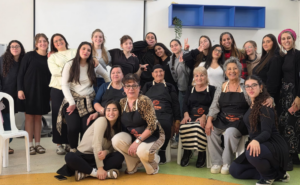
Bringing together the teachers, counselors (including a licensed family counselor), students, and parents creates the three sides of Eren’s triangle. A specific focus is counseling for the parents (Eren calls the Center the “school for parents”)—mostly in groups but also individually and done inside the school. Through these sessions, and their inclusion in the educational process, the staff and parents interact, with parents gaining a greater understanding and consequently learning how to support their children.
“In essence, ours is a change of educational
philosophy. Where we find this problem of parent involvement, we can manage it. We can help,” states Eren.
According to Eren, the results of the Center’s work are readily evident. “It is very interesting to see the change in the parents—their reaction, how they approach and relate to their children and better understand their children’s world.” In turn, Eren knows it undoubtedly affects how the students relate to their parents.
It’s not just what Eren and his staff see; the numbers speak to the concrete progress of his program. “We have about 90 percent of our students doing Bagrut and 100 percent going into the Army,” he says.
In addition, Eren explains that the counseling groups serve another important role. They bring together the Ethiopian population with other Israelis in the community—creating a bond, mutual respect, and understanding. “They learn from each other,” says Eren, and together “they can become “equals among equals.” We believe in the power of the group,” he concludes.
As he further explains, “The way we function overall, we are strengthening the bond between the school and the community. The school does not stand alone. We are part of something bigger.”
Currently, in a school of about 600 students, approximately 25 percent of families participate in this relatively new program, but Eren says that number is rapidly growing. “My hope for the future is that we can improve our numbers—including more students doing Bagrut.”
Parent apathy is a universal problem, believes Eren. “I think the worst thing that can happen is when any parent drives their child to school in the morning, closes the car door and believes in their heart, “That’s it; he’s not mine; take care of him.”
Ofer Eren’s abiding mission is to change that—”to make parents an integral part of the education process of their child.” So far, so good.
AMIT Atidim Or Akiva: Building a Garden
At the heart of Etti Laredo’s passion for education is the personal development of her students. “While school may be a place to teach, I see it as having a much bigger role—a place to empower and strengthen the child; to develop their motivation and help them believe in their ability.” She says that with this approach, in essence, every child can learn.
As the principal of AMIT Atidim Or Akiva for the past 12 years, Laredo is leading with this philosophy. With about 1,000 students who feed into the school from five elementary schools, providing such comprehensive nurturing is truly an achievement.
As an extension of her philosophy, and with the support of AMIT and the Ministry of Education, since 2019 the conditions for establishing her dream have ripened. Laredo started a special program after her team renovated and esthetically-designed a six-room therapy space and an additional large area for student group therapy and for mentoring teacher-therapists.
In this space, a pilot counseling program she calls “The Center of Emotional Education” includes teacher support, and when necessary, personal coaching and traditional psychological counseling, such as cognitive behavioral therapy (CBT). Counseling is conducted either in groups or one-on-one, according to the pupils’ needs.
Laredo’s team includes the oversight and mentorship of Dr. Einav Vered, a social worker specializing in attention deficit and hyperactivity disorders and learning disabilities and in communications and sociology, and founder and manager of the “Einav Center of Treatment of ADHD.” Vered is fully connected to Laredo’s approach. Similar to AMIT Hammer, the emphasis is on doing everything within the school. Bringing everything “in-house,” and including all teachers in therapy programs, says Laredo “strengthens the bonds.” The result is that the staff intimately knows the students, and what they need. As a result, teachers have a combined job description—both classroom teaching and partially providing therapy hours.
In order to succeed educationally, Laredo believes the students’ well-being must be cultivated and nurtured. She compares her mission to prepare students holistically to creating a garden. “You don’t grow a garden if you don’t prepare it first. You have to take care of the ground, cultivate it well, so it will easily absorb the water, which is the education we provide. As a result, teaching becomes the easy part of the process.” This approach also explains the high Bagrut results of the school’s students.
In preparing her “garden” for so many years, it has clearly bloomed. Laredo claims the difference is stark. “When I got to the school, the violence was terrible. It felt like we were at war. Now, we are one of the best schools.”
Facts back her up. AMIT Atidim is one of the crowning jewels of the AMIT system, designated an outstanding school in several areas by the Ministry of Education. Perhaps the greatest measure of its success, though, is the satisfaction the school staff receives from its efforts. In particular, Laredo praises her teachers, who provide extra time for the program voluntarily. Says Laredo with pride, “The teachers give with all their heart. They fight for every child as if they were their own child. In return, the students and parents give us back tons of love.”
In addition to the support of AMIT, she also attributes the school’s success to the cooperation of the municipality and the Ministry of Education. However, more than awards and academic achievements, Laredo ultimately defines success as the ability to reach one’s potential. “This means that the staff does their maximum and measured also by how much the students have progressed to their maximum capability,” she explains.
Based on her educational philosophy, Laredo has also created other innovative programs that engage students and further connect the school with the community, such as a volunteer program in which soldiers assist in the 10th and 11th grades.
Building on the success of the first year of the therapy program, Etti Laredo’s goal is to increase the budget in order to expand her Center, which she would like to see function “non-stop.” She explains, “I want it to be something that lives full-time in the school.”
Currently, participation in the pilot program is limited. Laredo explains her goal in the following way, “I want to make the program available not just for those in priority need, but for all the students, because everyone can benefit from it.” In addition, she hopes the program can grow to function proactively—“not just to solve problems, but to avoid them, to enhance our children’s resilience and self-efficacy,” she concludes.
AMIT Atidim is a shining example of the city of Or Akiva’s, AMIT’s and the State of Israel’s logo, which is inscribed with a Biblical verse from Job 8:7: “Your beginnings will be humble, so prosperous will your future be.”
Etti Laredo invites anyone interested in visiting her school program. Contact her at etti.laredo@gmail.com