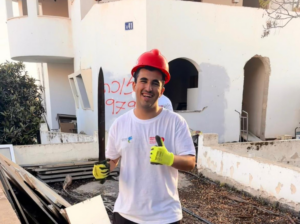


Ruf, 37, is commander of the Paratroopers Special Forces selection process and head of Paratrooper Warfare. He is also an officer in charge of giving eulogies at paratrooper funerals, something he’s had to do more than 20 times since the war began.
Ruf and his family are evacuees from Kibbutz Erez, near the border with Gaza. He is a new father; his third son was born just weeks after the war started on October 7.
“The hardest part [about the current situation] is the uncertainty,” he says. “I have no house and I don’t know what my future will hold. Sometimes I get calls at midnight and I must go explain to families how their loved ones died.”
For the first few months of the war, Ruf barely saw his newborn son, Nadav. But he says it’s hardest for his son Gilad, 3, who bursts into tears every time he sees his father in uniform, knowing it means Dad is leaving soon.
Ruf’s family was originally evacuated to a hotel in Mitzpe Ramon, but after Nadav was born, they rented an Airbnb in the town. Now the entire kibbutz has moved to a building in Kiryat Gat, although Ruf longs for the time he can return to his home.
“It’s especially difficult for the kids,” he says. “They loved the kibbutz.”
For six months, Ruf served more than full time in the army and couldn’t work for AMIT at all. Now he’s in and out of reserve duty, trying to catch up on his job at Eco 24/7, AMIT’s after-school program comprised of both formal and informal educational activities. Ruf says that AMIT has been incredibly supportive of his lengthy time in the army.
“The AMIT Network was always there for me and my family,” he says. “Amnon [Eldar] called me several times, and AMIT gave all kinds of special gifts to my family, like a voucher for a hotel, which we’ll use after the war ends. My boss always told me to do what I needed to do, and that really strengthened me. It’s been almost nine months of my not being able to do my job, but I do try to come for the important things.”
Living Our Jewish Values
Ofer Hahn, 42, is AMIT’s deputy director of innovation and a commander in the special forces Egoz Unit. Like more than 300,000 Israeli reservists, he was called up on October 7 and spent most of December and January fighting inside Gaza.
During that time, Hahn says that his wife, Liat, took care of their five children, ages 3 to 14.
“I think the challenge my wife had was even harder than the seven weeks I was in Gaza,” he says. “She was brave and the kids were too, but it was hard for them not to hear from Abba [Dad] for weeks, when every day you hear about people wounded or killed in Gaza.”
When he was released, Hahn says he may have broken the speed limit rushing to get his second grade daughter, Ahinoam, from school.
The night before he went into Gaza, a delegation of AMIT came on a solidarity mission to Israel and visited the area where he was stationed.
“I spoke to them about going into Gaza,” says Hahn. “It gave me a lot of power and strength. They came all the way from the U.S. to be here with us. It gave me a feeling that we really are one family, and it helped me deal with the challenges of fighting in Gaza.”
He describes his wife, Liat, a piano teacher and music therapist, as a hero, and says his children understood that he made a sacrifice to fight for Israel. But there are still negative effects from the ongoing war. Some of his children are suffering from anxiety, he says, and have had difficulty concentrating in school.
He notes that the AMIT Network has been very supportive.
“When I finished my reserve duty, they said, ‘We don’t want to see you back at work until you take a vacation with your wife and kids,’” he shares. “When I was in Gaza, I was very proud to tell people that I work for AMIT, and that they not only talk about values, but live their values.”
Recognizing the Power of
an AMIT Education
Amir Kalangel, director of Gogya and an intelligence officer in the Givati Brigade, agrees. After being drafted on October 7, he was on the outskirts of Gaza until the end of February. Since then, he has been on alert for a possible outbreak of war on the northern border. He is also the father of four children, ages 2 to 10.
“The most challenging part for me was that we had to cut off our regular life and give all our energy to defending the country,” he says. “Out of nowhere, the state said, ‘Now you are in miluim. There is no family, no children, no work, and no hobbies.’”
But being in kibbutzim like Beeri and Kfar Aza soon after October 7 sharpened Kalangel’s sense of what he was fighting for.
“After that, when we went into Gaza, it was challenging but very clear why we were there,” he says.
Now, he’s trying to balance both reserve duty and his job, spending one or two days a week in the army and the rest at AMIT. While it’s not easy to do both, he says, his time in Gaza helped him understand the importance of an AMIT education.
“In Gaza, we saw what education for evil can lead to,” he says, referring to Hamas, which inculcates hatred of Jews and Israel in the hearts and minds of young people.
Kalangel continued, “Coming back to Israel, I realize that education can save the world, and it is no less important than fighting.”