
By Helga Abraham
At the AMIT Orot Shaul Hesder Yeshiva in Ra’anana, Rav Yuval Cherlow is teaching the morning Torah class to first year students. As he rounds up his discussion of the prophet Amos, he raises questions related to ethics, Judaism and the modern era. “Is it possible to have a code of ethics for the Internet? How does Judaism deal with such issues? Can one draw up a code of ethics that balances Jewish halacha and the modern world of communications?” The questions are complex and do not always have an easy answer, but they reflect the ethos that is helping to make AMIT Orot Shaul an attractive place of learning for young boys who wish to pursue both in-depth Torah studies and make a contribution to Israeli society.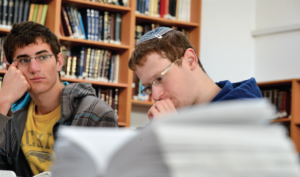
“We are offering as wide an approach as possible and bringing in new discourses,” says Rav Cherlow, the 57-Year old joint rosh yeshiva who, in another capacity, is also an active member of the Tzohar association of religious Zionist rabbis dedicated to shaping the Jewish identity of the state.
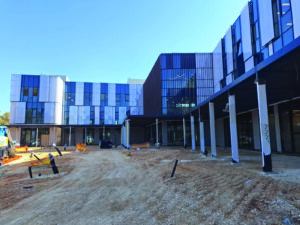
This innovative approach of Torah study and service to the state is the result of major changes instituted in 2013 when the yeshiva moved from Petach Tikva to its new premises on the Kfar Batya campus in Ra’anana. “In order to solve the problem of low registration, we started a revolution,” explains Rav Cherlow, “based on three pillars: a change in staff and therefore a change in the character of the yeshiva, a change of location, and a new curriculum.” As part of the first change, the yeshiva appointed 47-year old Rav Tamir Granot to serve as co-Rosh Yeshiva. “We called this a shidduch. While I am more rational and focused on ethics and Jewish identity, Rav Granot is interested in strengthening the student’s relationship with God,” says Rav Cherlow. Together with the two other pillars – the move to a bigger campus with improved facilities and a new curriculum offering senior students the option of majoring in three different tracks, Gemara, Jewish philosophy or Torah studies – the revolution proved an immediate success. “We have 45 first-year students and 40 post-army students, which is double what we expected,” says Rav Cherlow.
Rav Cherlow moved with his family from Efrat to Kfar Batya to oversee the revolution while the AMIT organization provided the necessary financial and organizational support. “I have nothing but admiration for AMIT, its transparency, professionalism and planning abilities,” says Rav Cherlow who proudly claims four generations of AMIT activism in his family. “My mother was active in AMIT all her life, I am involved, and my son-in-law works with AMIT and several grandchildren attend AMIT schools.”
For his part, Rav Granot travels five hours every day to and from his home in the Golan Heights to come and teach at the yeshiva. “AMIT Orot Shaul offered me the opportunity to develop a wider approach than the general rule in a yeshiva. Within my main goal of teaching Torah and helping students become better people, I have two additional aims: I want Torah study to be relevant to Israeli society and, secondly, I do not want to teach solely in an academic manner, I want to encourage a holistic approach that is in tune with each student’s individuality.”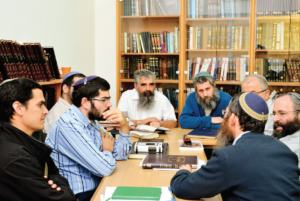
Hesder yeshivot offer young men the chance to acquire an in-depth grounding in Torah during their formative years while also serving in the IDF. For the first two years of the program, students study in a yeshiva, after which they serve a minimum of 16 months in the army (since the majority go on to become officers and commanders, their service often extends to two and a half years). They return to the yeshiva for another 18 months of Torah study. In 1991, the hesder yeshiva, as an institution, received the Israel Prize for the unique manner in which it combines the “book and the sword.” Recently criticism was voiced in the Knesset regarding the short length of service performed by hesder recruits in comparison to regular soldiers who serve 36 months, particularly in view of the time it takes – at least 10 months – to train combat soldiers. It’s a criticism which Rav Cherlow vehemently rejects. “On the contrary,” he says, “the army is very satisfied with hesder soldiers, 85% of whom serve in combat units, and their record both during military service and in the reserves is exemplary.”
First year students Matan Bloch and Yair Luria both chose to study in a hesder program because they wanted to pursue a high level of Torah study and “share in the burden” of defending the state. Matan, who studied at the AMIT Nachson Yeshiva High School in Mateh Yehuda, specifically chose AMIT Orot Shaul because of the variety of courses offered and its open approach. Second year student Itamar Naor came to AMIT Orot Shaul for the same reasons. “I found a high level of studies here, a very supportive staff and an open approach.” Naor, however, will not return to the yeshiva after his military service since he has been accepted into the IDF’s prestigious air force pilot’s course which demands an impressive twelve year commitment! “I will be 32 then and far too old,” he says laughing. His hevruta partner Tori London, from New Jersey, chose to study at AMIT Orot Shaul because he wanted to be “regular” Israeli. “I immediately felt integrated,” he says. “All the students took me in and treated me like a brother.”
While most hesder yeshivot concentrate on strict Gemara study, AMIT Orot Shaul offers a broader curriculum to its postarmy students. Rav Itamar Eldar, who also travels from the Golan Heights to teach at the yeshiva, explains, “The hiddush or innovation is that a senior student can become a talmid chacham not just in Gemara, but also in Jewish philosophy or Torah studies. We call these specialization tracks “sha’arim” (gates) because each student can choose the gate that suits him.”
Rav Haim Vidal, a new member of staff who teaches Jewish philosophy, is pleased that almost a third of the senior group chose the Jewish philosophy track.
This year the students are studying Jewish philosophy of the Middle Ages, covering the Kuzari by Rav Yehuda Halevi, the Rambam, the Ramban and more. “The level is very high,” says Rav Vidal, “half a day every day is devoted to this track with secondary classes in Gemara and Torah studies.” Ultimately, Rav Vidal hopes to introduce a weekly class in general philosophy beginning with Socrates to modern times.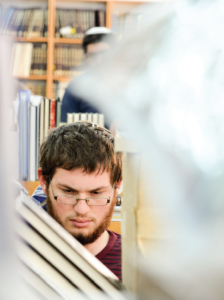
Rav Avi Blidstein, who teaches Gemara at the yeshiva, says that despite the difficulties posed by Gemara study, 50 per cent of the senior students still chose Gemara as their specialization track. “Gemara is like studying a legal text in Latin. It is not just in a different language, it has a different logic, but once you understand the abstract concepts behind the words, then it becomes relevant.”
Twenty-one-year-old Yitzhak Shizgal is a senior student who has returned to the yeshiva after completing his IDF military service serving on a Dvora class coastguard ship off the coast of Gaza. He opted for the Gemara track and says that Torah study is easier for him now. “During the first two years, before army service, you are building yourself. After the army, you approach things from a broader, more mature perspective and you have the feeling that you are helping to build society.”
For his part, Rav Granot is already envisioning new horizons for the yeshiva. “Since we are located close to Tel Aviv and Herzliya, my dream is to forge a meaningful dialogue with academic, artistic, and social institutions in these cities, creating joint programs that will benefit all of our young adults.”
Helga Abraham is a freelance journalist and translator based in Jerusalem. Before making Aliya to Israel, she worked as a radio producer for CBC in London and Toronto.