AMIT Mobilizes After October 7

All Israelis were affected by the events of October 7. But for the almost 2,000 high school students who studied in AMIT schools in the town of Sderot, located just over a mile from the Gaza border, it was catastrophic.

"We understood that getting these students into a framework was hatzalat nefashot, or saving lives.”

Dozens of Hamas terrorists rampaged through the streets of Sderot, killing at least 50 civilians and 20 police officers. Most of the students and their parents hid in their safe rooms for more than 24 hours until Israel regained control of the town of 36,000. Israel then ordered the evacuation of all civilians, and like the close to 200,000 Israelis living near the borders of conflict, the residents of Sderot were evacuated to hotels and guest houses around Israel.

Approximately 450 of them were evacuated to Eilat, where AMIT moved quickly to establish new structures of educational support.

“We worked much faster than the government did,” says Tzahalon Siri, who oversees the new AMIT framework in Eilat. “We understood that getting these students into a framework was hatzalat nefashot, or saving lives.”

Siri lives in northern Israel, but he willingly took the job, spending Sunday through Thursday in Eilat, and then driving six hours to his home on Moshav Hoshaya in the Galilee.

He says that within two weeks of October 7, they were able to start afternoon classes at two Eilat schools after the regular students had finished their studies. By the end of October, the students had school at least a few hours a day, from 2 to 6 p.m.

At first the parents were hesitant to send them, he says. Two weeks after the schools opened, there were several rocket alerts—not from Hamas in Gaza, but from pro-Iranian Houthi militants in Yemen. There were no casualties from the missile attacks, but they frightened many of the students and their parents.

“One of the attacks happened when the students were in school, and several of the girls even fainted,” says Siri.

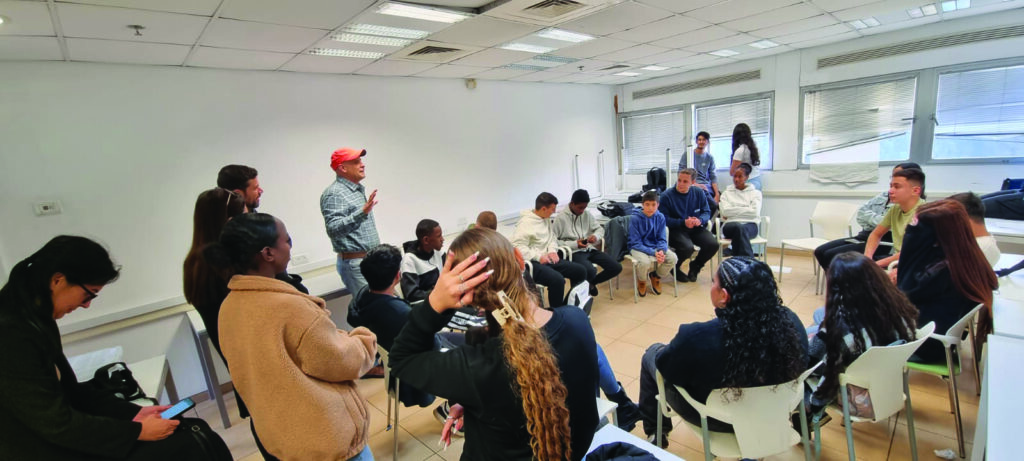
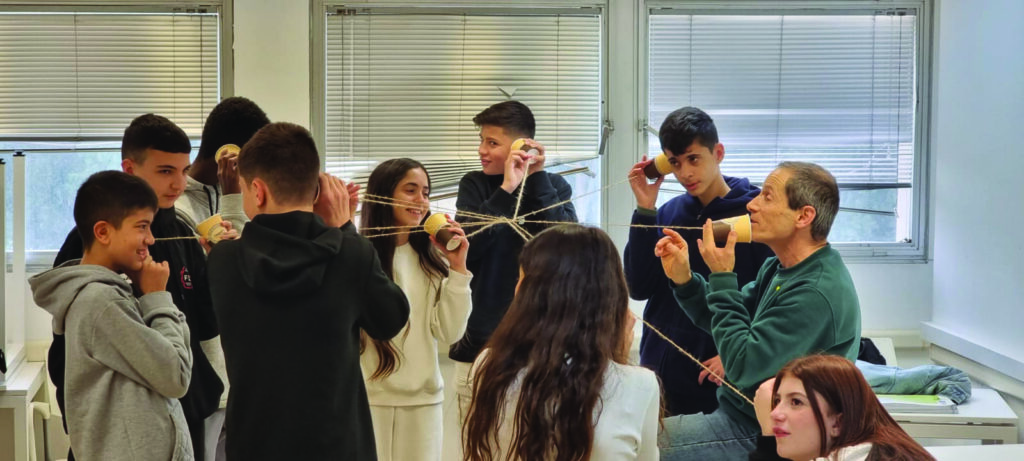
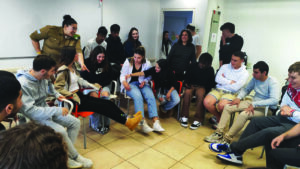
Siri says they also had the initial problem of finding enough teachers. Therefore, the school concentrated more on extracurricular activities like art, music and even dog-training. Alongside the teachers were soldiers from the educational branch of the army, post-high school students doing a year of volunteer work before the army, and retired teachers who volunteered to help out with the students.

We understood that getting these students into a framework was hatzalat nefashot, or saving lives.”

They started with 80 students and today have 300 students. He says AMIT gave him a “blank check” to hire anyone he needed in order to create an effective educational framework.

“The children were spread out among 30 hotels without books, without anything,” he says. “We were actually starting from minus, not even from zero.”

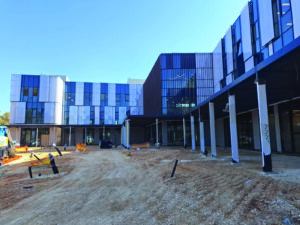
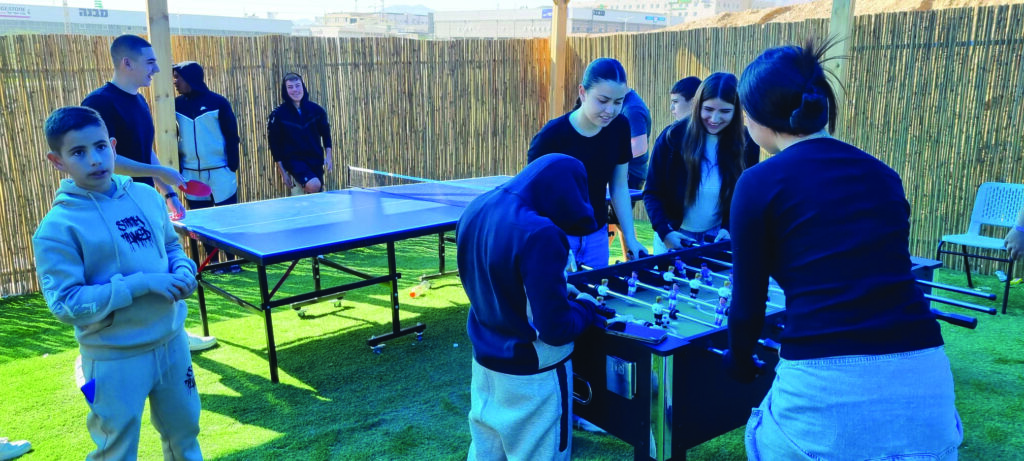
Just before Hanukkah, he says, AMIT opened its own campus called Eshkolot in Eilat with two schools—one religious and one secular. The campus has 15 classrooms, sports facilities and even a Ping-Pong table. He says they are focusing on the core subjects of English, Hebrew language and math, which the students need for their matriculation exams at the end of high school.

The students’ situation is still not back to normal, says Siri. Four months after the war started, they are still living in hotels, which makes it hard to study. They are not with the same students in classes or the same teachers. But, he says, AMIT has worked hard to make life as normal as possible given the difficult and surreal situation.

“Like all of Am Yisrael we woke up on Shabbat morning to sirens in Jerusalem, where we had celebrated Simchat Torah, and to reports of the horrible massacre,” Dr. Amnon Eldar told the Makor Rishon newspaper. “Already that Saturday night I held a meeting of our leadership. Our experience with Covid was very successful. We immediately shifted to emergency mode and we reestablished our war room headed by Yuval Elimelech. Our rule in AMIT is that the community has a superpower. So our schools function as a learning community.”

Dr. Eldar added that AMIT-USA immediately stepped in with major financial assistance that enabled them to function. Along with hiring teachers and staff, they were able to buy laptops for hundreds of students that enabled them to resume their studies.

More than 350,000 Israelis, including hundreds of AMIT teachers and other employees, were immediately drafted into reserve duty, and many of them are still serving four months later. They were mobilized by means of Order 8, an emergency mobilization order. Yuval Elimelech, deputy director of pedagogy at AMIT headquarters, said AMIT saw the need for an educational Order 8.

“Teachers who were themselves evacuated and at the same time worried about their students and schools that functioned even though their staff was in reserves, this is true educational heroism,” Elimelech told Makor Rishon.

The school in Eilat is just one example of how AMIT helped the students in Sderot, says Dani Rahat, deputy director of strategic affairs for AMIT. He was the principal of AMIT Sderot 20 years ago when the Qassam rocket attacks from Hamas began, and he knows the city well.

AMIT had three schools in Sderot: a secular school; a religious school; and an ulpana, a religious girls’ school with a total of 2,000 students. After the evacuation, they were spread around the country, with 450 in Eilat, 200 at the Dead Sea, 200 in Jerusalem, 200 in Tel Aviv, 100 in Netanya, plus an additional 850 scattered around the country.

It is especially important to get high school students back to school, as they have a series of matriculation exams called bagruyot in 11th and 12th grades. These exams are necessary for admission to universities. While it is possible to finish them after the army, most students want them taken care of before they begin their mandatory service of two years for women and almost three years for men.

Rahat says that his immediate issue was how to deal with the trauma the residents of Sderot all lived through.

“They spent more than 24 hours in their safe rooms hearing shooting in the streets,” Rahat says. “They were shocked, afraid and panicked. All of them—the students, the parents and the teachers—were in trauma.”

He adds that AMIT moved quickly to establish four educational systems in Eilat, the Dead Sea, Tel Aviv and Jerusalem and to find a solution for all the other students from Sderot who were scattered around the country. He hired someone from AMIT to be in charge of each city and, like Tzahalon Siri, some of them commuted from other areas of Israel. It was complicated by the fact that the teachers themselves had been evacuated and many of them were taking care of young children. In addition, AMIT asked the army for “soldier-teachers,” young women doing their compulsory army service who work as teachers in the army, and he was assigned 75 of them. Rahat put out a call for retired teachers or those on sabbatical and was able to cobble together an educational framework for each student.

In addition, he created mentoring groups in which every student had a personal mentor, whether it was a “soldier-teacher” or a retired teacher. In these small groups the students were able to discuss what happened and process their feelings.

“We feel a deep responsibility to our students,” says Rahat. “The situation is complicated, but we have a deep commitment to their learning and development.”