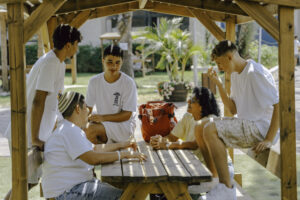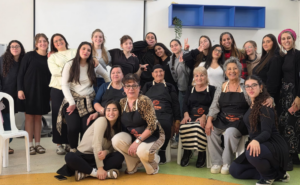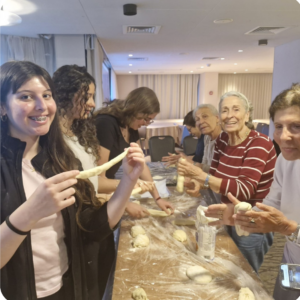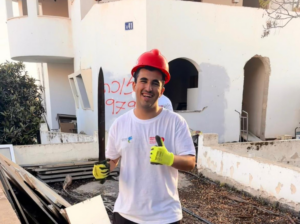

Between Israel’s eight-week summer vacation and the Yom Kippur through Simchat Torah break, students at the AMIT Hatzor Haglilit complex of schools, like other Israeli kids, didn’t see much of the inside of a classroom until the end of September.
But that didn’t stop the students or local residents of Hatzor Haglilit, a community of 9,000 people in the verdant Upper Galilee, from tapping into the school’s resources during the long holiday period.
Every day, many vacationing students and local residents prayed the morning, afternoon, and evening prayers at the campus’ beautiful synagogue. On Shabbatot the shul overflowed with worshippers, as it does throughout the year.
Even during vacations, the leafy campus’ large community garden was open to the public, and so was the adjoining petting zoo, which is home to a slew of rabbits, guinea pigs, ducks, geese, and roosters. AMIT’s sports field and court were also open, allowing kids and young adults to play soccer and basketball all summer long.
AMIT Hatzor Haglilit is such an integral part of this community “it’s sometimes hard to distinguish where one begins and the other ends,” said Liat Cohen, a member of the local community council and mother of three AMIT students who were visiting the campus to pick up her children.
Cohen said the AMIT Network, which maintains boys’ and girls’ elementary, junior and high schools on a single campus – a highly unusual arrangement in Israel that has helped foster a sense of community and continuity among the students – has also helped create “a new spirit” in the wider community.
“Our goal is to serve as a community school, in every sense of the word,” Avichai Golan, director of the AMIT Hatzor Haglilit campus, said in his office, whose door is always open to teachers and students.
First and foremost, Golan said, AMIT has worked hard to create a welcoming environment for the area’s students, many of whom come from financially distressed homes.
“Most schools close their doors at 3 or 4 p.m., but we offer help with homework, test prep, and several afterschool activities, including a Beit Midrash,” Golan said. The boys typically play soccer, learn carpentry, and enjoy guitar lessons, while the girls prefer art, drama, and dance classes.
Students’ families pay about $20 per year for the activities, thanks to a grant from the AMIT Network.
 This open-door approach is similarly reflected in the schools’ enrollment policies. Roughly 80 percent of the schools’ students and many of the faculty members live in Hatzor Haglilit, which means that students typically learn alongside friends and neighbors for a full 12 years.
The welcome extends to children with special needs, who can enroll in the schools’ special education classes or, if their abilities allow, integrate into regular classrooms.
The schools of AMIT Hatzor Haglilit also offer six separate classes for new immigrants from Ethiopia who have been in the country anywhere from a few days to three years. The students, who are being raised by their parents in an absorption center in Safed, a short commute by bus, learn Hebrew intensively and become fluent within a short time, Golan said. “Eventually they enter the regular classrooms.”
The new immigrant children receive extra help “because their parents don’t know Hebrew, they can’t help them with their schoolwork,” Golan explained. “They’re immersed in the absorption process.”
On his way with his classmates to a computer class after a class trip, 12-year old Amara Abveh, an Ethiopian student now studying in a regular class, said his parents and younger siblings rely heavily on him when he returns home from school every day.
“They ask me, ‘What is this?’ What is that?’” in the supermarket and at the doctor’s office. “They speak a little Hebrew, but not much,” Amara said before darting across the grass with his friends.
While the new immigrant families face unique problems, veteran families in Hatzor struggle as well, according to Avi Chapnick, principal of the girls’ elementary school and a longtime resident of Hatzor Haglilit.
“Most people have at least three or four children and limited resources,” Chapnick said of the town, which in the 1950s served as a transition camp for Jewish refugees from Arab countries. Their descendants still live here, as do about 1,000 Chassidim who run their own educational institutions.
“We’re raising our nine children in Hatzor because the people here are very warm, very likable good people,” Chapnick said. “My neighbor’s children learn on this campus, and so do my own children.”
AMIT’s close ties with the Hatzor community extend to mentoring the town’s once-floundering chapter of the Bnai Akiva youth group. A rite of passage for modern Orthodox Jewish youth throughout Israel, the Hatzor Haglilit branch of Bnai Akiva attracted only a few kids.
“The branch had no budget and no running water,” said Chapnick, who encouraged AMIT to take the chapter under its wing
“We asked the scout leaders, ‘What would you do if you had a budget? How would you publicize your activities? Tell us what you need in order to improve your level of professionalism?’
AMIT now provides guidance to the scout leaders and scholarships to children who otherwise could not participate in the youth movement’s activities such as overnight hikes during Pesach and Sukkot or in its summer camp.
“Three or four years ago, almost no one attended summer camp, but last Pesach, seventy kids went on the overnight hike,” Chapnick noted with pride.
Without AMIT in the town “the children would recognize less of their potential,” he believes. “The children meet their full potential and feel good about themselves. Ultimately, that contributes to the community. ”
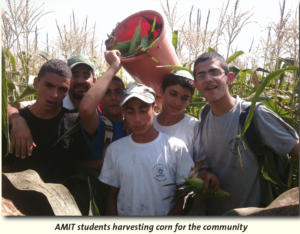
At AMIT Ha tzor Haglilit, giving to others is an integral part of school culture.
Outside Golan’s office in the administration building, boys from the high school load rice, sugar, cooking oil, and other staples donated by the schools’ students and staff into cardboard boxes, which they will later deliver to the poorest families in the town.
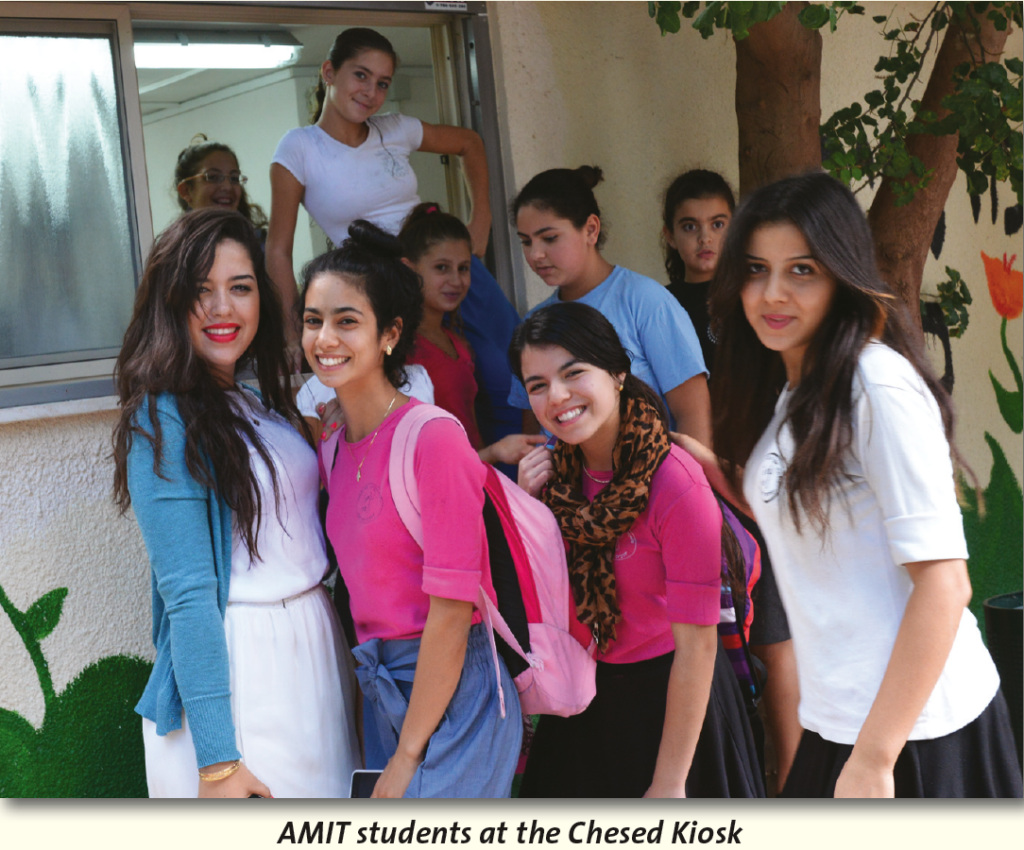
During recess, students line up at the Chesed Kiosk run by the high school girls. Thousands of shekels are raised every year through sales and are donated to dozens of local needy families.
“It’s keffi, – fun – to work in the kiosk,” said 17-year-old Netanella Yosef, as she stood behind the counter, taking orders from the kids lined up to buy a sandwich or a candy bar. “My classmates volunteer on a rotating basis. It feels good to give of ourselves.”
Mark Alush said he and his 12th-grade classmates had spent the morning volunteering at the Renanim special education school in Kiryat Shemona, 27 miles away, and located on the Lebanese border.
AMIT Hatzor Haglilit adopted the school more than a year ago, and before that, volunteered at another school for children with disabilities. Each of Renanim’s 17 classes hosts at least one AMIT student per class
Mark, 17, said he spent the three-hour visit getting acquainted with the children, who have moderate cognitive disabilities.
Mark admitted feeling “a little anxious” before meeting the Renanim students “because I didn’t know what to expect. They’re truly sweet kids and I feel a lot of satisfaction by working with them once a week.”
Orna Konkel, Renanim’s principal, said the volunteers “help us give our students individualized attention, according to their specific needs.” Her students “benefit greatly” from the mentoring, but the volunteers benefit as well, she emphasized.
“They become aware of another population they might not ordinarily interact with. They develop sensitivity and patience and experience unconditional love.”
That’s been the case for the younger students, who regularly visit with the elderly residents at the senior living center across the street from the school.
“Last year the elementary school kids volunteered,” said Liat Cohen, the city councilwoman. “My daughter ‘adopted’ a woman there and the bond they created was very, very strong, and is continuing.”
Shimon Suissa, head of the Hatzor Haglilit town council, said he “couldn’t begin to imagine” the town without the AMIT Network.
“The network and its staff promote good values, both educationally and morally.” He noted that more than seventy percent of AMIT’s high school students complete their college matriculation exams – something he called “a big achievement.”
Suissa called the AMIT campus a“Bayit Chinuch,” literally a “house of education.”
“It’s a house of warmth and caring, where our children learn about math but also about life.”
Tending to some of the vegetables she planted in the communal garden, Liron Ben-David, aged 9, said that she, her mother and older sister come to the garden “all the time.”
“We like to grow things and it’s nice to see other people from the neighborhood here, too. Especially the grandmothers,” Liron said.
Zahalon Siri, who is the AMIT Network mentor of AMIT Hatzor Haglilit, said that from first to twelfth grade, the Hatzor Haglilit campus reflects the Jewish and Zionist values AMIT strives to impart.
“Through the Beit Midrash, through volunteering, through inclusiveness, through the garden, the children here learn what’s important,” Siri said.
Michele Chabin began her career editing women’s magazines in New York. In 1987 she moved to Israel, and has been a reporter there ever since. An award-winning journalist, Michele frequently contributes to the New York Jewish Week, Religion News Service, USA Today, and many other publications.