
By Michele Chabin
ETTI LAREDO, THE PRINCIPAL OF AMIT ATIDIM JUNIOR and Senior High School in Or Akiva, was wearing a proud grin. In her office was Dana Maman, a student who only three years earlier rarely attended school. “I would sleep all day and I just didn’t care about school. When I did come, the kids would give me a standing ovation,” Dana said, biting her lip in embarrassment. Dana, now 18, is about to join the army. A film she co-produced with two other students while enrolled in the exceptional film studies program at AMIT Atidim, was chosen to compete in the International Film Festival in Hollywood.
While Dana Maman might have snoozed her way through another high school, the educators at Atidim – which AMIT took under its educational wing in September 2011 – had other plans. “The teachers didn’t give up on her,” said Etti Laredo, whose door is always open to students and faculty. “The teaching staff realizes that every kid needs to feel noticed.” That’s especially true in Or Akiva, Laredo said, where 40 percent of residents “are known to social services.” Nearly 70% of the AMIT Atidim students “come from difficult backgrounds,” noted Laredo.
Or Akiva is a working-class town 30 miles south of Haifa. It is part of the Haifa District of Israel, located just inland from the ancient port city of Caesarea and the Mediterranean Sea, and to the north of the city of Hadera.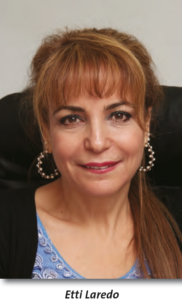
Dr. Amnon Eldar, director-general of the AMIT Network, said the Or Akiva municipality asked AMIT to take on the school, which was struggling financially.
“When we accept a secular school that asks to be part of our network we try to have not only a regular core curriculum but an emphasis on Jewish heritage. Because of Etti Laredo’s true commitment, we agreed to help them,” Eldar said.
The way AMIT imparts Jewish values is through study and by example. “We’re talking about a house of learning. That means a dialogue between students and teachers. That means a good atmosphere at school. That means respect for each other and giving equal opportunities to everybody.”
Laredo said her secular school’s transition into the AMIT Network has been seamless because “our philosophies match, we believe in Zionism and the importance of Jewish values.”
Jewish values.” Prior to Etti Laredo joining the school, nearly 170 students dropped out of school every year. Last year, the number was 30. Today, every AMIT Atidim student takes the Bagrut – matriculation exams – and 91% of AMIT Atidim students pass!
THE AMIT FILM TRACK
One of the turning points for Dana Maman, who said she is excited about going into the IDF, was enrolling in the school’s film track, whose project is a short feature film.
She is also thrilled about having her film – Secrets from the Past – shown at one of the world’s most prestigious film festivals. Last year, a film produced by a group of the school’s seniors won first prize at the festival. Other films produced at AMIT Atidim have won prizes at the Haifa Film Festival.
Roughly 450 of the school’s 10th, 11th, and 12th graders participate in the film track, which has grown in parallel with Israel’s thriving film industry.
Film track students said they’re inspired by these successes. From 2007 to 2012, four Israeli films competed for an Academy Award for Best Foreign Language Film.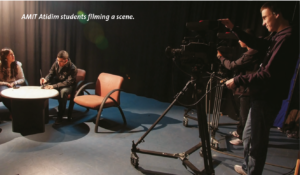
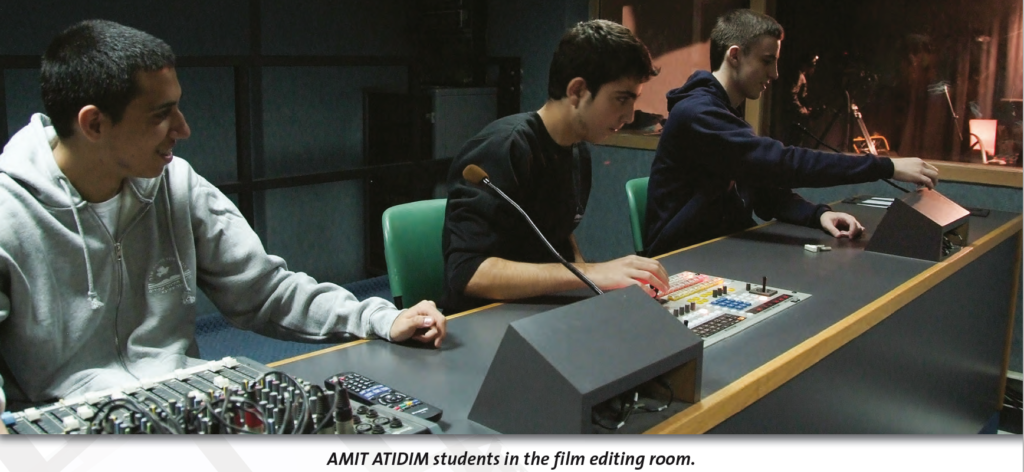
The film track which is now part of AMIT’s popular multi-school communications track takes place in a series of studios packed with state-of-the-art equipment. The hallways are lined with posters from popular Israeli films and on one special wall hangs the posters of films produced by students at AMIT Atidim.
Erez Maouda, the energetic filmmaker and teacher who co-runs the program, said students study various aspects of filmmaking three hours a week (seniors, six hours), and that doesn’t include the time they spend writing, filming, casting and editing.
“They learn how to write a story that incorporates action and how to bring out the drama; they learn how to craft characters and cast actors, about composition, lighting, and other technical aspects of production. They take the film, edit it and add music,” he said.
The actors include students from AMIT Atidim’s theater track as well as teachers, members of the students’ families, and people in the community.
community. The plots of most of the films focus on the lives of teenagers, family conflicts, and life in a place like Or Akiva, a nondescript town with a host of socio-economic problems. Two-thirds of the school’s students come from immigrant homes (the Caucasus, Russia, and Morocco), and their traditions are sometimes reflected in their filmmaking.
AMIT Atidim students Lev Segal and Amy Ifrach were sitting in the control room, busily working on a film about a gritty murder investigation. Working on the film “is giving me practical experience,” said Ifrach, who would like to join the IDF Communications Corps and eventually become a journalist. “You start with the script and then you find the right actors. You shoot the scenes and edit them. It’s a process.” The process, Ifrach said, isn’t easy, “but it’s taught me how to stare down challenges. I feel a lot more confident now.”
THE FILM THAT MADE A DIFFERENCE
Dana Maman’s film – Secrets from the Past – is a drama about a teenage boy named Tomi who searches for the truth about his brother’s death. During a chance meeting with a neighbor on the day of the funeral, Tomi learns that his brother might not have died in a car accident, as his parents had told him. Desperate to learn the truth, Tomi discovers that his brother died under very mysterious circumstances.
The experience of making the film was challenging, she said. “We had to learn how to work together and there were some arguments. We learned to be flexible with each other and the material. Every moment, we changed things around.” Her face lit up and she continued, “ I couldn’t believe that we had produced a film of such quality that it is being shown at the International Film Festival.”
Dana Maman readily admits that her transformation from loafer to motivated student didn’t come overnight. “It was a process. I came to school because I saw that my teachers, and not just the ones in the film track, really cared about me. If I didn’t come to school they wanted to know why. To this day we still keep in touch.”
Film Teacher Erez Maouda said his job is both “fun” and “fulfilling.”
“It’s fun to see them in the field, lighting their sets with flashlights or whatever they can jury-rig. They’re very creative.” Observing the kids as they work outside the classroom enables the teachers to see them in a different light, Maouda noted.
“We get to know them better. We get to learn about their families. By the end of the program, you see their sense of accomplishment.”
Once they graduate from AMIT Atidim, the students can study film for an additional year at colleges in Givatayim or Karmiel before being tapped for the Communications Corps of the IDF. Some are choosing film as a career path.
“We open a door to a new world but they bring themselves, their culture, and their experiences to the film. They develop maturity, responsibility, discipline, and a passion – just take a look at Dana,” Mouda said with pride.
Michele Chabin began her career editing women’s magazines in New York. In 1987 she moved to Israel and has been a reporter there ever since. An award-winning journalist, Michele frequently contributes to the New York Jewish Week, Religion News Service, USA Today, and many other publications.