
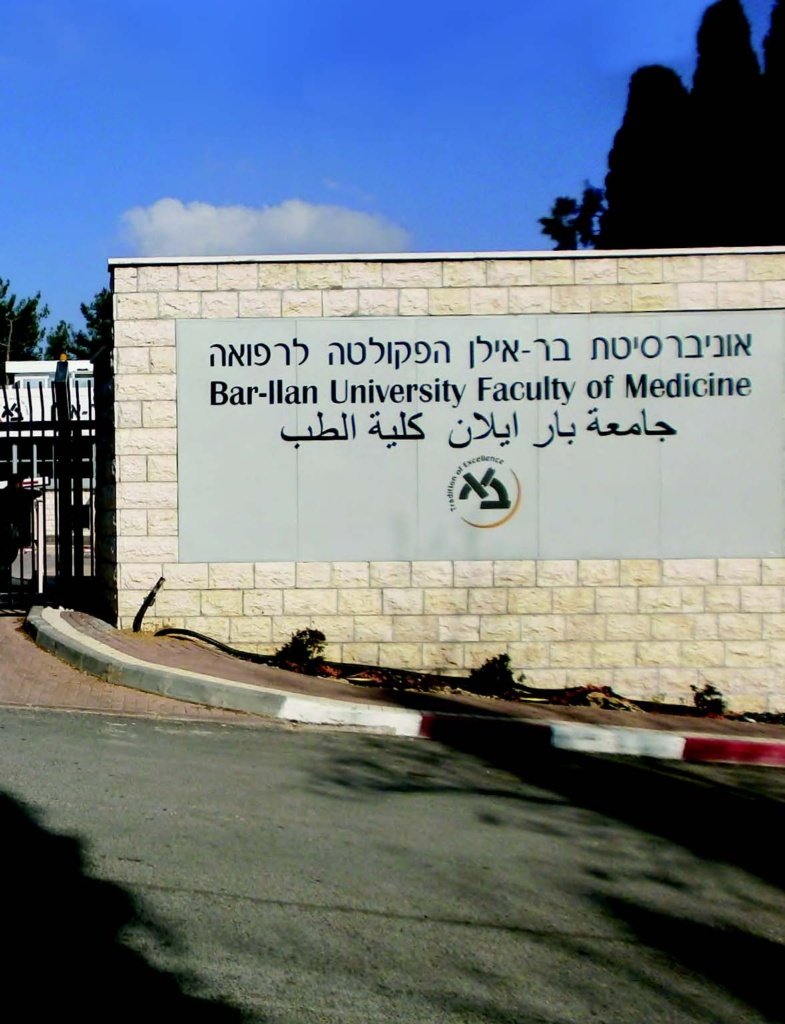
Every week 10th and 11th-grade students from AMIT’s two high schools in Tzfat make their way to the city’s new Bar-Ilan University Faculty of Medicine in the Galil. There they hear lectures on anatomy, cardiology, physiology and nutrition, learn modern techniques of examining the human body and even observe operations. They are part of an innovative three-year youth medical program entitled Pirhei Tzfat LeRefouah – literally “Tzfat Buds of Medicine.” The program was launched in 2011 in conjunction with the much-awaited opening of Israel’s newest medical school.
Currently based in temporary headquarters in the center of the city, and functioning on a relatively small scale, Tzfat’s new Faculty of Medicine, under the aegis of Bar-Ilan University, will eventually enjoy a sprawling permanent campus on the outskirts of the city, with a capacity for 1,000 medical students, state of the art laboratories, and student residences. But even before that, the faculty has already injected new life and a vibrant spirit into the city. “Now that we have a medical school, Tzfat no longer suffers from the stigma of being a peripheral city and we see many more young people around,” says Orel Doron, an 11th-grade AMIT student, who is participating in the youth medical program.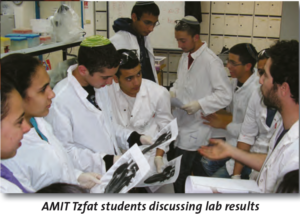
The program was the brainchild of Tzfat Mayor Ilan Shohat as part of his vision to promote education in the city and it fused perfectly with Bar-Ilan University’s own aspiration to integrate its new medical students into the city’s urban life through collaborative projects with schools, hospitals and community centers. The teachers in the youth medical program are all medical students while the “young medical students” come from AMIT Florin Taman Junior and Senior High School for Boys and Girls. In addition to taking courses at the medical school, the AMIT students visit hospitals and clinics around the country, take part in summer workshops and devote extra hours at school to science, mathematics and English – studying nine hours more a week than their fellow students. AMIT selects the most eligible students for the program but, as at all universities, the students have to meet the requirements set by the Medical School in order to be accepted.
“The faculty sets high standards and not all students who want to take part in the program are accepted,” explains Meir Yoshai, principal of AMIT High School for Boys. He cites the case of one AMIT student, Neria Zelinger. Neria was initially rejected by the medical school because of his low mathematics grade. “Neria, however, was very determined, and in the end, as a result of his persistence and dedicated volunteer work with Magen David Adom, was accepted and proved his worth,” recounts Yoshai. At the end of the first year, Neria was selected as one of the four outstanding students in the program who met with Prime Minister Binyamin Netanyahu and Prof. Moshe Kaveh, President of Bar Ilan University. Although a serious medical program in every aspect, the aim, says Yoshai, is not to train future doctors. “We know that few of our students will go on to become doctors,” he says. “But this is unimportant. The aim of the program is to expose the students to academia, give them an opportunity to discover the medical world and develop their abilities, both personally and academically.” Few of the students in the program, in fact, aspire to be doctors, but all find the program stimulating and worth the extra hours involved.
AMIT students, Michael Dadush and Tahel Azrad, were not interested in joining the program at all. In Michael’s case, his parents pressured him and he now agrees that they were right. “I don’t want to be a doctor, I want to be a farmer like my father,” he says, “but I am enjoying learning about the human body.” In Tahel’s case, her teachers persuaded her to join and she has no regrets. “I am really happy to be in the program,” she says. “Even though I don’t want to be a doctor, it’s a privilege to enter the medical world and broaden my knowledge.”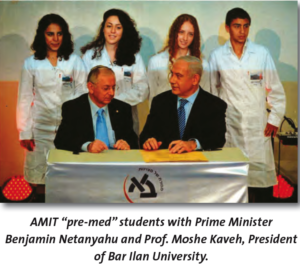
Like Neria Zelinger, several students at AMIT Tzfat for girls were also initially rejected from the program but succeeded in entering in the second year, through sheer perseverance. “I kept pressuring my teachers,” says 11th grader Shira Levy, who aspires to be a psychologist, “and I was thrilled when, finally, I was able to get into the program. I find all the subjects very interesting and mind-broadening.”
Oddly enough, there are many more girls in the program than boys. “Girls think about the future while boys live for the present,” stated Eden Nahari, who says she wants to be a doctor. Rav Yehuda Peles, head of the program at the AMIT Florin Taman Junior and Senior High School for Girls, concurs. “The girls are very ambitious and motivated,” he says. “They are not all Einstein’s, but they are very determined in their studies.” No AMIT student has left the program despite its stringent demands.
Eleventh grader Yaakov, who also wants to be a doctor, recounts excitedly how he carried out a virtual heart catheterization. In the course of the program the students also learn how to perform an EKG, operate ultra-sound devices, take a pulse, and learn about social work.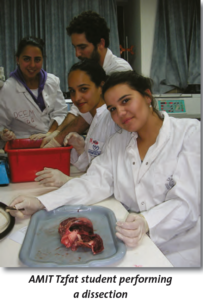
At the lecture on sports medicine which I attended with the AMIT students, Shani Kochavi, a medical student at Bar-Ilan, was explaining to the group the role of each of our muscles: biceps, triceps, quadriceps, pectorals major and minor, trapezium, etc. It all sounded very complicated and I wondered whether the heavy Latin terms did not intimidate the young students. “No,” she answered. “They are not scared of such terms. In fact, I have found that professional language actually motivates them.” Kochavi went on to lecture on the role of sports medicine and the proper way of training and avoiding injury. The class ended with a discussion on the controversial use of drugs in sports. Making the subject relevant to the students by comparing the use of drugs to cheating in examinations, Kochavi explained the particular health dangers of drug use and its domino effect in encouraging peers to do the same. While the program is not formally credited toward a high school certificate, it has raised the overall standard achieved by the students. “Since the conditions of acceptance are high,” explains Yaffa Farjun, principal of the girls’ school, “this stimulates the girls to work much harder and achieve higher grades in math, English and the sciences.” At the end of the first year of the program, AMIT witnessed a dramatic rise in class grades and standardized testing. The program is also impacting on the general atmosphere in the school. “The fact that we have such a prestigious program has had a ripple effect,” says Farjun. “It makes all the other students aspire to excellence.”