

By Amnon Eldar, Director General of AMIT
 Assaf Rappaport, head of research and development at Microsoft Israel, recently said that the greatest missed opportunity in Israeli high-tech is the lack of women—they account for less than 20% of the high-tech workforce.
The number of women pursuing higher education and careers outside of the home has increased due to both the women’s rights movement as well as the higher cost of living—but women still have to contend with great disparity when it comes to opportunity: wage gaps, sexism in employment and hiring practices, differences in titles between men and women in managerial positions or professions that are perceived as male-oriented.
The AMIT network, in collaboration with parents, teachers, students, and other members of the educational community in Israel, long ago adopted three central values for itself, one of which is realizing our students’ fullest potential. I believe this is AMIT’s answer to the questions and discontent about gender equality in the workplace, especially in the sciences.
Our network strives to improve the achievements of each and every student, regardless of gender, and motivates them to attain excellence by identifying their unique abilities and skills and pushing them toward self-fulfillment and personal development through a process of dialogue and developing self-esteem.
That is why AMIT offers varied programs for our students and invests great resources in trying to increase the number of students who pursue math, English, science, and technology subjects at the highest bagrut level (5). Over the years, we have seen a demonstrable increase in these numbers. At the same time, we also believe that students should pursue what interests them, what they are passionate about, and that is why we cultivate our teachers to become mentors who accompany students throughout their process of personal growth. They help our students identify what motivates them deep down and help them to grow and excel in whatever field they choose.
With that said, we are all too aware of the phenomenon mentioned by Microsoft’s Rappaport, and to the chauvinism inherent in Israeli culture, which often pushes girls to pursue humanities instead of the sciences. That is why we at AMIT not only emphasize that girls are just as capable and just as excited about science and technology as boys are—we allot resources to boosting girls’ self-esteem when it comes to pursuing these subjects.
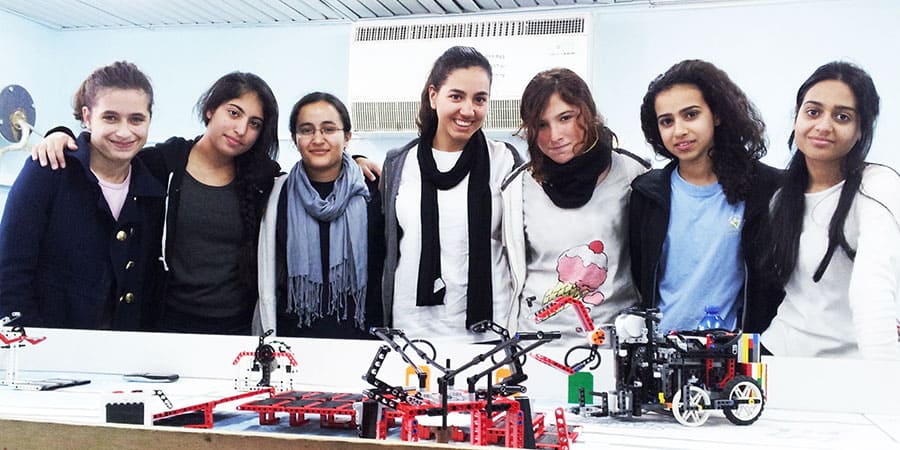
Just recently, Yedioth Ahronoth ran an article about how AMIT has succeeded in significantly increasing the number of girls who study physics at the highest level. Between 2016 and 2018, there was a 53% increase in the number of girls studying physics at a five-credit bagrut level. In 2016, 76 girls took a physics bagrut exam, while this year, 198 girls will take the test. Some of these girls even went to Geneva this month to visit the CERN particle accelerator. This is just one example of the encouragement and support that our schools and teachers receive and that they pass on to their students, who will ultimately have the power to remedy the situation that Rappaport lamented.