
By Michele Chabin
Petach Tikva, Israel – By the end of the school year, not many high school students have the desire to sit and study in a classroom while the sun is shining outside, but the six young men learning about the Israeli economy in a bright classroom at Yeshivat AMIT Kfar Ganim in Petach Tikva were fully focused on their teacher just three weeks before the start of summer vacation.
The 17-and 18-year-olds, who were discussing why immigrants move to Israel and the contributions they make to the economy, looked like any other AMIT Kfar Ganim students studying for a Bagrut (matriculation exam).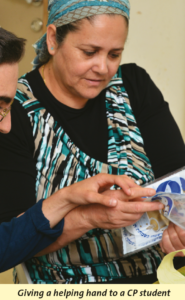
It was only later, while talking with the students during a break, that some seemed just a bit socially awkward, perhaps due to their being on the autism spectrum.
Watching his classmates play ping-pong, Moriel Ever, 18, said he began to study at a regular class at AMIT Kfar Ganim in the ninth grade, but transferred to one of the school’s special classes for high-functioning students with autism “because my behavior was extremely problematic.”
Despite those adjustment problems “at first I didn’t want to go to this class,” Ever said. “But now that I look back, I know it was the best choice for me.”
“I feel that I absorb more here than in a regular class,” added Naftali Elkins, 18, one of Ever’s classmates. “The materials are geared toward us and I’ve made friends. We’re like brothers.”
AMIT Kfar Ganim’s program for students on the autism spectrum began modestly seven years ago, at the initiative of Rabbi Shai Piron, the school’s former principal who left his position this year to become the country’s Minister of Education.
The rabbi’s goal “wasn’t to help only the disabled students. It was so the normative students could learn tolerance and respect,” explained Rachel Tzedakah, director of the school’s ASD (autism spectrum disorder) program, during a tour of the school’s building for kids with special needs.
Tolerance and respect are the guiding principles behind the AMIT Network’s special education classes. More than 350 middle school students and nearly 600 high school students with learning disabilities attend classes specially tailored to their needs. Additionally, five students with cerebral palsy study in a special class at the AMIT Atidim Junior and Senior High School in Or Akiva. – “Junior and Senior High School in Or Akiva.
“We believe that every child deserves a good, quality education in our schools,” said Dr. Amnon Eldar, AMIT’s director-general. “Some have bigger challenges and need special tools, and that’s what we’re trying to give them. The goals are the same, but the way to achieve them depends on the child.”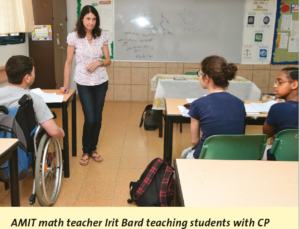
Every child in AMIT’s special ed framework is thoroughly assessed and subsequently provided with an individualized program that combines secular and religious studies with a wide range of therapies: music, art, occupational, psychological, gardening.
At AMIT Kfar Ganim the high functioning ASD students prepare not only for university studies but also for the IDF – where some volunteer – or National Service.
The teachers and teachers’ aides spend a great deal of time on life-skill training “because knowing how to pass a Bagrut doesn’t mean the students know how to make a sandwich,” Tzedakah noted.
That skill is taught – both to high- and low-functioning students – in the special education building’s training kitchen. The building, part of which resembles a small home, features classrooms, a virtual-reality room with a video game console, a lounge and specially-built Snoezelen – a controlled multisensory environment (MSE) that has proven therapeutic for people with autism and other disorders.
During the June visit, teachers and aides taught several older boys how to affix labels on plastic “goody” bags that, they knew, would later be filled with treats and distributed to needy children.
Taking a break from applying stickers, Ori Engleman, 17, proudly recounted how he recently paid 12 shekels for cheese at his local grocery store, “and I received 8 shekels change.” He said his teachers had taught him how to make purchases and calculate the change.
Every week, the high functioning boys volunteer at the Beit Noam Center for severely physically disabled adults, an activity that boosts the student’s self-esteem, social skills and understanding of others while performing volunteer work – something required of Kfar Ganim students.
The fact that the kids with autism study on a mainstream campus afford them a degree of integration many disabled children never enjoy, according to Rabbi Chagai Gross, the school’s principal.
“It depends on the level of the student. The higher-functioning boys are often mainstreamed in specific subjects and are 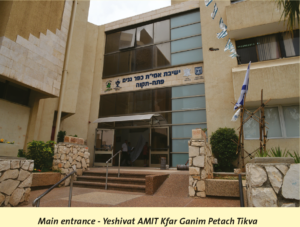 involved in the life of the school whenever possible.”
The school maximizes the interaction between the students in special ed by mainstreaming, when that is an option, and by requiring the “regular” kids – as they’re referred to in Hebrew – to spend 60 hours per year volunteering their time to the students with autism.
“I help them with their homework and work with them in class,” said Shlomo Ellinger, an 18-year-old senior who has also accompanied the special ed students on outings. “It was rewarding to see them make progress, and I think it made me more mature.”
Tzedakah said Kfar Ganim goes to great lengths to ensure that the boys in special ed participate in the same school activities as their non-disabled peers.
Orna Raphaeli, director of the school’s five special education programs (four are for the learning disabled), said the school maps out school trips that, when not fully accessible, include multiple meeting points where the students with disabilities can join up with their able-bodied peers.
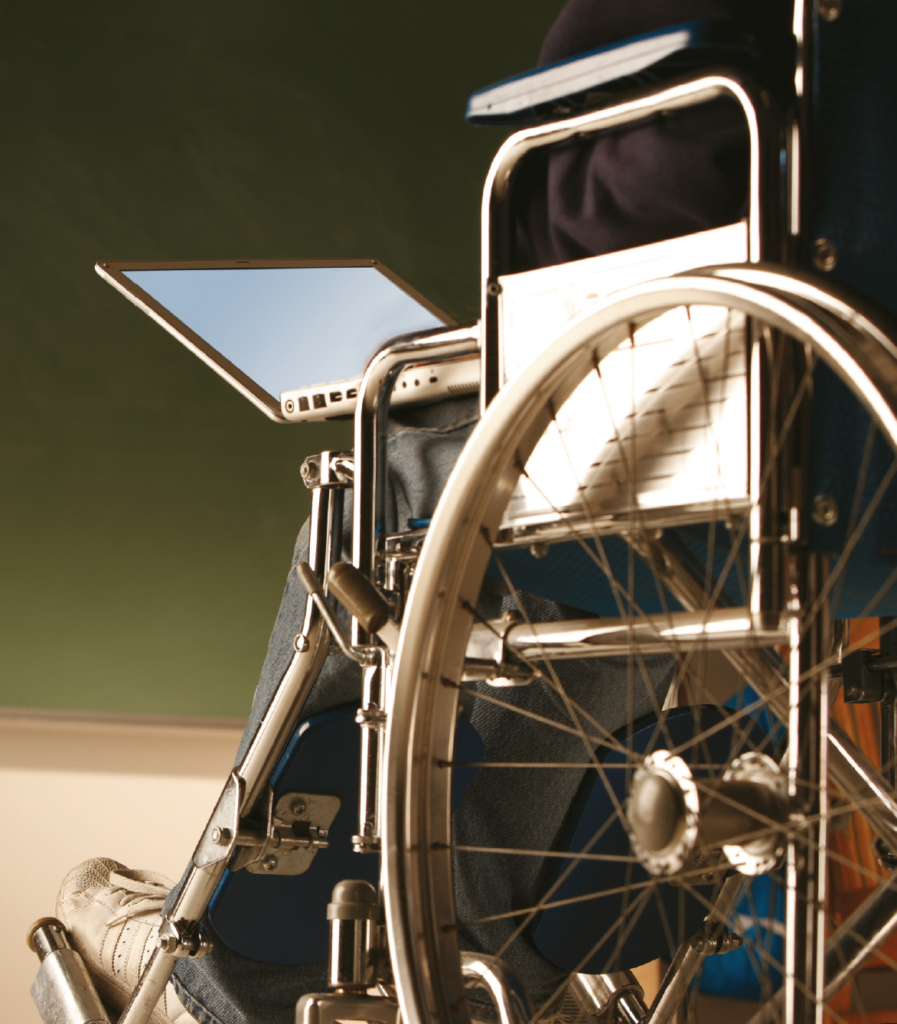
How much the students with CP, some of whom use walkers or wheelchairs, are integrated into regular classes depends on the child. All are very bright and inquisitive, but their physical limitations impede their ability to take notes and answer questions, necessitating extensive adaptation and assistance from teachers and aides.
The students with CP receive occupational and physical therapy. Twice a week they travel to a nearby kibbutz, where they take therapeutic riding lessons.
The students spend roughly 10 hours out of their 33-hour school week in their own classroom, where they receive individualized help with specific subjects. Male and female aides help some of the kids with personal hygiene.
Raphaeli said the three-year-old program, begun at the request of the Or Akiva municipality, has encouraged many of the able-bodied students to overcome their preconceived notions about people with disabilities.
To facilitate integration and break the ice, the five teens with CP went with Raphaeli from class to class and answered the other students’ questions and, to give those students a sense of what it’s like to have CP, asked them to try to write with their hands tied.
Despite this integration, it’s taken time for the students to form lasting friendships.
“I saw that they were sitting kind of on their own, and I wanted to get to know them better so I approached them,” Molly Istafarov, a 15-year old able-bodied classmate, said of the students with special needs. “I realized that they’re not different and are fun to hang out with.”
Asked how the school funds the inclusion program, Etti Laredo, AMIT Atidim’s principal, smiled and sighed. Although it is largely funded by the municipality and various government ministries, the incidentals add up, she acknowledged.
The students may not know exactly how much effort goes into their special program, but they do appreciate it.
“It’s great for me here,” said Liat, 15, who has been a member of the class for children with CP since its inception.
Liat, who uses a walker to get around, said she is grateful for “extra help and therapies” she receives.
“I’ve made good friends here, in the small class and in the integrated classes,” she said. “I’m happy.”
Michele Chabin began her career editing women’s magazines in New York. In 1987 she moved to Israel and has been a reporter there ever since. An award-winning journalist, Michele frequently contributes to the New York Jewish Week, Religion News Service, USA Today, and many other publications.