
Debut author, poet and translator Idra Novey recalls one day when she had to be at multiple places at once and didn’t want to go to any of them. Instead, she felt the urge to vanish into a tree with a book—and while she didn’t actually do that, she did use that image to open her award-winning novel, “Ways to Disappear.”

Idra Novey. (Credit: Donata Zanotti)
Set in Brazil, Novey’s novel centers around the disappearance of celebrated writer Beatriz Yagoda—who climbs into a tree with a book, a suitcase and a cigar—and her American translator, Emma Neufeld, who hops on a plane from Pittsburgh to search for Beatriz alongside her two children and her publisher. The book is a mash-up of noirish mystery, black humor and budding romance with a smattering of surrealism. Itt has received glowing reviews and its aesthetic has drawn comparisons to that of a Coen brothers’ film. It also won Novey the 2017 Sami Rohr Prize for Jewish Literature.
Despite the name of the $100,000 prize, “Ways to Disappear” isn’t an overtly Jewish book. The characters are all Jewish—apart from the loan shark trying to reclaim a hefty debt from Beatriz—and there are mentions of Shabbat and reciting kaddish at a funeral, but the allusions to Jewishness are all quite understated.
“The Jewish aspect of the book was subtle, but certainly a significant part of the story,” Novey said. “I thought that choosing it for this award was honoring the many ways that a book can speak to the Jewish experience, and especially the Jewish experience in Latin America, which I think is not as visible in English-language literature.”
Subtle but significant could also be an apt description of Novey’s relationship with Judaism growing up in Johnstown, Pennsylvania, in the Rust Belt. “Appalachia, where I grew up, is this very underdeveloped, sort of forgotten area,” she said. “It’s racist and anti-Semitic and backwards. There were very few Jewish kids in my class. I had someone in the cafeteria say to me that they were worried I was going to ‘Jew them out of their lunch money.’ So that was the kind of place I grew up in. On more than one occasion someone had graffitied a swastika on the synagogue. You learned to be very cautious. You don’t tell people that your family is Jewish if you don’t have to.”
Still, Novey’s parents introduced her to what she calls the “Jewish value” of social justice activism. Her father was active at the local synagogue, and she said, “My dad was always writing letters on behalf of the ACLU and the Southern Poverty Law Center. And that was just seen as part of life and your duty, just like what you, as an educated person, were responsible to do.”
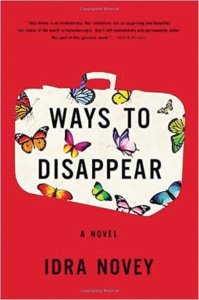
“Ways to Disappear” by Idra Novey
Novey applies this philosophy both in her teaching and in her family life. She and her husband, a Sephardic Jew from Chile, who she said also grew up feeling like an outsider in a Catholic country, have written to Mayor Bill de Blasio, thanking him for making New York a sanctuary city, and have taken their young children to various marches in support of civil and human rights.
“I’ve always sought out ways to teach beyond academia,” Novey said. “When I was teaching at Columbia, I taught in the Bard Prison Initiative, and when I was teaching in Chile, I set up a writing workshop at a local domestic violence shelter. At my new position at NYU this coming year, I’m helping out with a workshop for women at Rikers.”
Novey also credits learning basic Hebrew during her youth for setting her on a path to languages and writing.
“I think it was actually through Hebrew school that I realized how much I loved languages,” she said. “It was through seeing how quickly I learned Hebrew, how easily it came to me, that I realized that I really loved decoding language and wanted to do something with languages.”
That, coupled with the fact that her family had welcomed Argentinian and Brazilian exchange students into their home, is what attracted Novey to learning Spanish and Portuguese at Barnard College, to traveling to South America and, ultimately, to translating the work of Latin American authors into English. Among the notable writers whose work she has translated is Clarice Lispector, a Brazilian Jew whose writings have experienced a resurgence in recent years, and whom one critic has described as the “most important Jewish writer in the world since Kafka.”
Now Novey’s work is the one being translated. “Ways to Disappear” is being published in Italian, French, Portuguese, German and Spanish. She hasn’t sold the Hebrew rights yet, but thinks that, in light of the Jewish literature award, it would appeal to Israeli readers—particularly those who are fans of author Etgar Keret.
“I love Etgar Keret’s work, and I would definitely consider him an influence on this book,” Novey said. “He pushes toward the darkness through humor. His humor is very subversive, and I think that’s true of this book.”
Novey now hopes to turn her attention to writing another book. The “life-changing” Sami Rohr prize money will enable her to do that, though it will also ensure that the process for the second book is much different than the first.
The author kept “Ways to Disappear” a secret for five years, throughout the process of writing and up until she sold the book.
“It’s funny, when you have children, people just always ask about your children first,” she said. “So, it wasn’t like I denied it existed, it just didn’t occur to anyone to ask. I just didn’t bring it up, but I also loved that I had this secret dimension; it was really freeing. I’d highly recommend it.” —AR