
By Rabbi Joshua Lookstein
About a year ago, I observed the model lesson of a prospective middle school Gemara teacher at the school I lead, Westchester Day School. Being the week before Pesach, the teacher naturally focused the lesson on the chag. He began with the quote from Parshat Bo (13:14) that is the basis for the simple son’s question at the Seder: “Vihaya ki yishalcha bincha machar leimor ma zot…(And when your son asks you tomorrow what is this all about…)..” The context in the Torah of the simple son’s question is the mitzvah of Pidion Bechorim (redeeming the firstborn). His question, basically, seeks the reason for this mitzvah, and the answer given is that it is because the firstborn Jewish males were spared in the plague of Makat Bechorim (Ibn Ezra, among others).
In the model lesson, the teacher asked the students to translate the second word in the passuk, “ki.” One student raised her hand and, channeling a translation of “ki” offered by Resh Lakish in masechet Rosh Hashana (3a), said, “It means ‘if.’” That translation would have the sentence mean, “If your child asks you tomorrow what is this all about….” It wasn’t the answer the teacher was looking for. He was looking for “When;” thus, the sentence reads, “When your child asks you tomorrow what this holiday is all about….”
But as is often the case, there is so much to learn from the hava amina, the rejected answer. It actually makes more sense than the “right” one. After all, how do we know that the child will ask the question tomorrow? How can you say, “When the child asks?” What if the child doesn’t ask? “If the child asks” makes so much more sense.
The obvious answer—and one of the main educational aims of the Haggadah—is that it is our job to make sure that the question is asked. It is our job to inculcate a sense of wonder and provide an environment where it is safe to take risks, to be so educationally systematic that the questions will be inevitable, a matter of “when,” not “if.”
What is the significance of the word “Seder?” The Seder is, by definition, a system. It is a carefully planned evening that leaves very little to chance. It is a script. There is a beginning (Kadesh) and an end (Nirtza) and steps along the way to get us from “kuf” to “nun.” One may certainly ad lib and expound but not deviate. The seder plate itself leaves nothing to chance. Most new seder plates aren’t even just plates. They are sectioned off somehow, with bowls or dividers and words designating each area. It has become a piece of art in people’s homes, but its inspiration is more science.
And how do we spend the time at the Seder? We manufacture questions. The Haggadah is a mix of deliberate questions, inferred questions and oddities that almost demand to be questioned. The deliberate ones, those not needed in order to transmit information, abound. We could have had Avadim Hayinu without Ma Nishtana. We could have had Pesach, matzah and maror without Al shum ma. We could have learned Lavan’s plans without “Ma bikesh Lavan Ha’arami la’asot….” We could have done “the math,” as my father likes to refer to the calculations of the number of plagues, without Minayin ata omer shelaku hamitzrim. Hallel itself has several sentences that are formed as questions. And, of course, Echad mi yodea.
And then there are the inferred questions: Yachol mei’rosh chodesh (you might be wondering why), and Dayenu, where we are asking if it really would have been enough. These are questions of depth rather than breadth, making someone consider a deeper meaning, or another way to think about things.
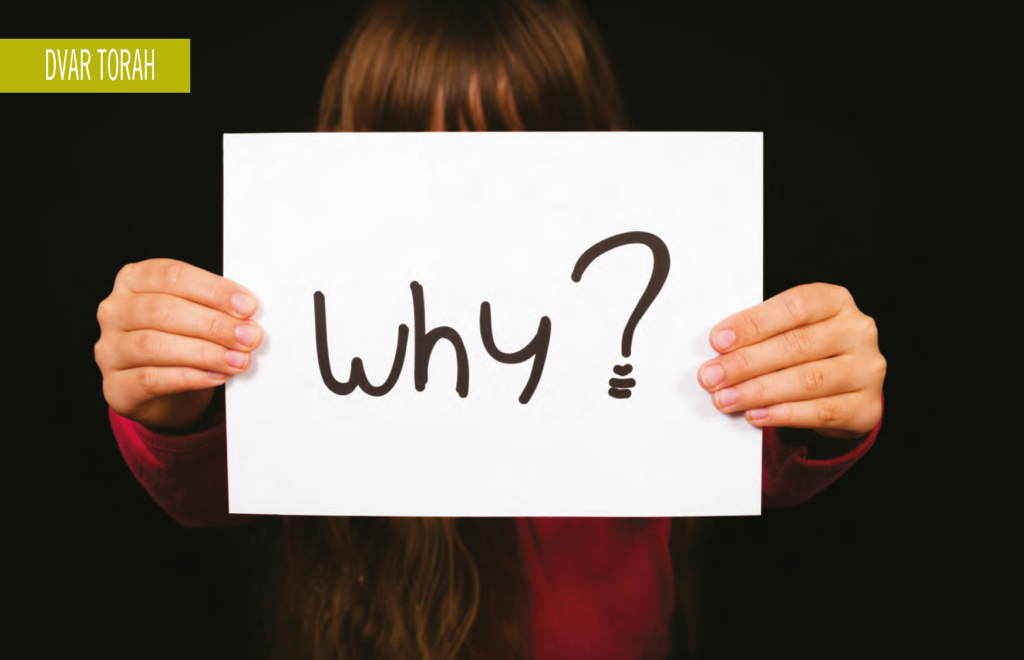
The oddities that beg questions are everywhere. Having three matzot, breaking one of them, a specific one at that, begs the question “why.” And every Seder, for instance, right before urchatz, my father tells the story of my eldest sister who, when she could barely talk, washed her hands and started saying the brachah, and my father stopped her and she looked up at my father with a horrified look of, “Why no bracha?!”
The Haggadah is the blueprint for designing a milieu that fosters questions: Model a questioning mindset by phrasing information as answers to questions, probe for deeper understanding and alter the status quo to create awareness of things we take for granted.
What is the significance of asking questions? Questioning is both the basis of learning and a key element in our relationship with God. Socrates famously said, “Wonder is the beginning of wisdom;” learning is difficult when a person isn’t curious about the world around him. We are all born with a sense of wonder and curiosity, but, for many, that sense wanes as they get older. Maintaining that attitude is what fosters a growth mentality no matter the age.
In a similar statement, David Hamelech says, “Reishit chochma yirat Hashem” (Tehilim 111:10) or “Fear of God is the beginning of wisdom.” Wonder and fear of God are related. Being awed by the world is to acknowledge that there is a higher power. When God tells Avraham to look up and try to count the stars, Avraham is presented with the opportunity to behold the wonder of the universe and to recognize both his place in it and God’s dominion. Wonder, and the resulting questions, are elements of the humility needed to experience a relationship with God.
Rav Soloveitchik, in a speech given in 1975, as summarized by Rabbi Steven Weil, Executive Vice President of the OU, said in the April 2013 edition of Jewish Action that Torah study is an “ecstatic, metaphysical performance”; it is a personal revelation. We, therefore, must approach learning Torah the way our ancestors approached the receipt of the Torah at Mount Sinai—with fear, awe, tremor, and trembling (see Berachot 22a). Torah study must include deep humility, a recognition that one is standing before the Almighty, which itself leads to surrender to the Torah’s, meaning God’s, demands. If a Jew is incapable of experiencing the presence of the Almighty, he is forbidden to study Torah, because he lacks this crucial attitude.
Our questions are not confined to the Seder. Far from it. The Seder should be the springboard for a life of questions, wonder, wisdom, humility and Torah learning. It is our responsibility to ensure that our questions and those of our children are not left to chance, but are rather a matter of when, not if.
Rabbi Lookstein is the Head of School of Westchester Day School, a co-ed, Modern Orthodox Toddler-8th Grade day school in Mamaroneck, NY. He is the proud son of Audrey (and Rabbi Haskel) Lookstein, a former National Vice President of AMIT.