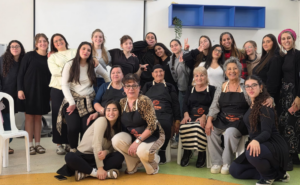


It is a little embarrassing but nevertheless true: My mother is the President of AMIT and until last week I did not fully appreciate what that meant. From May 7-11, I was on the 2023 Groundbreakers’ Mission. Luckily for me, over the four days AMIT was on full display, with a clarity I couldn’t have predicted.
As we toured the expanding AMIT footprint throughout the country – a religious girls school in Beit Shemesh, a vocational school in Ramleh, a secular school in Shoham – and heard from the former Deputy Director of the Rameh Municipality about the unique Druze school AMIT is consulting on, I tried to create an equivalent American image in my mind based on what I know about schools in the U.S. After all, I am a mother of three kids and deeply invested in their education. But time and time again, I came up empty handed. I could not conceive of an equivalent “network” of schools with a central headquarters.
Let me set the stage as it was laid out for me by Professor Dan Ben-David from Shoresh Institution. The level of basic education in Israel is at the bottom of the developed world. Nearly half of Israel’s children are receiving a third world education. If you graph education quality vs. economic growth, the result is clear – the better the education, the more successful the country. The findings paint a bleak picture of Israel’s future. And the gap is growing when you factor in the fastest growing sections of the population, haredim and Arabs.
But where does Israel score at the top? Confidence. Despite low scores, Israeli students are overwhelmingly positive they can understand even the most difficult math materials. How do we reconcile these extremes? Can Israeli students “chutzpah” be channeled to change the trajectory of the curve and build a more successful, more economically-sound country?
If anyone can do it, it is the teachers and administrations of the AMIT schools. Educators like Michal Aflalo, who with her team created an AI (artificial intelligence) chatbot and is on the forefront of understanding what a tool like ChatGPT means for education today and tomorrow. Her willingness to harness the power of AI is testament to her ability to adapt to and embrace sweeping technological changes rather than run from them. Her students will be better for it.
Miriam Koren, the passionate Principal of Noga, had full knowledge about each of the five students we met – what their major is, what project they had completed, what their plans following graduation were. Under her leadership, teachers are building a curriculum and tools they can share with AMIT’s 59 other high schools.
Teachers like Tamar Inbar-Garamah in Chevel Modiin, who was specially trained in the Makerspace, a dedicated classroom space with 3D printers, woodworking tools, laser printers, and much more. She fosters a space for students to learn how to use their hands and translate academic material into real-life applications.
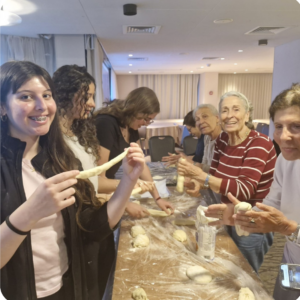
And teachers like Eli Alfasi, the chef at the Ramle vocational school who brought a seriousness to his demonstration of how to bake lava cakes and fruit bars. He underscored a simple but critical point – how you do one thing is how you do everything.
These teachers hold every child accountable. They exhibit boundless flexibility in the face of ever-changing landscapes. They have passion, expertise, and vision, and the courage to try, fail, and try again. They have fierce dedication to each student as a whole person. They engage with students not just in the sliver of time when they are in the school building but throughout the entire day and the whole week. They draw on the creativity of the headquarters staff to partner with organizations and facilities throughout Israel to offer students opportunities they could otherwise only dream about.
My children are fortunate enough to go to a school with teachers who are dedicated, creative, and thoughtful. So what makes AMIT unique? AMIT teachers are doing all this in a more challenging environment, on a much larger scale. They are doing it with students from wide ranging socioeconomic backgrounds, with parents who are, culturally, less involved than in the U.S. When we pray for the next 75 years+ for Israel, we also pray these teachers are fully prepared for whatever comes their way. They are on the front lines with the children who will be defending and building Israel after they graduate from their AMIT school. AMIT is the foundation that ensures the future of the Jewish state.
I am so glad I was able to see the work AMIT is doing in person. As someone wiser than me phrased it, “It’s the best way to see Israel.”
Sarah Blechner