
By Alisa Bodner-Bryant
For centuries, the Jews of Ethiopia would trek miles from their villages to the highest mountain in Northern Ethiopia, where they would lift up their eyes toward Zion in hope and prayer. The Sigd holiday was observed each year on the 29th day of the month of Cheshvan, 50 days following Yom Kippur. It was marked by fasting, a renewal of commitment to God, and a communal prayer for the return to Jerusalem. In 2008, Israel’s parliament legislated the Sigd Law, declaring the 29th of Cheshvan a national holiday on the calendar. Each year on that day, Israelis of Ethiopian descent travel to Jerusalem where they gather in the Armon Hanatziv neighborhood, while kessim (Ethiopian religious leaders) read sacred texts and recite prayers before the community.
Though Sigd is an official Israeli holiday, it is not widely observed outside the Ethiopian-Israeli community, which numbers approximately 180,000 people. In recent years, there have been increased efforts to mark the Sigd holiday as an opportunity to educate broader Israeli society about the history of Ethiopian Jewry, with the goal of opening a window into its rich culture and traditions. AMIT has played an integral role in these efforts by marking the holiday in its network of schools and providing educational materials to integrate into classroom learning.
Marking the Day
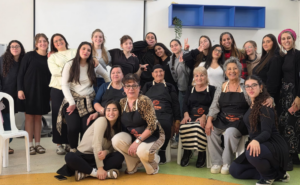
This year, in honor of Sigd, the Dina & Moses Dyckman Ulpanat AMIT in Beersheva hosted speaker Dr. Yaffa Melda Edelstein, head of health and education at the Resilience and Health Hub in Sderot and an alum of the ulpana. Dr. Edelstein spoke about her experiences as a young immigrant, her time at the school, and how encouragement from her teachers helped her achieve her goals. She challenged students to chase their dreams, even offering to serve as a mentor for the girls, paying forward the guidance she benefited from in her life.
“The visit brought me back to magical moments and to a time when my teachers played such a meaningful role in shaping who I am,” said Dr. Edelstein. “I would be honored to return for a more personal conversation with the girls about excellence, perseverance, and the values I gained here.”
AMIT Dyckman Principal Nurit Davidi added, “Our vision at AMIT is to cultivate excellence with love and faith. We set ambitious goals for all our students, and with encouragement, belief, and genuine care, we see them rise and flourish.”
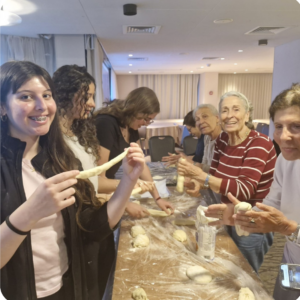
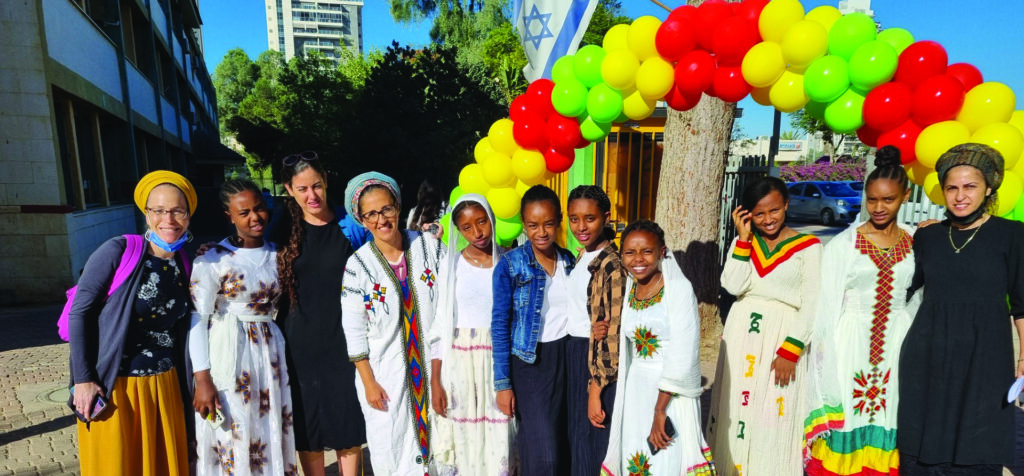
Students at Ulpanat AMIT Anna Teich in Haifa enjoyed an Ethiopian cultural day in honor of Sigd, complete with a buna coffee ceremony, an exhibit of Ethiopian crafts, traditional dress, and hair braiding.
AMIT Kiryat Malachi, based in the southern city, serves many Ethiopian-Israeli families and prides itself on its diverse student body. Its annual Sigd celebration honors the heritage of so many of its students, strengthening their connection to their roots, while giving them the confidence to chart their own way. Leah Genie Avuno, a graduate of AMIT Kiryat Malachi, remembers Sigd as one of the highlights of the year.
A Personal Story of Belonging
One of 15 children, Avuno immigrated to Israel in 1999 at the age of 2. Like many other immigrants from Ethiopia, her family was separated while awaiting aliyah, and only reunited years later once in Israel. They moved to Kiryat Malachi to be near family and Avuno started at the AMIT school in seventh grade. She deeply appreciated that her new school in a new country honored her family’s traditions.
Each year, the school invests in educational programming leading up to Sigd. Teachers dedicate classroom time to the history of Ethiopian Jewry, and students of Ethiopian descent bring in traditional foods and share stories of the customs they grew up with. Avuno’s mother would join her in school and distribute home-cooked injera, a traditional Ethiopian flatbread made with teff grain and spices unique to the Ethiopian kitchen.
The attention shown by the entire school body — principal, teachers, and students — in marking the annual holiday made a deep impression on Avuno during her formative years as an Ethiopian-Israeli teenager. “It felt just like home. I never had to hide anything,” she explained. She added that watching her principal and teachers learn to speak Amharic and eat traditional Ethiopian food that her mother prepared has had an impact on her to this day.
From an early age, Avuno navigated questions around her identity. In high school, thanks to the supportive environment of AMIT, she learned how to represent herself as both Israeli and Ethiopian, and to embrace all parts of her identity.
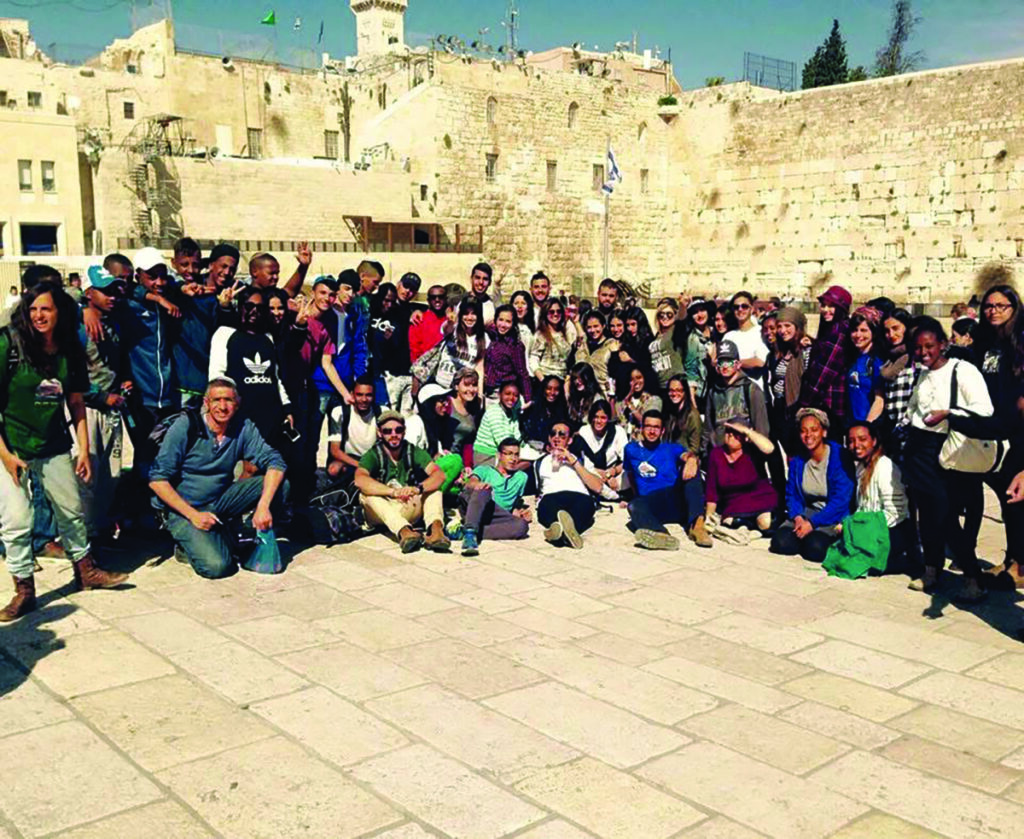
During a 10-day educational hiking trip in 11th grade, Avuno visited Jerusalem with her entire grade. On Jerusalem Day, which is also a day of observance for the approximately 4,000 Ethiopian Jews who perished on their way to Israel, the students toured Mount Herzl. Avuno was selected to speak about the significance of the day at the monument dedicated to the memory of the Ethiopian Jews who died en route to Israel. She spent time learning about the memorial in preparation. It was not lost on her that her school dedicated the same amount of time in the schedule to the memorial for Ethiopian Jews as it did to the graves of politicians and fallen soldiers. “I felt so seen, so appreciated,” she said.
Since a large percentage of students at AMIT Kiryat Malachi are immigrants, the school has dedicated resources to providing additional support to ensure their full integration. In many Ethiopian-Israeli households, the children are involved in household tasks that would typically be overseen by parents. Due to language gaps, the children take over these responsibilities, and as a result often struggle to balance family life with school. Not only does AMIT Kiryat Malachi provide additional tutors for immigrant families, but the school also has many teachers and administrators of Ethiopian descent who serve as role models, easing cultural differences.
A Foundation for Success
Avuno fondly remembers studying for exams in her teachers’ homes when her own home was not conducive to a quiet study environment. “There were no limits. If you wanted to succeed, they did everything to help you succeed,” she explained.
After her army service, Avuno became a mentor for immigrants in AMIT Kiryat Malachi, like those who helped her succeed as a high school student. She worked as a social coordinator arranging tutors, providing emotional support, administering home visits, and simply being present.
In addition to academic rigor, AMIT Kiryat Malachi also gives students a strong foundation of volunteerism and social responsibility. Avuno volunteered in her community from a young age, attended Yeshiva University’s Counterpoint Israel program for a few summers, and did a year of community service in Tucson, Arizona, bringing Israeli culture to Jewish day schools and institutions in the city.
Today, Avuno works for AMIT as an international relations coordinator, organizing events for overseas donors and helping strengthen the connection between supporters of AMIT abroad and the projects they impact in Israel.
Beyond the Classroom
AMIT leadership is sensitive to increasing cultural awareness around the needs of students from immigrant homes. Hosting traditional celebrations and highlighting Ethiopian-Israeli alumni who are successful and respected demonstrates to students that they are fully part of the fabric of not just AMIT schools, but Israeli society.