

The Father: Leading by Example
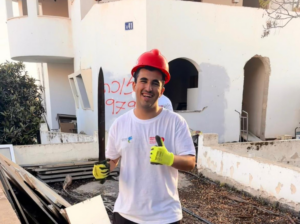
Nedavya Naeh, a company commander, left his position as principal of the AMIT Tzfat Vocational High School to serve in Lebanon for many months. Several of his teachers were called up for reserves as well.
“My second-in-command, who is an educator at my AMIT school, talks to my signaler, who was also a student of mine. I look around: They’re all from AMIT,” said Nedavya.
“The fact that the principal does extensive reserve duty—and I’m not the only one who does this—is making a statement: This is the most meaningful education there is,” he added. “The students see that although the educator is not present with them, some things are more important. There is educating through words and educating through action.”
The northern town of Tzfat was the target of dozens of missile attacks, so schools were closed for months. One rocket even hit near the school and set fire to some of the trees on campus. Classes were moved online—a challenge for any school, and even more so for AMIT Tzfat, where many students have learning and emotional issues. In some cases, students have even gotten in trouble with the law.
“It’s seen as a last chance school for kids before dropping out of the system,” Nedavya said. Even when classes went online, teachers continued to visit students at home to maintain their connection, he explained.
Nedavya connects to students through his own life experience. He became a teacher without obtaining a bagrut, a graduation certificate, due to his struggles with dyslexia. So, at age 30, he studied for the exam along with his students, a decision he sees as an important message that it’s never too late to strive to do better for yourself and get a degree.
In his two years as principal, Nedavya has turned the school around. Almost all students will get a bagrut, some even accomplishing a rigorous course of study—quite an achievement for any school, let alone for kids at risk. AMIT also funds vocational courses and activities to keep the children off the streets and participating in meaningful programs.
Nedavya shared a story about 10 young women who recently completed a cosmetology course that taught them not only a vocation, but also how to write a business plan, and explored the challenges of opening their own businesses. It was an expensive course, he noted, but AMIT was able to pay for it and give these students the opportunity for advancement.
“[AMIT] was prepared to invest in the students,” Nedavya said. “In our school, you see all of Israel: We have some kids in special education, some on the autism spectrum and some who are doing the highest-level math and science. It’s amazing.”
Nedavya shared another example about a trip he took to the U.S. He visited a high school where students were studying firefighting and volunteering with the fire department. He brought the idea back to Israel and incorporated the program into AMIT Tzfat’s offerings. He and his team are intentionally keeping enrollment small, with just about 100 students, sometimes even turning applicants away.
The AMIT Tzfat Vocational High School offers more than just a place to learn; it’s a home, and the people, a family. The building has a kitchen and living room where students can relax and spend time together. Even in the summer, when there are no classes, you can find students hanging out at school, Nedavya said.
The Son: Motivated by AMIT
Oz, 23, is also a graduate of AMIT. He works at Rafael Advanced Defense Systems in top-secret security-related work. Oz said he wasn’t much of a student, but his teachers never gave up on him. He mentions one high school teacher, Rabbi Gil Karasente, who invited all his students to his home for a Shabbat once a year.
“HaRav Gil loved us like his own children,” Oz said. The invitation for Shabbat continues to this day, even though Oz finished high school five years ago. Every year, he and his classmates spend a memorable Shabbat with their former teacher.
“Education is less what the teachers say, and more about setting a personal example,” Oz said. “It’s the kind of atmosphere he creates in the class, and how he talks about values and Zionism. [Rav Gil] encouraged all of us to do combat service if we could.”
Oz was drafted to an elite combat unit, Maglan, where he continued even after his mandatory service ended. Since the war began, he has spent several months serving in Gaza.
Oz explained that Rav Gil encouraged him to work hard for his bagrut even though he wasn’t a great student. In Israel each student must choose a major in high school, like college in the U.S. Rav Gil introduced Oz to a major called “Land of Israel” that included hiking, something Oz has always enjoyed.
*Oz cannot be seen in photos for security reasons.
The Family: A Powerful Legacy
The Naeh family’s connection with AMIT goes back many years. Nedavya’s wife, Efrat, did Sherut Leumi in an AMIT school many years ago. When Nedavya once snuck in to visit her, he was caught and kicked out by none other than AMIT’s director general,
Dr. Amnon Eldar.
The strong relationship between father and son, with the backdrop of AMIT schools woven through their lives, is evident when speaking to this impressive family. Oz is very proud of his father and his achievements, and Nedavya lights up when he talks about his son and finding his niche as an educator at AMIT.
“I always had an affinity toward working with children and teens,” Nedavya explained. “I was going to work in agriculture; I even had a farm. When the opportunity with AMIT came my way, my wife said, ‘You won’t grow tomatoes, you’ll grow people.’”