
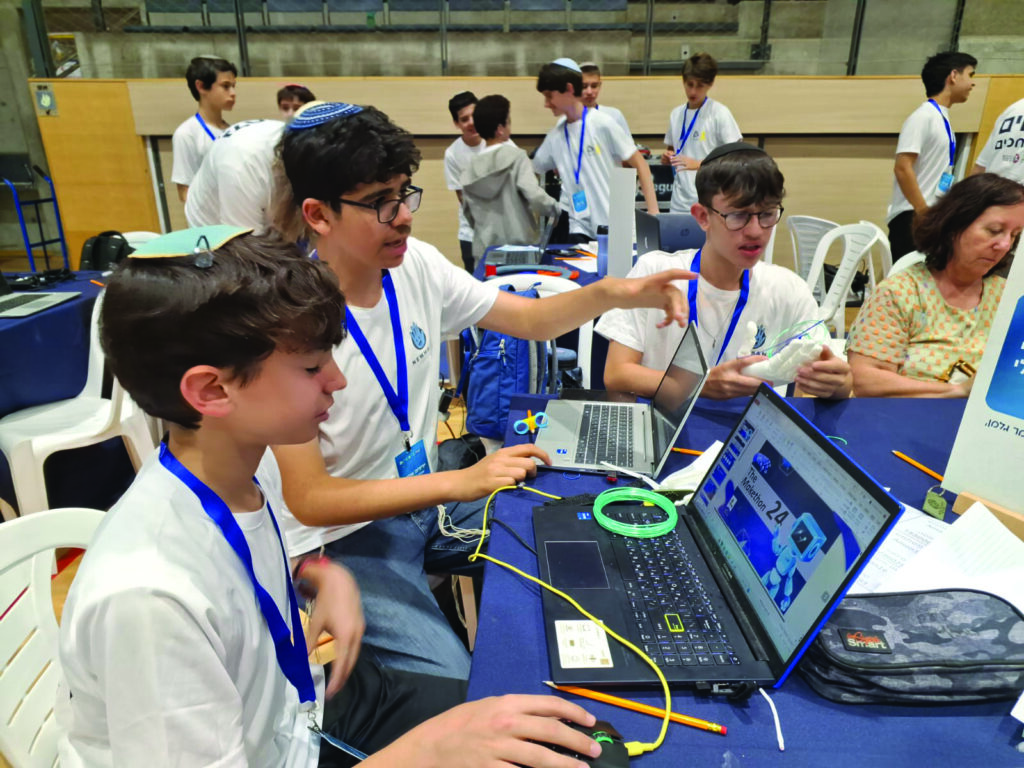
Fourteen-year-old Chana Ben Chamo frowns at the computer screen in front of her.
“I can’t get the Wi-Fi to work—and without Wi-Fi, I can’t test the sensor,” says Ben Chamo, student at the AMIT Wasserman Junior and Senior High School for Girls in Ma’ale Adumim, in frustration.
Ben Chamo is at the AMIT Make-a-thon as part of a team of five girls who have come to Beit Halochem in Beersheva to present tech projects they’ve worked on all year. Their project is a voice-activated smart shower meant to help veterans who have lost the use of their hands.
All students at the Make-a-thon met with disabled veterans—either from the current war with Hamas or from earlier conflicts—and were then tasked with developing technological solutions for veterans’ unique challenges. Students competed first within their schools before advancing to the national competition.
“It’s a special feeling when you can help someone,” Ben Chamo says. “At the beginning it wasn’t so easy to work together as a team, but then we divided up the work and that was easier.”
The voice-activated sensor for the shower is housed in a waterproof box next to the shower stall. The students invented the device and built a prototype. Now, they’re practicing for the pitch they will give to the competition’s judges.
The idea of getting up on stage in front of hundreds of people makes some of them nervous.
“I’m a little emotional right now,” says Hodaya Zarzar, 14. “I never thought we’d make it here. It makes me very happy, but I’m also a little afraid.”
Einat Shabtai, their dynamic junior high principal, reassures them. The school has 72 girls in the eighth grade; three teams, those who won the competition in the school, are here today.
“They came up with the idea, and we helped them with the practical part,” Shabtai says. “The whole process has taught them creativity, self-confidence, and how to work together. No less important, they learned a lot about chesed.”
While this project was planned before the war in Gaza, she says the girls have become much more connected to it because of the war. The project was also meant to encourage the young women to learn about adults with disabilities. For example, they played basketball in wheelchairs to understand what it’s like to play sports without the ability to run across the court.
The principal of the school, Ruchama Vogel, believes the Make-a-thon embodies AMIT’s theory of education.
“The program is not just another program at our school. It is the very essence of what defines us; it is the DNA of our school,” she says. “In today’s world, a bagrut certificate alone [the matriculation certificate earned by students who pass their exams] is no longer sufficient. Students need up-to-date skills to navigate a constantly changing world. This is where the Educational Ecosystem comes in, providing practical knowledge and hands-on experiences both inside and outside the classroom.”
Vogel says these projects also inspire self-confidence and independence.
“We want the student to believe in herself, in her abilities, and, of course, in the Creator of the world,” she explains. “And then, she will decide that she needs to initiate and positively influence the world. The Ecosystem is the tool with which she can influence and do good in the world, with the help of the Almighty.”
At another table, students from the AMIT school in Hatzor are working on their presentation for a magnetic hand.
“We met a soldier who can’t lift silverware, so we designed this magnet hand to help him,” Ido Menachem, 14, says proudly. “Each magnet can lift five kilos [11 pounds].”
The projects go from vision to reality with the help of Ariel Drach, manager of the Makers Department of Innovation in AMIT schools. Drach’s position is new, and he says that until now these projects were outsourced. The makers movement, which started in the U.S., is a do-it-yourself movement that uses both old-school tools like hammers and nails and new tools like robots and 3D printers to help students understand how machines work, he explains.
“Nowadays, we realize that kids need to understand the process,” Drach says. “At AMIT, we want to bring the education to the makerspaces. We want to bring students and teachers to learn history, Torah, and even sport through makers. For example, in history we make games using a 3D printer, and we use robots to teach the kids programming.”
After dinner, the contest begins with the teams going up on stage and pitching their ideas. The judges, including former cabinet minister Matan Kahana, vote on the best projects.
“It is very emotional to be here this evening, which is the climax of an educational and values-oriented process,” says Dr. Amnon Eldar, director general of AMIT. “The students took the issue of wounded IDF soldiers, which is especially relevant now in war, and helped each student learn how to help wounded soldiers.”
The first-place winner is a project called “Makom,” or “Place,” from students at the AMIT school in Shoham.
“We spoke to some people with disabilities who said that sometimes people don’t want to get up and give them their seats,” says Alon Stollar, 16, a member of the winning team. “The idea is that when they use their Rav-Kav [public transportation card], Makom shows them where there are available seats. If there are no seats, it shows the person sitting in them that this is a priority seat for people with disabilities and tells them to get up.”
The smart shower and the magnet hand were among three projects that tied for fourth place.
The next stage, says Drach, is to help the students build prototypes that can eventually be used commercially. The program is part of AMIT’s philosophy that encourages hands-on, project-based learning rather than rote memorization.
“The story of the 21st century is the ability of students to handle changes and solve problems that arise,” says AMIT spokesman Shmulik Klein. “Creativity and solving specific problems is very important. This is also essential for AMIT’s moral compass, which talks about giving to society and about responsibility to the people of Israel and the state of Israel.”