

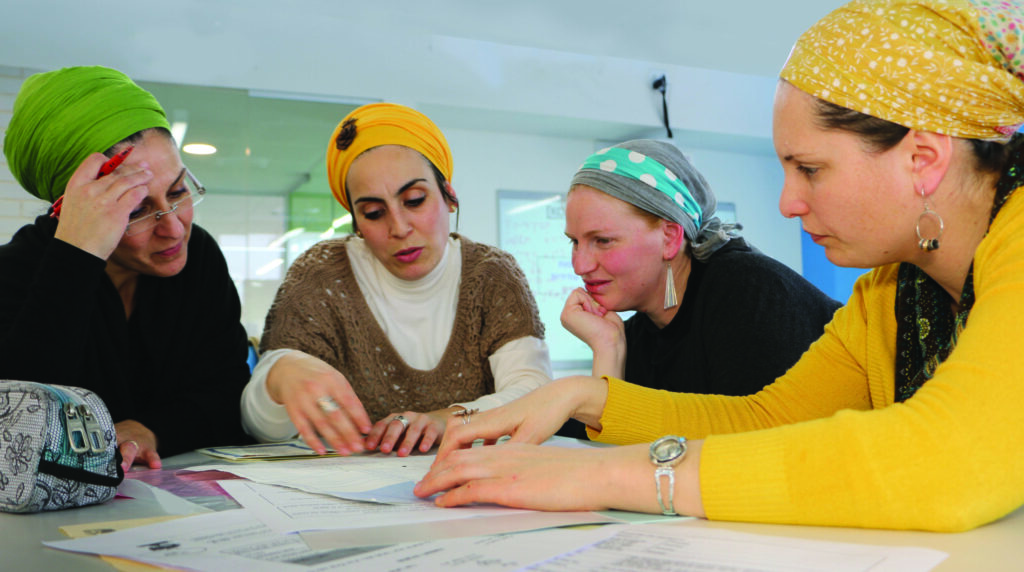
Training teachers for 21st-century students: New program harnesses strengths of AMIT and Bar-Ilan University
Across the world, the arsenal of qualified teachers who can meaningfully inspire students is shrinking. Globalization, technology, and a rapidly changing economy and society present real challenges to the teaching profession and workforce—and teacher shortages are a crisis we cannot ignore. As AMIT has done for over a century, we’re helping change the narrative of education in Israel—this time, with a revolutionary new teacher training program in partnership with Bar-Ilan University: Amitim.
“For the first time, we’re integrating the ivory tower in academia with the real world in a very real way,” says Dr. Lior Halevi, who was the principal of AMIT Modi’in until he was tapped to head this joint venture.
The Root of the Issue
Like every school principal in Israel, whether in the AMIT Network or not, Halevi faced the teacher shortage crisis in real time. Based on data from Israel’s Central Bureau of Statistics, every third high school teacher leaves the system within five years.
“The dream of the Jewish mother has not historically been that her child becomes a teacher over a doctor, lawyer, or high-tech programmer,” Halevi explains. “Teaching is challenging work, and kids today have more distractions than ever. University departments in education have been getting smaller, too.”
Professor Yaacov (Kobi) Yablon, founding dean of the Faculty of Education at Bar-Ilan University (BIU), acknowledges the global nature of this issue but points to Israel-specific challenges.
“You can’t take education out of its ecological system, and there are some major educational challenges unique to Israel,” says Yablon. “We have huge gaps in learning between students who live in different areas in Israel. Israel’s matriculation exams are not the best way to assess student performance. There are different educational streams in Israel, like the Haredi school system, the Arab school system, and the dati-leumi system. And if you’re religious, like AMIT is, how do we educate students in Ahavat Hashem and Keyum Mitzvot?”
Yablon continues, “We looked at the educational challenges in Israel, and AMIT and Bar-Ilan came up with the joint venture we’re calling Amitim.”
Dr. Amnon Eldar is, of course, the AMIT Network’s director general, and one of Israel’s most influential educational leaders.
“Together with Bar-Ilan University, we are offering a unique program for the teachers of the future, adapted to new pedagogy. This program will develop new horizons for teachers and give them the possibility of a future filled with more inspiration and satisfaction, and the ability to realize their educational dreams,” says Eldar. “It is clear that teachers with this experience will want to continue learning and developing in the world of education.”
“With this new program, we want to make a better connection between theoretical learning, practical learning, and studying theory within its context—an idea previously championed by Professor Tova Michalsky, head of the teaching and learning master’s degree program at BIU Faculty of Education,” says Yablon. “It’s a unique, nontraditional model, and it requires the resources of two institutions like AMIT and Bar-Ilan.”
A New Vision for Training Teachers
Amitim’s curriculum is structured in a unique way. Students spend three days a week on the Bar-Ilan campus and one day a week visiting the Gogya AMIT campus in Ra’anana, where they receive hands-on experience.
At the Gogya campus, they interact with students and learn about their real-life struggles in and out of the classroom. Practical experience is emphasized from day one.
Amitim participants also learn what it takes to engage with the students meaningfully. “There’s a difference between learning to cook in the kitchen and learning through a recipe book,” explains Halevi. At Amitim, students benefit from classroom instruction as well as practical experience.
Students will obtain their bachelor of arts degree, master of arts degree, and teaching certificate in four years instead of six or seven. Courses focus on educational research and hands-on fieldwork, in which students practice from the very beginning the theories they are learning in the classroom. Other key factors of the program include strengthening pedagogical training, providing ongoing professional development, offering field practice within the AMIT school system, and empowering students with a strong research background and skills to support ongoing innovation research and evidence-based practices in education.
There are also learning seminars and regularly scheduled visits to pioneering schools in Israel, where students learn and observe innovative teaching methods, which will also be reviewed in Bar-Ilan University’s simulation centers. In addition, a learning seminar abroad will familiarize students with advanced education systems that exist outside Israel, in the hope that a cross-geographical exchange of ideas might occur for the benefit of all students. All of this is happening alongside the emotional and pedagogical mentorship of each student and the creation of a group with a high affinity to the pedagogical and educational principles of AMIT’s Network.
Another factor the program will address: teacher isolation.
“Many teachers feel very lonely when they just start working in the school system,” explains Yablon. “Teachers walk into their classrooms and close the doors behind them, and they’re by themselves in terms of colleagues—at least until that first phone call from a parent. And in their training at university, they probably didn’t get the chance to practice talking to an angry parent.”
Yablon says Amitim presents a new vision of how academia and the field can work. “We want to give students the ability to enjoy these two worlds together—two worlds that speak the same language,” he declares.
Amitim just welcomed its first cohort of students this fall, and most of the students received substantial scholarships as part of the new partnership.
“I believe that teachers who are trained in the new systems—with the goal of serving as mentor of the student and facilitator of the learning process—will have a totally different experience at work, sense greater satisfaction, and have fewer discipline issues,” says Eldar.
He continues, “In the era of Google and ChatGPT, the focal point of learning shifts from teacher to student. The primary role of teachers will be to truly see their students and serve as mentors to help them maximize their potential, while instilling within them a strong sense of identity and values. Amitim’s approach states that teachers should never stop learning and should enthusiastically embrace the goal of engaging in new learning journeys, ensuring that school will remain relevant to the lives of students.”
For his part, Halevi is optimistic that Amitim will help combat the ever-present challenge of the national teacher shortage, although he recognizes that change doesn’t happen overnight. “It’s not a sprint; it’s a marathon,” he says. “But we’re confident this will help us better prepare more teachers for the future.”