
By Tova Cohen
Something from Nothing
One of Israel’s most defining and admirable attributes is the ability to create, over time, something of enduring value from humble beginnings—something from nothing, one might say. This axiom is evident in the blossoming of fertile ground and the cutting-edge technological landscape that have arisen from primitive desert land.
This has also been a major theme in the creation of AMIT’s Kfar Batya campus, a groundbreaking site that will educate the next generation of Israel’s leaders and equip them with the tools to enlighten and secure Israel’s future.
Like many inspiring stories, the tale of the AMIT Kfar Batya campus begins with a woman ahead of her time. In 1927, Bessie Gotsfeld—a Polish Jew, ardent Zionist, and founder of American Mizrachi Women (which would later be called AMIT)—traveled from New York to pre-state Palestine. She brought both a suitcase filled with cash and a dream of educating and empowering young people to help develop a modern Jewish homeland.
Where most would have seen backward land on which stretched seemingly endless sand dunes, Bessie literally saw Israel’s future. She purchased an expansive plot of acreage, called it Kfar Batya in homage to her Hebrew name, and built vocational schools to teach young women to agriculturally cultivate the land.
A Team Effort
Fast-forward 80 years—in the early 2000s, the land that Bessie purchased had become prime real estate in one of Israel’s most sought-after cities. A challenge began to percolate among a core group of AMIT leaders around how to use the extraordinary appreciation of the land to endow AMIT’s mission and educate Israel’s children through a singular educational campus. Debbie Isaac, a past AMIT President and experienced real estate lawyer herself, worked side by side with AMIT’s executive team in Israel to brainstorm, retain experts who keenly understood Israel’s complex land laws, and create a Kfar Batya committee comprised of members of AMIT’s board of directors. What followed was 15 years of starts and stops, complex negotiations, and thousands of hours dedicated to seeing the project to fruition. As AMIT President Audrey Axelrod Trachtman notes, “AMIT was extraordinarily fortunate to have Debbie lead this project. Her commitment, passion, and expertise were critical to getting us to where we are today. We are very grateful.”
And this would be no ordinary academic campus. Rather, it would be a powerful hub of progressive education and innovative vision where AMIT could make its headquarters and reimagine its mission to develop the full potential of more than 44,000 children and teens; level the playing field by providing opportunities for every child from Dimona to Tel Aviv, from Sderot to Jerusalem; and democratize and positively change the face of Israel.
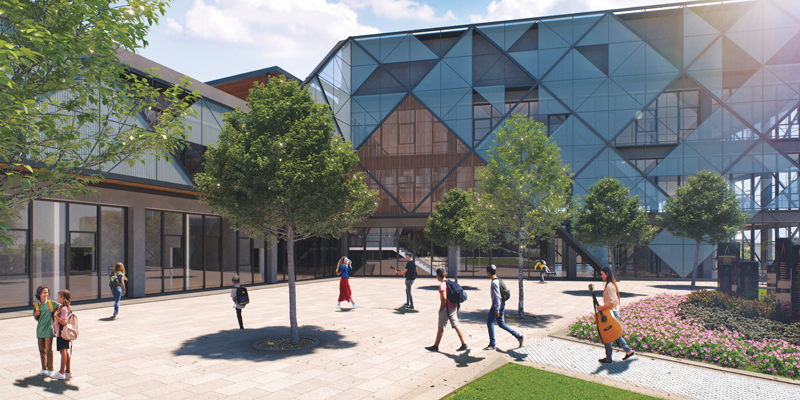
A diverse team of authorities, from professional architects to school administrators, was consulted to collectively envision how to maximize the space to the fullest. There would be bright and open learning spaces to inspire the mind, an on-site sports complex to nurture the body, and an innovation center to inspire new ways of thinking about—and solving—age-old challenges.
The high school building would educate more than 1,000 boys who would study in classrooms furnished with modular tables, desks, and chairs. The school would feature many open spaces, ideal for working collaboratively in small groups. “It’s a very dynamic place where you can move around and be proactive in your learning,” says Rav Yoni Berlin, one of the experienced educators who was tapped as a project consultant and who will serve as principal of the boys’ school.
AMIT’s signature Goyga pedagogy, developed in 2014 and increasingly transforming schools throughout Israel, would infuse the entire campus with forward-thinking educational practices and encourage new ways of learning. An athletic center would be open to the public after school hours, a symbiotic relationship for both the city and the student body. An open-air amphitheater seating 1,000, a memorial park for Israel’s fallen soldiers, and learning gardens round out this hub of educational life and innovative vision.
Overcoming Obstacles
This would be an ambitious plan anywhere, but especially so for Israel, where bureaucratic rigmarole is interwoven into everything from renewing one’s passport to standing in line at Ben Gurion. Over a period of 15 years, more than 100 people would become involved in this sprawling project.
The first hurdle to overcome was rezoning the land from public to residential status, which required the buy-in of the local municipality in Ra’anana, the Israel Land Authority, and various regional councils. Permits were approved and then put on hold, progress stalled and then restarted, and political regimes changed. Three different mayors of Ra’anana, for instance, would come and go during this time, each with his own personality and political priorities.
“There were a huge number of obstacles along the way, and it involved a lot of negotiations,” says Daniela Paz Erez, founder and CEO of Paz Economics and Engineering, one of the most influential real estate consulting firms in Israel. The AMIT team would take one step forward, and two steps back (welcome to Israel).
Daniela has been involved in this project for more than 13 years. “I recently celebrated my Bar Mitzvah,” she quips—but she has persevered because she knows the meaningful potential of a project at this scale. “This campus will educate the next generation,” she says. “As much as this is good for AMIT, it’s also good for the community.”
Another significant hurdle involved skirting the strictly defined laws around school-building and regulations on classroom size and structure. Part of AMIT Kfar Batya’s success hinges on its innovative open-air concept that encourages active and student-centered learning. While this kind of layout has become typical in the tech and entrepreneurial worlds, where open-space offices are preferred, it’s much less common in Israel’s more traditional educational system, where rigid mandates dictate the construction of classrooms and school buildings.
“Regulations require you to build a school with a certain number of classrooms that are a specific size and shape,” Debbie explains. “We had to convince them to take a chance on approving a more innovative structure that didn’t have the strict classroom spaces with the dimensions they’re accustomed to.”
A Payoff Worth Waiting For
Nevertheless, these key players in AMIT Kfar Batya’s existence persisted, embodying the tenacity of AMIT’s visionary forebearer.
“Sticking with [this project] was worth it,” says Debbie. “When you can see that you’re having a real impact on people’s lives, that’s transformative.”
When AMIT Kfar Batya welcomes its first cohort of students in fall 2025, it will be close to a century after Bessie Gotsfeld first bought the land on which the campus will proudly sit. While that arc will have come full circle, it is by no means a conclusion. Rather, it is a fitting chapter in the continuing story of Israel, AMIT, and the lives of countless young men and women across the country who will benefit from this major investment in their futures.