
6 AMIT Schools Win Coveted Education Excellence Prizes
by Debra Kirschenbaum
Stop by the colorful hallways of Yeshivat AMIT Amichai on any weekday, and you’ll be struck not just by the sound of laughter, but also by a palpable sense of optimism.
AMIT Amichai, a combined junior high and high school in the central Israeli city of Rehovot, combines academic excellence with a love of Torah. But to pupils, it’s more than just a school — it’s also a safety net for the entire student body.
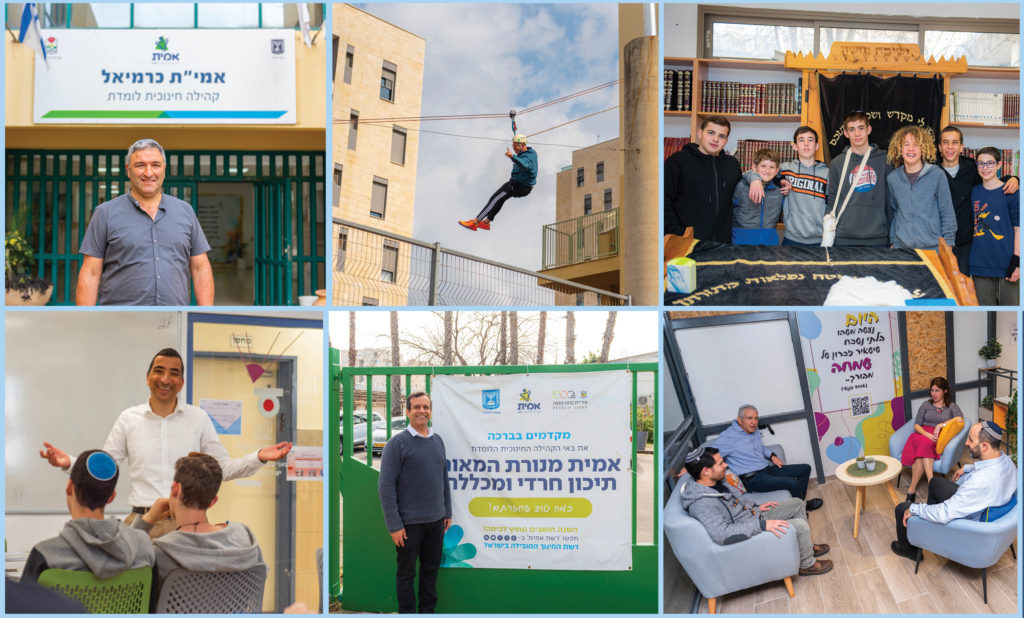
AMIT Amichai is among six AMIT schools that received Israel’s Ministry of Education Excellence Prizes. The prizes confirm what the students at each school already knew: The classroom can also serve as a community. The schools have each found a creative way to become a haven as students navigate adolescence, stress and the deeper challenges within Israeli society. Whether grappling with identity and exploration, facing terrorism or COVID-19 loneliness, the students at each of these schools know when they walk through the school door they are entering their second home. And that is the secret of their success.
It’s all rooted in the Jewish idea of kehilah (community).
“Jewish values are the beating heart through which our students are taught to constantly ask themselves what their place and purpose are in the world,” said Shimon Shushan, AMIT Amichai’s principal. Students come from a range of socioeconomic backgrounds and religious observances, and the school has a 97 percent (bagrut) matriculation rate — nearly 30 percent above the national average. “We strive to teach them that their contribution to the world and their community goes hand in hand with their contribution to their own success and academic growth,” Shushan said.
In the tiny city of Karmiel in Israel’s Galilee, 89 percent of AMIT Karmiel Junior and Senior High School students matriculate, many with high-level certificates in the key subjects of English and math. Principal Guy Dekel points to a holistic view of the student as the key to achieving educational excellence.
“We hold personal conversations to identify where students have difficulties. And we create a program in accordance, with a plan to bridge their gaps and help them progress,” he said.
At AMIT Sderot Religious Junior and Senior High School, the challenges are more readily apparent — the entire school is fortified against frequent rocket attacks from nearby Gaza. Many students are immigrants from Ethiopia and the former Soviet Union, but despite poverty, language gaps and the persistent threat of terrorism, matriculation rates are an impressive 98 percent. The reason, said Noa Epstein, a teacher and school coordinator, is a commitment to ensuring students don’t give up when faced with challenges, either academic or social.
“We put a maximum effort into giving our students all the keys that they might need in the future, to open all sorts of doors,” she said. The school has tracts for both religious and non-religious students with the same rigorous standards. This, too, serves as a motivator — universally high standards creates a rising tide that lifts all students.
At AMIT Menorat HaMaor in Petah Tikva, matriculation rates have climbed from 62.5 percent to 93 percent in just two years — with school leaders determined that its ultra-Orthodox students graduate fully prepared for professional success. Sixty percent of its students continue toward a computer engineering degree; the school has cracked the code on providing a well-rounded education that teaches Torah as well as technical skills. They do it by personalizing the education to meet the unique needs of each student.
“For each student, a personal plan is built according to his or her academic level,” said Principal Ilan Chamami.
Yeshivat AMIT Nachshon, near Beit Shemesh, is located in one of the fastest-growing areas of Israel. As the population swells, the student body has become increasingly diverse. In Israel, most schools are homogenous, but here the diversity is embraced. Sephardim, Ashkenazim, and immigrants from around the world all attend, as do students who are classified as youth-at-risk. They are integrated together with an emphasis on highlighting each other’s strengths.
And at AMIT Kfar Blatt Youth Village in Petah Tikva, students truly do come to see their school as a home. Many of the school’s 500 at-risk teenagers grew up often not even knowing where their next meal would come from. At Kfar Blatt, the teens are placed in family-like units with surrogate parents, where in addition to academic excellence, they are offered a chance for healthy physical and psychological development.
They live in residences for 16 to 18 girls or boys, along with a young couple and their own biological children. Here, they become part of a family, sometimes for the first time in their lives. Their days include chores and communal meals. That sense of security translates into success: over 95 percent of Kfar Blatt graduates continue to serve in the IDF or participate in National Service, a crucial step toward long-term employment.