
A Window to A World to Inspire Students
By Gloria Averbuch
Marcelle Machluf shares a background much like the majority of AMIT students. She grew up in Ashdod facing a trio of challenges—sexism and the economic and cultural challenges—of being from an immigrant family and living in the periphery. To the child who would one day attend Harvard for a post doc, her local librarian scoffed at her desire to borrow certain books. “You’re a girl, what are you going to learn?” the librarian told her. “Every part of life I had to struggle,” she told AMIT students. Yet she has gone on to dramatically defy the odds. Today, Professor Machluf is dean of Biotechnology and Food Engineering and head of the Lab for Cancer Drug Delivery & Cell Based Technologies at the Technion.
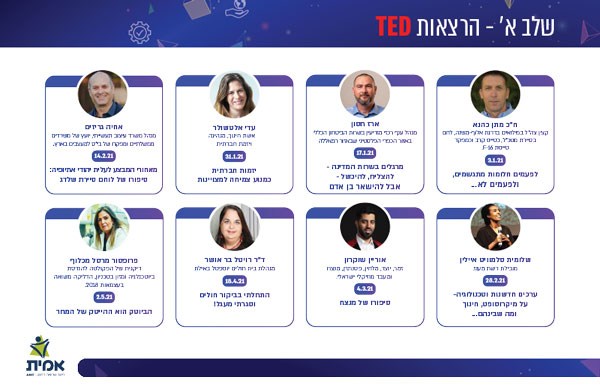
She was also a presenter in the new AMIT TED Talk program, where she passionately shared her life and work with impressionable AMIT students from all over Israel who marveled at her story.
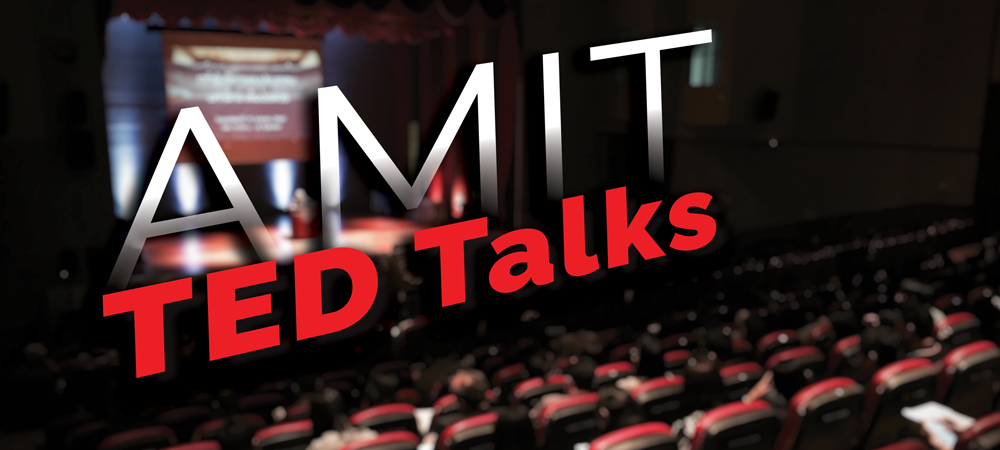
The AMIT TED Talk program, titled “A View of the Future From the World of Ted Talks,” was launched in fall of 2020; this pilot program will continue through June. The program reaches 700 female and male AMIT students from 11 varied schools throughout the country, with an emphasis on AMIT’s peripheral schools. The bi-weekly TED Talk speakers include leading figures in a wide array of industries—from scientists and social entrepreneurs to AI experts and hospital management.
What’s more, of the initial 12 elite speakers (six men and six women), half of them are AMIT alumni, including a senior adviser to Israel’s Economy and Welfare Ministry; a manager of electronic warfare for a major Israeli company; and a senior urban planner who serves as an adviser to municipalities and government offices.
TED Talks was created by AMIT’s Partnerships and Ecosystems Department and is overseen by Limor Friedman, department director, with help from Nechami Hollander, one of the organization’s coordinators, who worked hand-in-hand with Friedman to develop the program.
According to Friedman, the TED Talks intentionally reach students at a crucial age—the beginning of high school (7th and 8th grades) and is even more important for the 70 percent of AMIT students from the periphery. The goal, says Friedman, is to “give them as much exposure as possible to a world they would never otherwise encounter, and to open their minds and give them a vision and inspiration of what they might want in their future.” Following the weekly TED Talk, students engage in a structured reflection process in the classroom as part of their growth and learning process, exploring how the topic relates to them, their lives and their dreams. The program also contributes to potential partnerships with extraordinary professionals, those who can “ultimately help the students break the glass ceiling.”
When Friedman and her team reached out for TED Talk speakers, the strength of the response “caught me by surprise,” she says. She explains that despite being voluntary, “They were thrilled to be included. Their enthusiasm was genuine.” That sincerity is clearly evident. Among her many accolades, Machluf was one of the few distinguished Israeli citizens selected to light the torch for the 70th celebration of Israel Independence Day in 2018. She relayed through her TED Talk that what made her even more excited than lighting that torch was “to light for you (the students) a new world of dreams.”
Machluf’s personal story is one to which the students respond. Friedman is deliberate in creating a personal connection between the students and the speakers. She understands that more than even the topics of the talks are the speakers’ life stories of how they got to where they are. To that end, the first 15 minutes of each talk is dedicated to the speakers’ challenges and how they overcame them. In the case of Machluf, this meant relating the story of growing up an only child with her mother and grandmother and being told by the world around her what a girl couldn’t do—yet going on to become an innovative researcher whose findings have led to significant breakthroughs in cancer treatments.
 Why TED Talks?
TED (Technology, Entertainment, Design) Talks are powerful communication tools viewed at a rate of 1.5 million times a day. In addition, AMIT students benefit as they are an ideal education tool, particularly with the isolation and non-classroom learning during COVID-19. The AMIT Ted Talks are also “concise and entertaining,” explains Friedman. “They help open students’ minds and give them inspiration and an understanding of what profession they may want to pursue in the future.” She is also convinced of the role model effect of the TED Talk format. “For students who grow up in the periphery, having real-life interaction with these highly successful people is a game changer.”
TED Talks are a part of a larger effort of ongoing AMIT programs that are being launched by the Partnerships and Ecosystems team, created two years ago with the primary goal of breaking down the school boundaries and recognizing that learning takes place in a much broader community of education. This unique ecosystem, including partnerships with the local community, parent body, industry, businesses, military, academia and more, provides students with a tremendous amount of exposure to the real world and enables AMIT to better prepare students for the world of tomorrow. Partnerships such as those generated in the TED Talks allow for these critical connections and opportunities for the students.
There are also future plans for AMIT Ted Talks to activate and enhance the learning experience. Friedman describes a next stage: to hold workshops beginning in May for the students to learn how to share their own personal story and crystallize their dreams. This includes working on communication through body language, how to build a PowerPoint presentation and how to give a lecture, ultimately creating their own TED Talks. “It’s important to ensure that that student experience is holistic. After hearing from 12 inspirational speakers over the course of the program, it is critical to us that students be able to reflect, develop their own dreams and stand up in front of their peers and share in a group setting.”
The Reaction and Response
Of those involved, the school principals have been effusive in their praise of the TED Talks. “I believe that this will generate a change among many students—that the future will look different by virtue of the images they encountered in this journey,” says Eli Nisenholtz of AMIT Bar Ilan High School for Boys in Netanya.
Rabbi Shalom Malul of AMIT Ashdod Yeshiva High School explains, “As a school principal for the past 10 years, one of the hardest things of all to witness is adolescents without a direction, without a dream, without desire. The TED Talk program precisely addresses that problem,” he says, proclaiming it “Exciting. Enchanting. Empowering!”
Perhaps most significant is the enthusiasm of the students. They actively participated and wrote comments in a lively chat during Machluf’s talk. They asked questions about her research, and many expressed gratitude and awe in her accomplishments. Wrote student Leal Shoshan, “Your story is really exciting. In the beginning you asked (from a quote), ’The question is not who will give to me, the question is who will stop me.’ I will take that sentence from this lesson and also will take it with me for life.”