

By Helga Abraham
It is hard not to come away from a visit to AMIT Ramle Technological High School without a sense of tremendous admiration for the educational work being carried out there. Reflecting the city’s mixed ethnic and low socioeconomic background, the student population consists entirely of young people with multiple needs – emotional, psychological, financial, and physical. “We do not accept good students,” affirms principal Yizhar Afgan, “we only accept students with special needs or difficulties.”
For its caring, innovative approach the school was named co-recipient of this year’s National Religious Education Prize. “The award”, says principal Yizhar Afgan, “is an honor for the school, for AMIT and for the city of Ramle.”
 Afgan’s students may have been expelled from their previous schools, or may simply not have been able to cope with the conventional educational system. What they find at AMIT Ramle is a family environment, a 1:5 teacher-student ratio, personal attention, psychological, emotional, financial support, a range of vocational tracks, and an educational framework tailored to the individual abilities of each student. “If a student has difficulty with math, he does not have to study math,” says pedagogic coordinator Rivka Shmuel. “And if a student, for personal or family reasons, can only study two or three days a week, we allow it and we build a special program for this student.”
When Afgan took up the reins as principal in 2012, the school had 85 students; today it boasts an enrollment of 225 and a waiting list of young people eager to be accepted. Much of the success is due to the reforms introduced by Afgan and to his warm, humanistic approach to education. “My primary goal is to enable each student to fulfill himself, acquire a profession, and tools to succeed in the world. We prepare our students for life with love, faith, and Jewish values.”
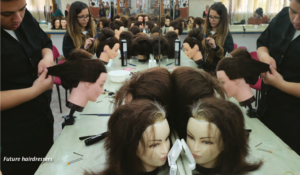
In addition to the existing business administration and electrical systems tracks, Afgan introduced two new courses into the vocational curriculum: a culinary arts track and a hair styling cosmetology track. He also expanded the electrical systems track by amalgamating it with a military cadet program, which prepares boys to enter the IDF’s logistics corps. “The program begins in the tenth grade and students have three years to learn all about the army,” says Afgan, who is proud of the fact that AMIT Ramle was the first religious high school in Israel to adopt the military cadet program. During the three-year program, the boys work closely with the army, participate in army activities, and wear an IDF uniform at school. As a result, enlistment by the students in the IDF has risen to a perfect 100%.
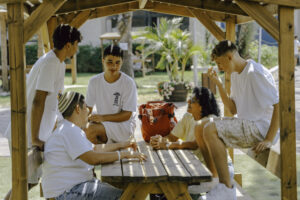
In the school’s pastoral grounds, we find twelfth grader Elior Amsalem, on his lunch-break, dressed in uniform. “I love this program,” he says. “We have an IDF commander with us all the time, we visit military bases and we learn a lot about the army.” A fellow student in the same track, 18-year-old Osher Katan, recounts that he always had difficulty learning in his previous schools. “All my teachers gave up on me,” he says with a smile, “but at AMIT Ramle, the staff tries to understand me, and my IDF commander calls me every day to make sure I get up and go to school. This is why I am now able to study and plan to become an electrical engineer.”
The track’s IDF commander, Nir Kashri, corroborates Osher’s comments. “Osher arrived here with many problems, but he has changed a lot. After he graduates, the IDF will send him to study for another two years. We give him 24/7 support.”
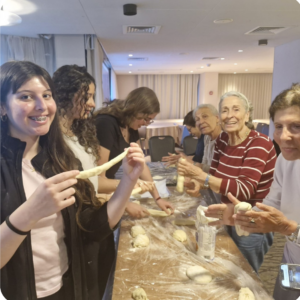
Afgan takes us next to visit the culinary arts track. As we enter the kitchen, he immediately orders the aspiring cooks to put on their chef’s toques. Having prepared a sumptuous array of pastries, the group is now learning how to decorate a birthday cake. For their final exam, the students will have to prepare ten dishes around one ingredient. Twelfth grader Aviel Sharvit chose lemon as his primary component. He has already made a difficult lemon tart based on French chef Jacques Genin’s recipe and will go on to prepare an English lemon cake, bread with lemon and poppy seeds, millefeuille with lemon cream, lemon macaroons…and more. “I love to cook,“ he says smiling, “and I want to become a chef.”
We next meet Nava Alemneh, who is studying in the business administration track and plans to graduate with a full Bagrut. Nava was born in Ethiopia and comes from a family of eight children with a difficult socioeconomic background. Her father is handicapped, and her mother, a kindergarten teacher, is the sole breadwinner. “I chose to study at AMIT Ramle because I wanted to learn a profession in addition to acquiring a good high school certificate. Everyone here is very helpful. It is like a garden of Eden.”
Wheelchair-bound Nadir Hovav, also in the business administration track, exudes enthusiasm about the school. “I chose to study here because this is not just the best school in the city; it is a school that gives every student enormous attention and care. Here, for the first time in my life, I was able to go on a school trip [to the Dead Sea] because the staff took the time to organize everything I would need on the trip.”
“If there is a school that gives its soul, visits students’ homes, sees empty fridges, and does something about it, it is AMIT Ramle,” says veteran teacher Pnina Cohen.