
By Michele Chabin
Ra’anana, Israel – When Joseline Rotstein, a new immigrant from France, was contemplating her family’s move to Israel, her top priority was finding a community where her teens would flourish.
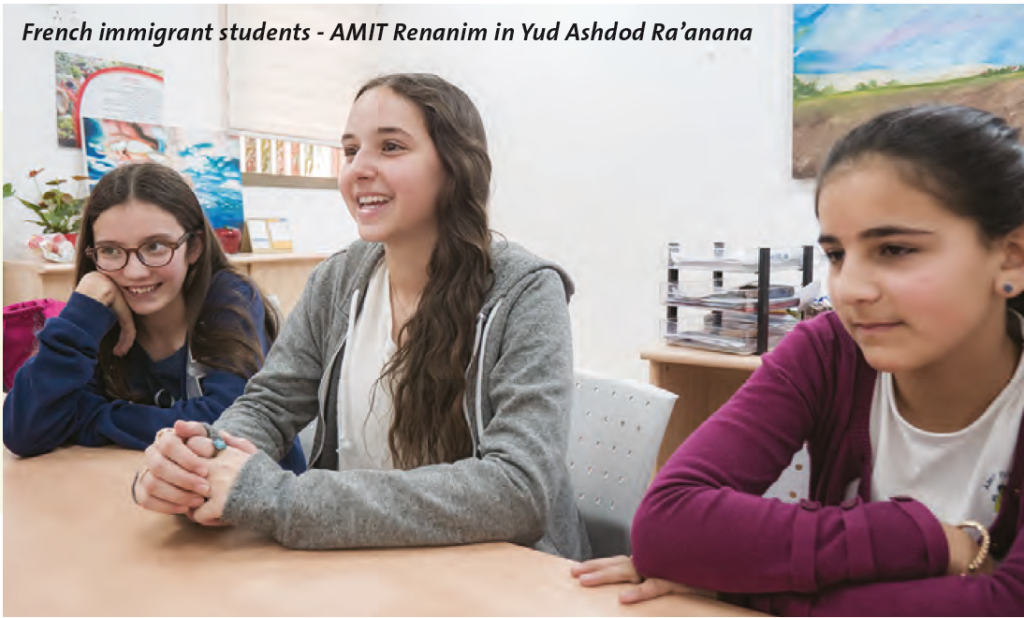
“We decided to move to Ra’anana because of the good schools,” Rotstein said, referring to the quiet suburb of Tel Aviv her family has called home for almost a year. “Everyone said AMIT Renanim Junior and Senior Science and Technology High School for Girls was the place for new immigrants, so that’s where I enrolled my daughter Yona.”
AMIT Renanim is one of three AMIT network middle/high schools that offer a comprehensive program geared specifically toward olim chadashim and the unique challenges facing them.
The programs are a lifeline for uprooted teens, most of whom know little or no Hebrew when they arrive in Israel. About 26,500 people, including 7,000 Jews from France, immigrated to Israel in 2014—a 10-year-high. More than 30,000 Jews made aliyah in 2015, including nearly 8,000 French immigrants.
Dr. Amnon Eldar, director-general of the AMIT network, noted that these French olim, who represent a growing pool of new immigrants due not only to the threat of anti-Semitism but strong Zionist values, tend to settle in Netanya, Ashdod, and Ra’anana.
 “From its establishment, AMIT’s values have always driven us to help immigrants. It’s part of our tradition,” Eldar said. “While scholastic achievement is important in its own right, the more successful children are in their social integration, the more it benefits the entire family. Successful aliyah also strengthens the state. Our attitude is to give each child what he or she needs, and that’s why our schools individualize programs to each child.”
AMIT Renanim’s program provides intensive academic support to immigrants from a variety of countries, with a large number from France. Of the 635 girls who attend AMIT Renanim, twenty percent are recent immigrants. Programs offered by AMIT Yud Ashdod High School and AMIT Bar Ilan in Netanya are also geared toward those with French-speaking backgrounds.
“Our goal is integration, but first the students need to learn Hebrew,” Ofra Pe’er, Renanim’s principal, said. “We work to strengthen their Israeli identity, but not at the expense of their existing identity.”
Newcomers fresh off the plane study in a special ulpan class that offers intensive Hebrew instruction as well as subject courses in easy Hebrew. When the students join regular classes, they still receive several hours a week of remedial instruction.
“Our program is very individualized,” Tzila Amosi, who heads AMIT Renanim’s immigrant program, said. “In addition to assessing the needs of every girl and providing the necessary support, we offer them social activities and programs.”
The school also organizes mother-daughter day trips for new olim, an experience that reinforces the awareness, for both the girls and their parents, that they are part of a community.
Sharon Tebul, 16, who made aliyah five years ago, said having the opportunity to study in the immigrant’s class has been a blessing.
“We more or less learn the same lessons as the regular classes but in easier Hebrew. It’s the difference between struggling, even possibly failing tests, and doing well and feeling good about myself.”
Joseline Rotstein said her daughter Yona, who is studying in the Renanim ulpan program, is blossoming. “Aliyah can’t succeed if your kids aren’t happy. She’s doing well in school, is very happy and she is making friends.”
Ashdod, Israel Almost one-quarter of the 724 students who attend the AMIT Yud Ashdod Junior and Senior High School in the southern coastal city of Ashdod are olim, 155 of them from France.
The school’s immigrant program is taught solely by veteran French or French-speaking Canadian immigrants “who know the challenges of making aliyah first hand,” said Ido Aharonovich, the school’s principal. Aharonovich noted that Jewish schools in France tend to focus on Judaic studies but teach almost no modern Hebrew.
“The level of Hebrew of French newcomers is very low, the principal said. “There are also gaps between the French and Israeli curricula, we work with them to bridge the gaps.”
The French immigrants’ Jewish identity is very strong, Aharonovich said. “It’s their Israeli identity we need to work on.”
Newly arrived middle-school students spend their first year in an intensive 20 hour-per-week ulpan program but are mainstreamed in regular after continued from page 9 French immigrant students – AMIT Bar Ilan in Netanya noon classes in the afternoon. Three times a week they receive remedial help to stay at grade level in math, English, and other subjects.
Thanks to a grant from AMIT, the school treats the olim to three-day-long field trips related to Israeli and Zionist history. Trips have included visits to Har Hertzl, Israel’s national cemetery, and the Latrun tank museum.
While the Ministry of Education and Ashdod municipality provide most of the funding, the AMIT network pays for the trip and many hours of additional learning, Aharonovich said.
In high school the olim are integrated into regular classes but study in an immigrants’ class when prepping for the many matriculation exams they are required to take. A whopping 98 percent of olim pass their exams, according to the school.
Realizing that successful immigration absorption is a struggle for the entire family, AMIT Ashdod also offers weekly hadracha—guidance sessions— to the new immigrants’ parents.
“Parents feel a big culture gap between what they had back home in France and what they encounter in Israel,” the principal said. In France there is much less independence and freedom due to societal norms and security concerns.”
Celine Chaya Abisdid, who heads AMIT Ashdod’s immigrant program, said the school offers help in four areas: educational, social, cultural and emotional.
“When a child feels like she is equal to others in her classroom, in the school, in the country, she will be more motivated and less marginalized. It’s vital that olim integrate, but they should not lose their culture in the process.”
Abisdid, 36, knows what it’s like to be a teenage olah chadasha. She emigrated from France when she was 18. Perhaps this is why students flock to her comfortable office so often and ask for her support and advice.
Given Ashdod’s proximity to Gaza, all new students, olim included, must learn where the bomb shelters are. Abisdid sends French-speaking parents updates and reassurances via the schools’ immigrant Whatsapp group.
“We’re on the front lines and we do rocket drills all the time,” Abisdid acknowledged. Eitan Srouchi, 16, from Marseilles, made aliyah nearly five years ago. “Before attending AMIT Yud Ashdod, I was in another school and received no extra help, even though the Ministry of Education requires a school to provide it to new olim. I was failing my tests. Here at AMIT I pass my tests, and I’m making friends.”
Srouchi said he is happy to be living in Israel, despite the challenges.
“In France, I was afraid to wear a kippa. Here I can be who I am.”
Netanya, Israel Amram Abbou, a 13-year-old new immigrant studying at AMIT Bar Ilan in Netanya, south of Haifa, shares Eitan’s feelings.
“There are many terrorists in France and we were afraid. I’m happy to live in Israel now, where I can wear a kippah and tzizit,” said Abbou, who made aliyah in September.
The school, which has 400 students, one-quarter of them from France, offers an ulpan program for middle school boys from 8:00 am till 3:00 pm. As part of the ulpan, students study math, English, religious subjects, and sports partly in Hebrew, partly in French.
By the end of the school year, all ulpan students will be in regular classrooms but will continue to receive several hours of additional help every week. The olim also receives emotional, social, and cultural support throughout the years.
Rabbi Yuval Elimelech, the school’s principal, acknowledged that olim absorption has required a learning curve.
“Last year we were less successful. I thought that our main goal was to turn them into Israelis, and that was a mistake. We must honor them as they are and protect their culture.”
Benjamin Nabeth, 14, a new immigrant from France, said he is “very, very happy” to be living in Israel and studying at AMIT Bar Ilan Netanya.
“Classes are taught on a high level and the ulpan has been great. Being here in Israel was my family’s dream. Now it’s a reality.”