
AMIT Sderot Religious Junior and Senior High School are one of the first schools in Israel to implement an innovative cyber-program aimed at preparing the youth of Israel for the important tasks they will have to fulfill when they enter the army.
When all the other students have already left for the day, a group of ninth-grade girls makes their way to their school’s computer lab, where they will spend the next three hours attempting to master sophisticated computer language as part of a challenging new cyber-program. The building they study in is completely fortified against missile attacks – the walls and ceilings are reinforced with concrete and the windows shatterproof. This, after all, is Sderot, the southern Israeli city, which has been under constant rocket attack in recent years and took the brunt of the six-week-long war waged last year with Hamas.
 Arriving in Sderot, one is struck first by its pleasant tree-lined boulevards (its name, in fact, derives from the Hebrew word for boulevard) and then by the strange bus stops that resemble concrete slabs lining the streets. On closer inspection, one discovers that each “bus stop” is a mini-bomb-shelter with an internal security room in which to shelter during an attack. Separated by just 900 yards from Gaza, Sderot citizens barely receive a ten-second warning of an impending missile attack — hence the need for immediately accessible shelters. Today, every home in Sderot has been equipped with a security room, and every school and classroom has been made missile-proof. In the case of AMIT Sderot Religious Jr. and Sr. High School, the school premises have been entirely rebuilt.
Before all these defensive measures were implemented, the sense of vulnerability was enormous among students and staff. Yaakov Ben Shoshan, head of social programs, recalls an incident eight years ago when a kassam rocket landed directly in a classroom. “The room was entirely destroyed,” he recounts, “but fortunately the attack took place in the morning when the students were in synagogue taking part in the shacharit prayer service, and no one was hurt.” Ben Shoshan’s son was one of those students. But even today, despite the strengthened security, living in a state of war is still hard to handle, particularly for young people. Principal Motti Arbel recalls how last summer a twelfth-grader was caught in an attack as she was on her way to school to take her bagrut (matriculation) exams. “The girl arrived in a state of hysteria and could not stop crying. It took me 40 minutes to calm her down.”
During the long summer war of 2014, AMIT students spent their vacation volunteering in daycare facilities, old age homes, and cultural centers. When the academic year resumed in September 2014, Arbel gave them the entire month off, arranging trips and outside-school activities to compensate for the lost summer holiday and get them to a place of normalcy. AMIT Sderot is the only religious high school in the city, and its 500 students are divided into a Ulpana for girls and a yeshiva high school for boys. In the past few years, 100% of the boys and 40% of the girls have entered the army. The remaining students serve in Sherut Leumi (National Service).
The school’s new Cyber Program is an initiative of the IDF. Acutely aware of the growing importance of cyber-defense and the need for cyber-specialists in the army, the IDF recently inaugurated two programs to train senior-level high school students in cyber-skills, Gvahim (Heights), a program for high school students in the center of the country and Magshimim (Realizing Dreams) for students in the periphery. In Sderot, Magshimim – a three-year program for grades 10-12 students – is taught at Sapir College and requires students to pass a stringent entrance examination. Last year, eight AMIT Sderot students took the exam. Unfortunately, not one passed. This year, the students will have a better chance. They are now learning basic cyber-skills in a new preparatory program for ninth-graders, also initiated by the IDF, called Nitzanei Magshimim (Magshimim Buds).
Arbel, who himself served in intelligence during his military service, was a moving force in introducing the program to AMIT Sderot. “I feel that our students have the ability to succeed in every domain, and the fact that they live in Sderot and are on the front line gives them added motivation and strength.” To emphasize the importance accorded today by the IDF to cyber defense, he quotes an intelligence chief as saying that “cyber-warfare is going to have a greater impact in the future than nuclear warfare.” Surprisingly, intelligence-gathering units are considered even more important today than elite combat units.
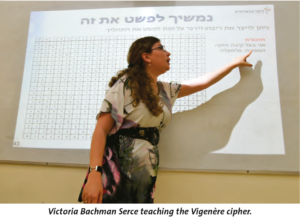
At AMIT Sderot, eight girls and six boys study in the Nitzanei Magshimim program. In the session I attended, Victoria Bachman Serce was teaching the intricacies of cryptography to the girls’ group. Every session in the program is divided into two parts: (a) the students first learn about a specific subject associated with information technology, and (b) they study basic programming and javascript. In the course of the year, they have learned about DNS (domain name service), social networks, cloud computing, GPS, and animation. After cryptography, they will grapple with artificial intelligence.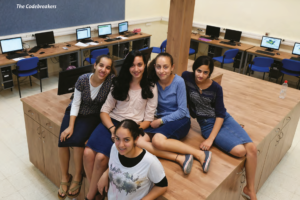
As an introduction to the complex subject of cryptography, Victoria described its long history, explained the various cryptographic methods, and showed the students a clip from the film “The Imitation Game” (which recounts the story of how British intelligence broke the German Enigma code in WWII). “Cryptography is important,” she told them, “because it is the basis of all cyber-security systems and cyber-warfare.” She then gave the students a six-line paragraph, each line written in a different code. Fourteen-year-old Na’ama Ben David succeeded in decrypting three lines in six minutes, incredibly fast for an adult, let alone a ninth-grader. Na’ama said that she chose to take part in the cyber-program “because it represents the future and enables her to understand the language of computers.”
In the second part of the session, the students learned about While and For Loops, programming languages that are used for repeating simple computer operations. Ninth-grader Koral Khouri says that she found computers and computing very difficult at first. “I would often get frustrated and despair,” she recalls, “but then I realized that there is a solution to every problem; and now I approach the subject with more confidence.”
Hadas Trabelsi admits she too found the course difficult but is happy with the proficiency she has acquired. She shows me with pride in an animation drawing, which she created for a recent assignment. Hadas Elezra, for her part, says she likes the practical side of cyber and proceeds to explain to me how an intricate GPS system works. As the girls lean over a computer screen, Victoria emphasizes that the cyber-course also has a social aspect. “Working with computers is usually solitary, but here we encourage girls to work together and solve problems together.”
Asked if the fact of living in a war zone has added greater meaning to their studies, Hadas Elezra answers that “knowledge is strength” while Na’ama Ben David notes that “without the Iron Dome defense system there would have been many more fatalities in the last war.”
A keen proponent of cyber, Principal Arbel is very satisfied with the progress of the girls. “Even if they do not go onto the more advanced course,” he says, “they have acquired knowledge for life, and they now have a greater understanding of programming, the Internet and the cyber-world in general.”