
By Michele Chabin
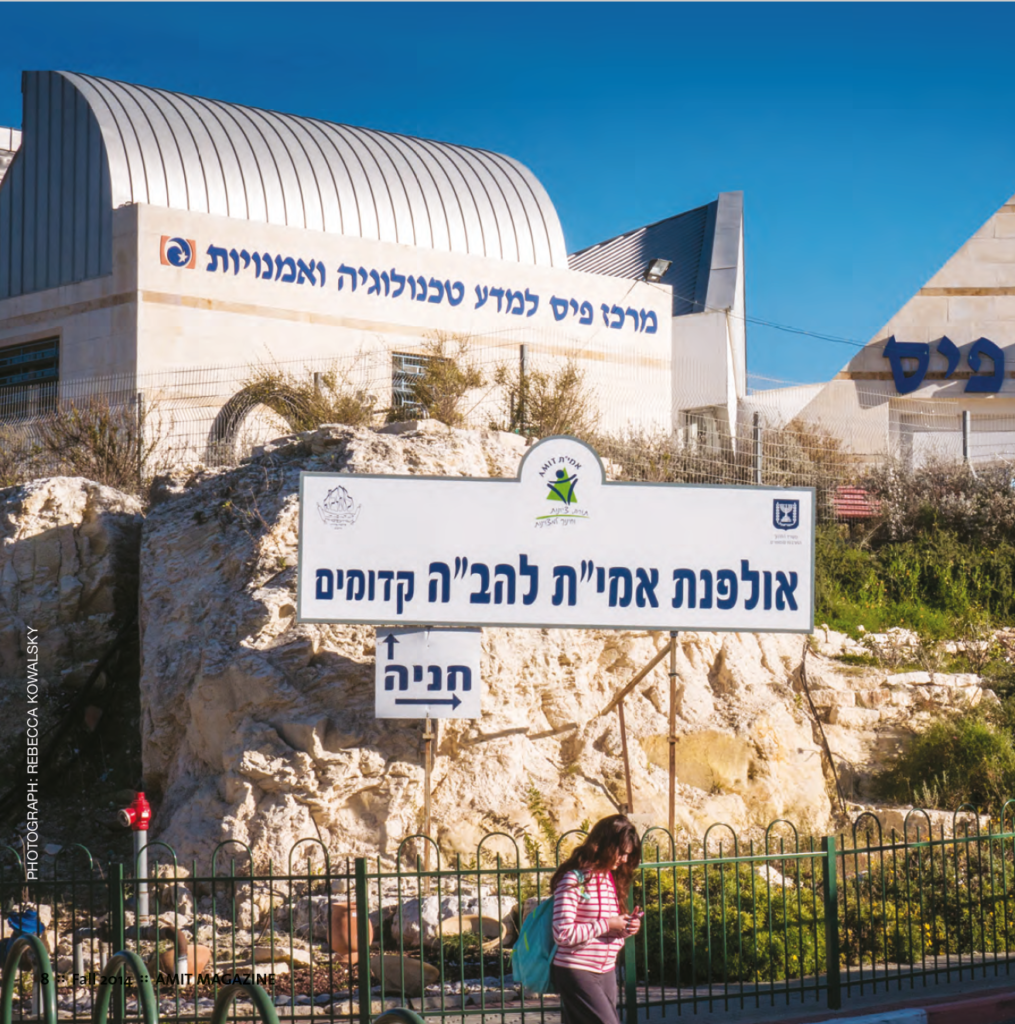
Kedumim – A couple of years ago, when Einat Vallach, principal of the Lehava Ulpana, a regional religious girls’ middle school and high school in this West Bank settlement, began searching for an educational partner that would help bring her school to an even higher level, she received a call from the AMIT network.
 Dr. Amnon Eldar, director-general of AMIT stated, “We knew the Ulpana was looking to join a network and we approached them because it is an excellent school, and also because it is very important for us to be an inclusive network, and we realized we didn’t have any schools in Judea and Shomron.”
“We have public schools, modern Orthodox schools, and two haredi schools in our network, so this was another step toward inclusiveness,” Eldar said.
After a series of in-depth meetings, Vallach understood that she and AMIT’s leadership had the same goal: to help students reach their potential and strengthen Israeli society within a framework of academic excellence, Jewish values, and Zionist ideals.
“Schools in Israel and elsewhere are becoming more professional, and it became clear to us that in order to grow educationally we needed to forge a connection with other schools and people,” Vallach said in her office on AMIT Lehava’s sprawling campus, which serves 900 religious 7th to 12th graders from more than a dozen settlements.
Vallach said Lehava joined the network last summer because “AMIT is all about professionalism and educational research and development and mentoring. The school is already seeing the benefits, and I believe the network is benefiting as well because we have a lot to offer. We are a very good, strong school educationally and ideologically.
The 30-year-old Ulpana has a strong history of academic achievement and innovation. Many of its students receive high grades on matriculation exams, and its robotics students compete in national competitions. The school’s beautiful library, with its many computer stations and 20,000 books, including hundreds in English, would be the envy of many schools in Israel. Its science center is filled with gadgets that make the study of science fun, and its boarding school is a home away from home for nearly 100 of its students.
Even so, Vallach, who herself attended AMIT Lehava, felt she and the school’s 150 teachers could do even better, pedagogically and administratively, and needed the kind of boost that only AMIT, with its vast expertise and resources, could offer.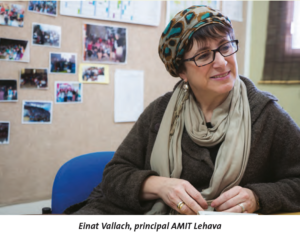
Thanks to the network, every AMIT Lehava classroom now has a computerized overhead projector system that has transformed the way teachers deliver their lessons, and students now have access to their own photocopy machines, located in the hallway. Students who want to photocopy a text or share class notes can now do so within minutes.
Like other AMIT schools, AMIT Lehava now has a large-screen wall monitor near the school’s entrance where the staff post announcements, and the school rabbi, Rav Yoni Lavi, posts questions posed by students. On a day when the municipality had to shut down the water for repairs, the question on the message board asked: “If there is no water to wash our hands before eating bread, can we eat the bread, and if so, should we say the regular motzei prayer?” The answer: “It’s possible to eat the bread, but hold it with a bag so it doesn’t touch your hands.”
Vallach is proud of the fact that the Ulpana is one of the 13 schools AMIT has included in a program for schools “identified as having very high potential for educational growth.”
Every week 15 to 20 of the Ulpana’s teachers meet on the campus with an educational consultant sent by AMIT to examine and identify the best pedagogical innovations to serve the school’’s diverse student body. Once a month the teachers attend educational workshops, along with instructors from other AMIT schools, at the Kfar Batya innovation center for teachers in Ra’anana.
Being a regional school, Lehava must accept students from all socio-economic backgrounds and academic abilities.
 “We accept every child who wishes to study here,” said Frimet Kampler, a 12th-grade teacher who has taught at the Ulpana for 25 years. “This diversity is one of the school’s biggest strengths.”
That diversity plays out everywhere on campus, where average students, academically gifted students, students with learning disabilities (there are one to two special classes per grade), and new immigrants, most of them housed in Lehava’s dormitory, all receive an education tailored to their needs.
“This is no 9 to 5 operation – 24/7 is more like it,” Kampler said with a smile.
Although most of the students go home at the end of the school day, nearly 100 girls – most of the new or veteran immigrants from Ethiopia, but also 15 Israeli-born girls not of Ethiopian descent – live in Ulpana’s dormitory.
While some of the boarding school students, who hail from all over Israel, come from dysfunctional families that cannot properly provide for their children, many others enroll in the program solely because their friends or siblings recommend it.
Eighteen of the boarders, new immigrants from Ethiopia, are in a special easy Hebrew class that is helping them master Hebrew quickly and integrate into Israeli society by living with and studying alongside native Israelis. Some of the newer immigrants, and all of the veteran immigrants, attend regular classes.
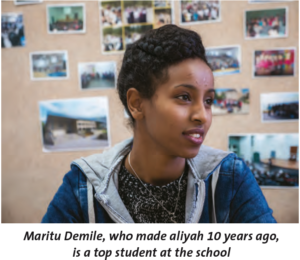
Marito Dalmi, an 18-year-old senior who hopes to become a doctor, is one of the Ulpana’s stars students.
Dalmi, who made aliyah with her family a decade ago, decided to live in the dorms because her older sister, who had done the same, “told me how good it is here. I love the activities, the girls, the evening classes. We get together for Shabbatot and do volunteer work.
Like the vast majority of other Lehava seniors, Dalmi, who will perform National Service when she graduates, recalled a recent lecture the school offered titled, Honing Interview Skills.
“We learned how to sit, how to dress and how to respond to questions, and how to interact during group interviews with a lot of other applicants. It was a good introduction to the real world.”
Dr. Eldar said the Ulpana’s diversity is in keeping with the network’s philosophy of inclusion.
“We very much like that the Ulpana has students coming from such a variety of different homes in Yehuda and Shomron, as well as 60 Ethiopian girls at the boarding school. They are doing a great job at integration and we are giving the teachers the tools to further this goal.”
One of the school’s goals is to have 40 Israeli-born students living in the dorms next year along with the immigrant students, “something that will foster not only integration but friendships,” said Racheli Molad, director of the boarding program.
Livnat Barel, an Israeli-born student who moved to the campus dorm this year, said she did so because she wanted to have “a more serious, more meaningful year and heard that the students who live on campus help the new olim learn Hebrew and create friendships. It’s been great getting to know the new girls.”
Talia Shira Weiss, an American who moved to Israel with her family in 2013 and commutes to AMIT Lehava every day, said the school’s students and teachers have been overwhelmingly supportive.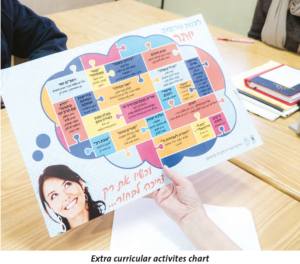
“I expected to be sort of an outcast, the only girl who speaks only English, but the atmosphere is so welcoming, and there are several girls whose parents are English speakers. They have definitely helped me to adjust. The moment I arrived at school everyone gave me a hug. I feel part of a community.”
Sad to say, though, members of the Ulpana community have suffered many tragic losses over the years due to wars and terror attacks.
Standing before a memorial wall where the photos of 30 terror victims – all close relatives of teachers, students, and support staff – are displayed, Vallach noted that “at least four of the teachers are widows. One of our students was in the middle of her matriculation exam when we got word that her brother had been killed.”
The principal emphasized that terror attacks and the pain they cause are not limited to the settlements.
“Unfortunately, there have been terror attacks all over the country. We are not alone or special. Not long ago there was a war in Gaza and now there is tension on the northern border. During the war in Gaza we didn’t hear a single air raid siren here in the Shomron.”
Vallach admitted that “it has been difficult at times, but not more difficult than elsewhere.” An optimist by nature, Vallach said she and AMIT Lehava’s teachers feel like gardeners. “We give our students love and in the end, it is what is inside a student that emerges.” The Ulpana’s partnership with AMIT, she said, is helping the garden grow. “Since joining AMIT, I’ve received so much help and feedback. Now I have people to brainstorm with on how to improve our school. I’m not alone.”