

When a war is raging in Israel, like the one we saw this summer, the stakes are very high. Everyone is on alert…and so many get the call. A recorded message informs you that your life is about to change immeasurably—no information other than a meeting point. Your unit has been called up, and you are expected to appear within a few hours. That was the reality this summer for many AMIT teachers whose civilian lives are dedicated to educating and nurturing the next generation of Israelis. One might think that would be service enough!
We sat down with four teachers from the AMIT Kfar Ganim School in Petach Tikva, to gain some insight into what the life of a “normal” AMIT teacher was like this summer. The men interviewed ranged in age from 27 to 36. For some, this is their third war experience, having served in the Second Lebanon War while still in regular army service, and Operation Pillar of Defense. We asked them to tell us about what it was like to be called up.
Amir Cohen teaches 12th Grade:
“When I received my army call-up I was under the chuppa at a wedding of one of our graduates. While I was making the blessings I received a phone call. I was instructed to report to the army. We knew that we were at a critical time, that we were about to be called up, but I thought that I would be able to celebrate this student’s wedding properly. I stayed another half an hour at the wedding, but then I had to go, and I was sent to the north to replace a Golani brigade, brigade 13. I was there for a month. It was very difficult for my wife at home.”
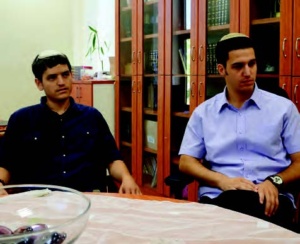 Nitzan Berger teaches 11th Grade:
“We had worked until late on Thursday night getting the house ready for Shabbat. I have a three-week-old daughter. We had no prior warning, but we knew that once troops started going into Gaza that we would also be called up, because of the role of my unit in the reserves. My wife and children took me to a school in Petach Tikva, where my reservists from my unit boarded a bus for the south. I said goodbye. I didn’t know how long I would be away. The bus took us to base 1, and after a few training exercises, we went into Gaza. I am part of a support unit called the infantry brigade. Specifically, we are experts at firing mortars. We follow behind the troops that are fighting and leading the way, and they direct us. If they see a terrorist or a target they point us in that direction and we shoot. That is the task that we did.”
Netanel Strauss, homeroom teacher:
“My wife hands me the phone as I’m about to bathe my daughter. I’m telling her, “Just one minute, I have to finish bathing and dressing my daughter.” I had been called up. We were in shock. They say to you, “Drop everything and come now, not 24 hours, now.” You don’t know what to do. They are tearing me away from my life. What shall I take? Where shall I go? What are we doing? It took me a few seconds to work out what was going on. Within a few hours, I was in my uniform at the meeting point. We replaced regular soldiers in the south of the Jordan River Valley, north of the Dead Sea. We patrolled the Dead Sea area, security for the residents nearby, security of Highway 90, through the Jordan River Valley. This was our task for 31 days.”
Baruch Gurtzweil, homeroom teacher:
whose call came while he was learning at the Yeshivat Hesder, where he spends his vacation: “At 5:00 in the afternoon I received a recorded call. I didn’t know if it was real, or practice, or what. I’m not used to this. I also called my officer, who confirmed that it is serious and for real. I came home. My wife was in her ninth month; she was due a week later. This is very complicated. She objected. She wanted me to stay home. I told her that when it is an emergency call-up to the army the first thing is to show up, and then I’ll explain things, and it would all work out. I went to the meeting point. I was sure that when I explained the situation— that she is expecting within a week— that the army would send me back home. At the base, we were told that we would not be replacing other units but were going to Gaza. As soon as I heard that we were going south, I told my wife to pack and take our children and go south to her mother—so when she gave birth I would be closer to her. She was preparing for birth, and I was in Gaza preparing for war. Our mazal was that my unit was doing five days in Gaza then out for a few days rest. It worked out that those five days rest coincided with the birth of my son. I was able to be there on that day. The following day I went back to the front. Our mazal continued. Two days before the brit milah, I was out of Gaza again. I was able to be at my son’s brit milah. A few days later, I was back in Gaza.”
Eli Edri, a former principal in Sderot, is now support director for AMIT schools in the south. He is an officer with the Home Front Command: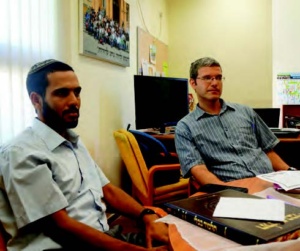
“My role as an officer in the Pikud Haoref is to assist the population in times of war or national emergency. Each day during the war, I gave an overall assessment of the situation as it pertains to the general population. The assessment is based on phone calls we receive from civilians—I analyze why they called. Was it because they could not locate a bomb shelter, fear, they didn’t hear the siren, they want to leave the city, their home has been hit. I take this information. We want civilians to be able to continue life as normal as possible. It is our task to maintain resiliency.”
“We are concerned about the soldiers going into Gaza and coming out. My command center is located on the road to Gaza. We are the coordination between the army and nearby cities and towns. We give the municipality a picture of what is going on. The civilians within the country are the frontline. The army is inside Gaza, but the missiles are being shot into the country. We have to give an assessment to the municipality about what will happen.”
Edri’s team had the difficult task of trying to help guarantee people’s safety during a funeral for a local boy—even while the rockets were flying around them:
“At the very end of the second funeral, there was a siren. Everyone had to lie down on the ground, on the graves. There are no bomb shelters in a cemetery. We have to tell them to shorten the service. That is difficult. How can you tell a family to shorten the funeral of their son? It is very difficult.”
And in typical Israeli fashion, Edri shared the lighter side of some of the requests.
“There was some kind of problem with the Iron Dome, and civilians wanted to have the Iron Dome placed next to their house. Lots of funny things like that. There were helicopters in the air all the time. People were calling to ask them to move. I am in the army—do you think I can ask a helicopter to move?”