
By Rabbi Kenneth Brander
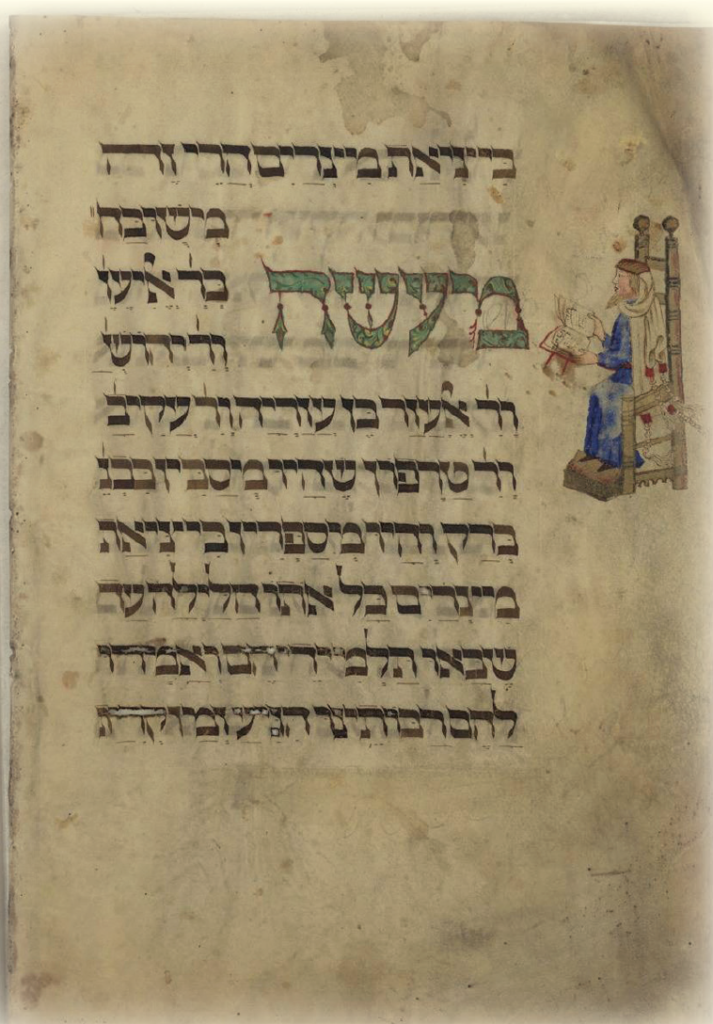
While there are several accounts of rabbinic Passover Seder gatherings, the most famous of these is the one recorded in our Haggadah: the Seder of Rabbi Eliezer, Rabbi Yehoshua, Rabbi Elazar, the son of Azarya, Rabbi Akiva and Rabbi Tarfon. They were reclining at the Seder service in B’nei Brak, and had spent the whole night telling the story of the Exodus from Egypt, until their pupils came and said to them: ‘Our masters, it is time to recite the morning Shema!
This account appears in the Haggadot of Geonim, such as R. Amram Gaon, and the Haggadot of Rishonim, including that of the Rambam (Hilchot Chametz u’Matza Nusach Haggadah), Tosafot, (Ketubot 105a, s.v. de-chashiv) and the Ritva.
Several questions arise when analyzing this account:
Rabbi Akiva is one of the younger members of the rabbinic cohort present at the gathering, while Rabbi Eliezer and Rabbi Yehoshua are elder members. Rabbi Elazar the son of Azarya is the Nasi (president of the high court and of the rabbinic community). Why does the Seder take place in Rabbi Akiva’s home in the town of B’nei Brak and not in a city where one of the more prominent members of the group resides? Most times, the student is expected to visit the teacher.
 In addition, why do these particular Tannaim sit together around the Seder table? Do they represent something unique or is this a random grouping of rabbinic figures?
To answer these questions, we must first note that the Passover Haggadah is divided into two parts: the pre-meal section of the Haggadah, where we recite Maggid and consume ritual foodstuff, and the post-meal section of the Haggadah. The premeal section of the Haggadah focuses on the Jewish people’s servitude in, and eventual redemption from, Egypt. The postmeal section of the Haggadah focuses on the future redemption and destiny of our people and society.
The Talmud states (Pesachim 116b) that we bifurcate the recitation of Hallel accordingly. In the Maggid section of the Haggadah, we recite the first two psalms of Hallel. This is due to the fact that these psalms focus on the Egyptian saga. The third psalm and the remaining psalms of Hallel are recited in the post-meal section of the Haggadah – they focus on the Messianic era (Pesachim 118a).
This division prompts disagreement between two of the rabbinic participants at the Passover Seder we read about in our Haggadah, Rabbi Akiva, and Rabbi Tarfon. Rabbi Tarfon contends (Pesachim 116b) that the concluding blessing for Maggid should focus solely on the theme expressed in Maggid and the pre-meal section of the Haggadah, namely the redemption from Egypt. His version of this blessing reads, “Blessed are you Lord our G-D Who has redeemed us and redeemed our fathers from Egypt.”
Rabbi Akiva disagrees. He refuses to allow this blessing to focus only on the redemption of the past. He insists that the blessing of Maggid also contain language that focuses on the future: ”likewise O Lord our G-D, G-D of our fathers, enable us to celebrate many other festivals and holy days which will come peacefully upon us; joyful in the rebuilding of Your city, and exalting in Your service… Blessed are thou our G-D who has redeemed Israel.” (ibid.)
Rabbi Akiva’s focus is fixed on the future redemption, even in the most difficult and trying of times. It is not coincidental that these rabbinic figures gather around Rabbi Akiva’s Seder table. They are individuals influenced by the weltanschauung (a particular philosophy or view of life) of Rabbi Akiva, someone who has the courage to be an optimist and to focus on the future even in the darkest of moments. Even when there is a bounty on his head by the Romans, even when he is martyred and the future of his people seems bleak, Rabbi Akiva knows that it is tenacity of spirit that guarantees the immortality of our people. They realize that it is Rabbi Akiva’s charismatic spirit that enables hope and paves the Jewish nation’s path towards the morning Kriyat Shema – a credo with G-D that is recited when there is clarity when one can discern between the colors of covenantal tapestry, the blue and white fringes of the tallit (B’rachot 9b).
It is the ability to discuss redemption, during the Bar Kochba revolt, that enables students to live and thrive in the phenomenological framework of the morning, a time at which the Jewish nation can be a people of destiny instead of a people of fate. It is in B’nei Brak the city of Rabbi Akiva, that such a Passover Seder must take place.
As we sit down to the Passover Seder, the Haggadah asks us to embrace the courage of Rabbi Akiva and for it to inspire our personal and communal experience. Like Rabbi Akiva we as individuals, families, and community members must not spend our time being paralyzed by the darkness in our personal lives or the challenges we face as a community. Rather we must engage in lifestyles that search for the morning star, dispelling darkness by adding light, ensuring that we try to live lives engaged in personal redemption and connecting to communal organizations that ensure the eternality of our people.
Rabbi Kenneth Brander is Yeshiva University Vice President for University and Community Life and David Mitzner Dean of the Center for the Jewish Future. He is Rabbi Emeritus of the Boca Raton Synagogue, and founding dean of the Weinbaum Yeshiva High School in Boca Raton.