
By Alexandra Halpern
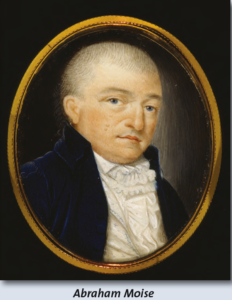
When Abraham Moise was a young man, he sailed from France to the West Indies, where he became a trader and a merchant. There, he met a beautiful woman 26 years his junior, a native who lived in an affluent Jewish community. They married and established themselves on a small plantation in San Domingo in what is now Haiti. Soon, the slaves in San Domingo began to revolt, and violence broke out against the French aristocrats. The colony began to collapse, and the Moise family was forced to leave their possessions and sail to America. Abraham and Sarah Moise arrived in Charleston in 1791 – one of the oldest Jewish communities in America. Charleston was a natural port, and its location attracted merchants and traders from all over the world. At the time, there were 53 families in the congregation at Kahal Kadosh Beth Elohim, and the sizable Jewish community convinced Moise to stay. The family lived in a house on Queen Street, in the heart of the peninsular city, and sold cloth and tea from their home.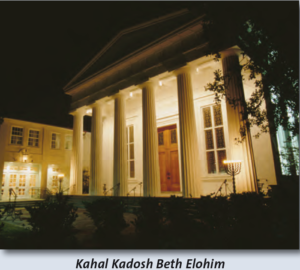
Two and a half centuries later, Anita Moise Rosenberg is a member of the same congregation her ancestors joined when they first arrived in the city. Mrs. Rosenberg is the ninth generation to attend services at Kahal Kadosh Beth Elohim, the oldest synagogue in continuous use in the United States. She can trace her Moise family history all the way back to Luis DeTorres, who sailed on the Santa Maria with Columbus and was the first Jew to set foot on American soil.
Carolina Colony’s charter, written by John Locke in 1669, granted freedom of religion explicitly for “Jews, Heathens and other Dissenters from the purity of the Christian religion.” According to Mrs. Rosenberg, who serves as vice president of Kahal Kadosh Beth Elohim, this notion of religious freedom wasn’t typical for conservative England at the time, but the proprietors of the Carolina Colony “wanted people to prosper, so they did everything they could to ensure peace and harmony among the people who were brave enough to settle.” Dale Rosengarten, in her comprehensive book, A Portion of the People, about Charleston’s Jewish history writes, “It was a business decision…they were looking for settlers who would be strong economic contributors.” In 1697, Simon Valentine became the first documented Jewish landowner, and therefore the first to have the right to vote. “This was the first place in the world Jews could own land and pay taxes and settle peacefully with non-Jewish neighbors,” says Anita Rosenberg.
This equality is exemplified through Moses Lindo, who brought the indigo trade to Charleston. He was a lucrative businessman and one of the few Jews to own a ship that brought Africans to America. Like many Jews, Lindo was a slave owner. According to A Portion of the People, “Carolina was the first political entity to treat Jews as equals, but it was also the only colony on the American mainland whose charter sanctioned racial slavery…Jews indeed were equal – to other white people.”
Mostly a Sephardic community, many families, like the Moises, came from the Caribbean, Amsterdam or London – their ancestors having been cast out of Spain during the Inquisition. By the 17th century, there were enough families to create a minyan, which they held in various homes each week. In 1749, the first congregation was established, and still remains today in its exact location on Hasell Street in the heart of downtown Charleston.
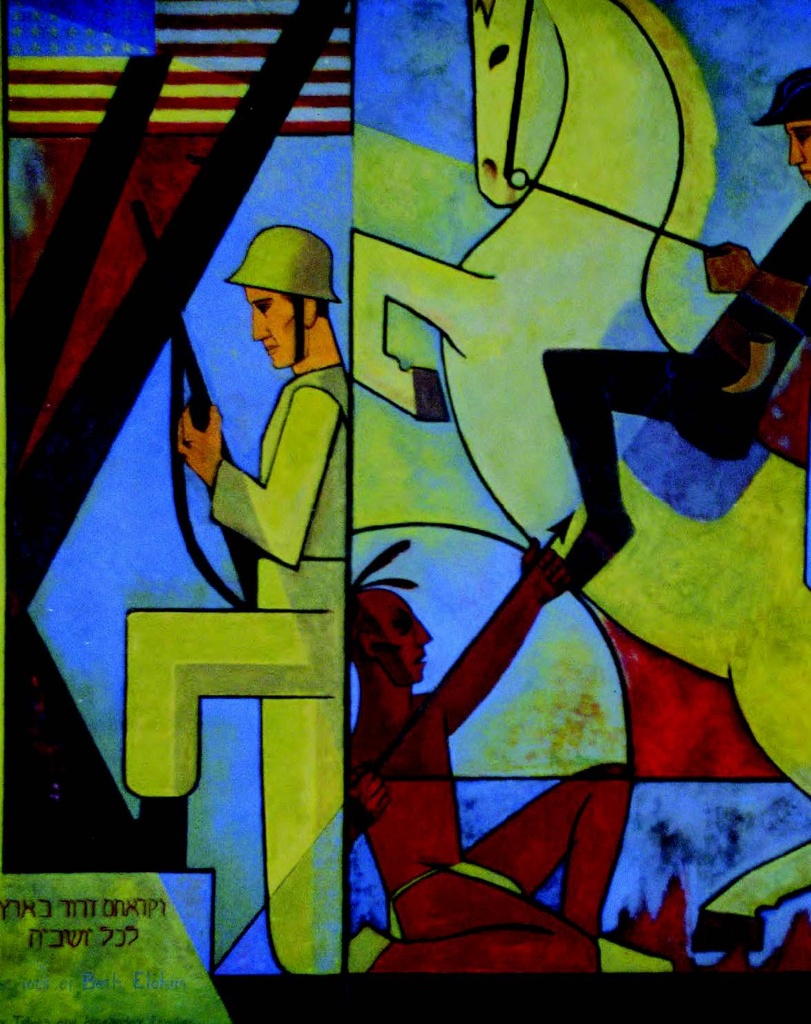
Kahal Kadosh Beth Elohim began as a Sephardic Orthodox community, whose congregants fought in every American war. Francis Salvador, the first Jew to die in the American Revolution, was also the first Jew in the western world to be elected to public office as a member of the South Carolina General Assembly and the first and second Provincial Congresses. Judah P. Benjamin, a Jewish American politician and lawyer, as well as plantation and slave-owner from Charlestown, was Confederate President Jefferson Davis’ secretary of state, and right-hand man.
 The story of this incredibly pivotal community in America’s Jewish history can be traced through its Jewish cemetery. The Coming Street Cemetery is the oldest and largest Colonial Jewish cemetery in America. It is surrounded by a pre-revolutionary brick wall, and though the structure needs wooden support beams in several places, the wall continues to separate the graveyard from what is now the residential area around it. The cemetery was sold to Kahal Kadosh Beth Elohim in 1764. The oldest known grave in the lot is that of Moses Cohen, who died in 1762. Cohen was the first religious leader of Beth Elohim, and he is joined by six rabbis and eighteen past presidents of the congregation. The cemetery is hidden from view from the street, and is eerily quiet for its location on busy Coming Street, surrounded by homes rented to mostly college students.
Ghosts supposedly haunt Charleston and its old buildings downtown, but whether you believe in ghosts or not, the cemetery is packed with the graves of veterans of every American war and almost three centuries of American Jewish history. Among the buried is Dr. Columbus Devega, who designed and served as surgeon on his famous floating hospital. During the Civil War, while stationed on the boat in Charleston Harbor, he was known for treating both Union and Confederate soldiers. Nearby is the grave of Joshua Lazarus, president of Charleston’s Gas Light Company from 1840 to 1856, who is credited with bringing gas light to Charleston. Penina Moise, daughter of Abraham and Sarah Moise, lays not far away. She was America’s first female Jewish published poet and hymnist. As the superintendent of the nation’s second religious school, her book of hymns was used by the congregation for years.
As you weave in and out between the many gravestones, you can see twelve veterans of the American revolution, twenty-three Civil War veterans (eight of whom died for the Confederate cause), six soldiers of the War of 1812 and two who fought in the Seminole Wars in Florida.
The long list of important players in Charleston’s history buried in this cemetery is no accident; because of the religious freedom awarded in the charter of the Carolina Colony, the Jewish community “worked very hard to make a success of their lives and be a part of the community. They were important players in the growth of the colony and economy, and influenced the people,” said Anita Rosenberg. Since the colony had given them religious freedom, they wanted to give something back.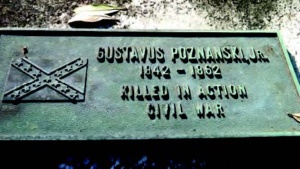
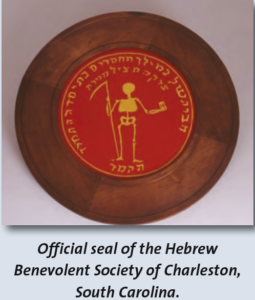
This desire to give back to the community was made apparent by the philanthropic societies that the Jewish community oversaw. Established in 1784, The Hebrew Benevolent Society was the first of its kind in the country. The society’s preamble states that “The object of this society is Benevolence. In that one emphatic, grateful word are comprehended all the tender offices of Charity.” According to Anita Rosenberg, the society was “a group of people who settled, and wanted to pay back the community for welcoming them.” This society is still in operation today, and it’s not the only one. The Hebrew Orphan Society of Charleston, established in 1801, had the mission to educate, clothe and support poor Jewish children and orphans. What is today’s Kahal Kadosh Beth Elohim Sisterhood began in 1838 as the Society for the Instruction of Hebrew Doctrine, organized to teach the congregants’ children about Judaism and Jewish heritage. In 1844, this group expanded to help women contribute to the community, and was called the Hebrew Ladies Sewing Circle-the the first organized Sisterhood in America.
 Charleston, whose modern Jewish population is dwarfed by metropolitan areas like New York, Philadelphia and Los Angeles, had the largest and wealthiest Jewish community during colonial times. Aside from building and maintaining the oldest synagogue still in use today, Charleston’s Jewish community was the first to introduce Reform Judaism to America. This may come as a surprise to those who know Charleston for its steeple covered skyline or South Carolina for its reputation in the Bible Belt. “Our kinfolk blinked in disbelief when I told them that two hundred years ago Charleston was the cultural capital of Jewish America,” writes Dale Rosengarten. While it’s not the bustling Jewish capital that it once was, the current community is thriving on more than just its historical significance. Today, there are four congregations (conservative, two orthodox and reform), and a population of about 12,000 Jews. Jewish students have the option to attend Addlestone Hebrew Academy, a day school that begins at 18 months and ends at 8th grade. Students at the College of Charleston can major in Jewish Studies, and their Jewish Studies Center features a comprehensive Jewish Heritage Collection. There is an active JCC, Federation and lots of programming to keep the community happy. All that, and an influx of people who fall in love with Charleston and opt to move and call the city home. According to Randi Serrins, a docent at Kahal Kadosh Beth Elohim, about half of the current congregation are from off, a term used to describe Jews who were not born in Charleston.
In 1806, Myer Moses, a member of the legislature and one of the first commissioners of education, gave a speech to the Hebrew Orphan Society of Charleston in which he stated, “Collect together thy long scattered people, and let their gathering place be in this land of milk and honey.” And so it was – the land of milk and honey was found in Charleston, South Carolina.
Alexandra Halpern is a native of Charleston, South Carolina. Her essays about travel have been published in various outlets, including National Geographic and Abroad View. She works as both a freelance writer and in international education. She has traveled extensively around the world, working odd jobs such as a farmer in the Pacific Islands, a librarian in Indonesia, and a microfinance advocate in Kenya, among others. She currently proudly calls Charleston home.