
By: Michele Chabin
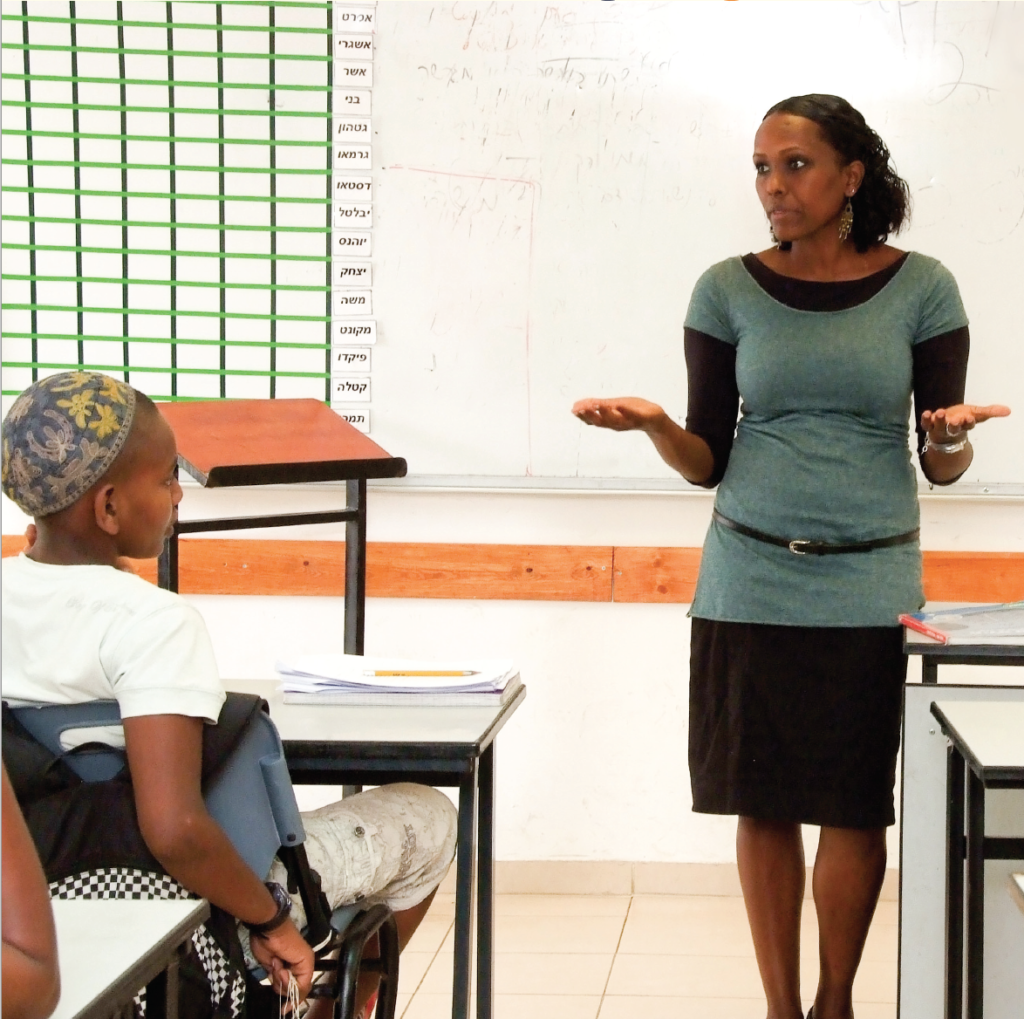
Petach Tikva, Israel – “Why do we celebrate Yom Yerushalyim?” — Jerusalem Day — Daniella Malasa asked the 18 sixth-grade boys seated in pairs in her classroom at the AMIT Yeshiva Kfar Ganim in Petach Tikva.
While a few hands flew up in response, other students shouted out the answer. They recalled how, in 1967, Israeli troops captured the eastern part of the city, including the Old City, from Jordan, and discussed how Israelis celebrate the milestone today.
Malasa, an animated homeroom teacher with a no-nonsense attitude that belies her youth, would have preferred to call on one student at a time, but she didn’t scold the kids for their impulsiveness. This time, at least, she welcomed their unbridled enthusiasm.
Until September 2011, the boys were enrolled in Petach Tikva’s Ner Etzion Elementary School, a staterun modern Orthodox school whose entire student body was of Ethiopian descent. Educationally segregated from other Israeli children because most of the other Orthodox schools in the area refused to accept them, and because white parents refused to send their kids to Ner Etzion, the students were educationally crippled and socially isolated.
In September 2011, Ner Etzion was suddenly shuttered following demands from the Ethiopian community to end this segregation. The Ministry of Education scrambled to find new schools for the children. Upon learning that it was proving especially difficult to place the sixth-grade boys, the AMIT education network offered to accept the entire class and to enroll the students in AMIT Yeshiva Kfar Ganim in Petach Tikva.
Since then, the students in Ms. Malasa’s sixth- grade class (the only one in the school; Kfar Ganim runs from seventh to twelfth grade and has 600 students) have received a first-rate AMIT education with a great deal of remedial help and enrichment from staff, neighborhood volunteers and students at the school and AMIT Yeshivat Hesder of Petach Tikva (a new addition to the network) that shares the campus.
Rabbi Shai Piron, principal of Kfar Ganim, said bringing the entire class to Kfar Ganim was a moral and religious imperative, and part of a longstanding AMIT tradition to reach out to children from underserved communities.
Daniel Uoria, an Ethiopian community activist, said that 16 segregated schools still operate in Israel, and that the situation hurts not only the children but society as a whole. “If we don’t help the children advance and reach their potential today,” Uoria warned, “they won’t be contributing members of society in the future. There is a huge amount of racism in Israel and the Ethiopian community can’t fight it alone.”
Uoria had nothing but praise for Rabbi Piron and AMIT, which he called true partners. “I thank them for their partnership and their complete faith in the children.”
That the boys arrived at Kfar Ganim with deficits came as no surprise, given the overall educational level of the nation’s Ethiopian children, Rabbi Piron said. Ethiopian students routinely do poorly in math, reading and science compared to both “average” Israeli children and children from poor families.
Even more worrying, educators say, is that the gaps that begin in first grade, partly because Ethiopian families often cannot afford pre-school, continue to widen until the eighth grade.
That was the case for Malasa’s students, many of whom immigrated to Israel when they were little more than toddlers. Their parents, who knew very little Hebrew when they arrived, could not speak to them in Hebrew, so the children entered first grade at a real disadvantage.
Ordinarily, immigrant children quickly make up the gap as they interact with native speakers and receive remedial help. That’s exactly what happens when other Ethiopian children have attended AMIT schools around the country – the first were admitted in the 1950s — where they are integrated with their Sabra counterparts. In the segregated schools, where many of the children arrive unprepared for first grade, “everyone flounders,” Uoria said. “Those schools are ghettos.”
The boys enrolled at AMIT are making up for lost time, their teacher said. “They arrived here at a lower level than most of their Israeli counterparts.” Malasa admitted that “They had difficulty sitting still and some of the students were aggressive. I was exhausted after the first 25 minutes!”
To create order, establish boundaries and remind the students exactly what was expected of them, Malasa designed a large chart that hangs just left of the board. Categories include attendance, arriving at school on time, bringing the required books and completing homework assignments.
Those with the most points during any given day, week or month are rewarded with anything from a cafeteria snack voucher to coveted tickets to a soccer game.
“What the students needed most were clear, strict boundaries and to know that people at AMIT really care about them. That if they didn’t come to school, someone would take notice,” Malasa said.
Malasa, who was born in Ethiopia and moved to Israel as a child, notices other things as well. For example, whether a child is wearing the same clothes, day in and day out, even if they are clean. “That is an indication that, financially, things may be difficult at home,” the teacher said. “That’s one of the reasons I make home visits. The other is to meet the parents and discuss their child’s progress” in the language they best understand.
The home visits are vital, Malasa said, because they provide a window into the challenges the child faces. “Sometimes we learn that there are so many children in a cramped apartment that the child doesn’t have his own bed, or a place to study or hang his clothes, or even the clothes themselves. If there’s a need, we try to address it.”
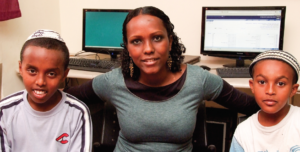
What makes the boys most happy is the day-to-day interaction they have with their schoolmates, including the AMIT Yeshiva Kfar Ganim’s upperclassmen. Everyone has a ‘big brother,’ an older boy who provides friendship and mentoring.
Despite their obvious progress, Piron emphasized, “They still are at the beginning of a long road that will take years. But I believe they will succeed if we do it together.”
Amnon Eldar, director general of the AMIT Network, believes AMIT is extremely qualified for this work, given that it has taught more than 1,000 students of Ethiopian descent in the past decade alone.
“In Kiryat Malachi, in Karmiel, in Sderot, we have helped the children earn a full Bagrut [the matriculation exams required to attend university],” Eldar said, referring to municipalities with large numbers of Ethiopians.
The 18 boys studying at Kfar Ganim “are receiving extra help, and not just in math and Hebrew. We’re engaging them in social activities, boosting their self-confidence and motivation,” Eldar said. Toward this end, AMIT has asked graduates of Ethiopian descent to speak before the class. “We’ve brought in army officers, university students, graduates, and professionals. These are the role models our students need to look up to.”
The message that everyone can succeed if he or she gets a quality education and works hard has not been lost on the sixth-graders, who said they feel the difference between their old school and AMIT Kfar Ganim.
“I feel we’re learning more here and we’re succeeding,” said 12-year-old Moshe, a boy with an infectious grin. “I like Hebrew best because we hear stories, some of them about Ethiopia.”
Moshe said it’s been great getting to know the “Israeli” kids at the school – as if he sees himself as not quite Israeli, and separate from other Israeli children. Malasa hopes this feeling will change over time.
Next year, all the boys will be integrated into seventh-grade classes at AMIT schools, the vast majority of them at Kfar Ganim. And, Malasa will continue to be on hand to help them find their way.
“My dream for them is that they will be able to stand proudly on their own two feet,” Malasa said, as the boys, happy and boisterous, returned to the classroom.
Michele Chabin began her career editing women’s magazines in New York. In 1987 she moved to Israel, and has been a reporter there ever since. An award winning journalist, Michele frequently contributes to the New York Jewish Week, Religion News Service, USA Today and many other publications.