
By Micha’el Tanchum
“A people is not reborn in a single day,” remarked a young Rahel Yanait Ben-Zvi with determining sobriety. The idealistic, 23-year old woman who had arrived in the Land of Israel barely a year earlier in 1908 could have been speaking about her own astonishing life and career which would unfold over the course of the next seven decades. She was a member of Israel’s founding generation, a collection of brave and visionary men and women who connected their moral beliefs to political action. Because of the profound sense of purpose, she found in the cause of Jewish national revival, Rahel Ben-Zvi realized her own potential and helped countless young women (and young men) realize theirs.
Rahel Yanait left her home in Russia and joined a special generation of young pioneers that became known as the Second Aliyah. Among her contemporaries were David Ben- Gurion and Yitzhak Ben-Zvi, whom she eventually married. Uncertain of what she would find when she arrived, Rahel Yanait Ben-Zvi was driven by her commitment, personal as well as political, to work for the restoration of the sovereign nation of Israel in its ancestral homeland. Of her first experiences traveling in the land with her fellow pioneer and future husband, she writes, “[We] hiked widely across the Judean mountains and desert. We went up to the Galilee, down to the Negev, roaming about for weeks in the desolate expanses, sleeping in the fields, and filling our lungs with the air of the homeland … envisioning and dreaming about the future of our nation in the homeland. We prayed in our hearts that we would be entitled to revive it by working and protecting it.”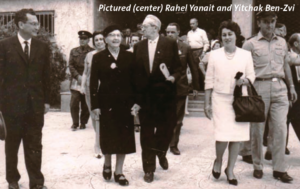
Rahel Ben-Zvi and her companions came of age during the era of social revolution in early twentieth-century Eastern Europe, but they were inspired by a two-thousand-year-old dream. “We were imbued with the revolutionary spirit then sweeping Russian Jewish youth,” Ben-Zvi explained in her autobiography, “but ours was an original concept – our own revolution in our own land.” These pioneers’ national vision for a new society was based on the ideals of the Prophets of Israel and the ethics of the Jewish tradition. “Was it not the echoing voices of the prophets which had brought us back to the Land?” observed Rahel Ben- Zvi, “They had kept our people alive in exile, guided them in their wanderings and beat in the hearts of Israel’s sons throughout the long, dark years. This was the spirit that now awakened us.”
Rahel Ben-Zvi knew that the realization of the pioneers’ collective vision of national revival depended on the personal development of each individual. “None of us really was satisfied with things as they were,” recalled Rahel Ben-Zvi. “Plunged in talk and thought, we were eager for deeds. And the true deed, the redeeming deed, was labor on the soil, the touch of the earth.” One of the first tasks for Israel’s founding generation was to make the barren land bloom – to reclaim the land and to restore the Jewish people to productive work on it. After examining the fledgling Jewish farms in the Galilee, Ben-Zvi decided to study modern agricultural science to contribute to the vital task. Her determination took her all the way to France to earn a degree in agricultural engineering. Adjusting to the new circumstances, she stayed true to her vision. “I was absorbed and intent on my work. Yet I never stopped seeing the bald, rocky hills of Judea in my mind’s eye…I watered the tender shoots in those forest-tree nurseries near Paris as if they were plants on the Jerusalem hillsides.”
 The outbreak of World War I prompted Rahel Ben-Zvi to return to Israel, then under Ottoman control. While the Ottoman Empire’s entrance into the war on the side of the Central Powers against Britain and France created a new geostrategic reality for the Zionist movement, the situation for the Jewish communities living in the Land of Israel became even more dangerous. In 1909 Rahel Ben-Zvi had been one of the founding members of HaShomer, the first Jewish self-defense organization in the land of Israel. During WWI, while applying the knowledge she had gained in France to the farms around Zikhron Ya’akov, she resumed her activities with HaShomer and recruited Jewish pioneers to fight under the British army in the Jewish Legion. Both to inspire others and to muster her own courage, Rahel Ben- Zvi drew on examples of Jewish heroism from the Bible to Bar-Kochba. She had adopted the name Yanait, identifying with the Israelite king and grand-nephew of Judah Maccabee.
When WWI ended and a triumphant Britain replaced the defeated Ottomans as the rulers in the land, Yitzhak Ben-Zvi returned to Israel from his service with the Jewish Legion and the pioneering couple married. In 1922, the League of Nations conferred its mandate to Britain to rule over the territory. However, the British Mandate did not bring peace to the Jewish community. When it became clear that the British would not confront marauding Arab gangs which were attacking Jewish communities, Rahel Ben-Zvi helped to found the Haganah. The pre-state Haganah was the first Jewish army since the time of Maccabees and the woman who bore the name of the Maccabean king served as one of its heads in Jerusalem.
Rahel Ben-Zvi knew that ultimately Israel’s best defense was an educated and capable population. She worked unceasingly throughout her life as an educator and counselor, providing young people with the skills and the values to contribute to the building of Israel’s future and their own. She played a central role in establishing the Hebrew Gymnasium – the first modern, Hebrew high school in Jerusalem. She was dedicated to the cause of high quality, Hebrew instruction to educate the youth of the nation’s capital.
Rahel Ben-Zvi combined her expertise in agriculture with her dedication to education. She founded the first tree nursery in Jerusalem providing instruction for pioneer women in the techniques of reforestation. With profound confidence in the ability of women to positively shape Israel’s future, Ben-Zvi mobilized working women in Israel in 1928 to establish the Meshek ha-Po’alot – the Working Women’s Farm, a training facility in the Talpiot section of Jerusalem. Immediately after the War of Independence, Ben-Zvi founded the agricultural youth village at Ein Kerem to absorb immigrant youth. The farmer turned the teacher knew that the education of Israel’s youth would produce the most fruitful harvest.
Like her contemporary Rahel Ben- Zvi, Bessie Gotsfeld’s impressive achievements place her among the ranks of the outstanding haluzot (pioneering women) whose efforts contributed significantly to the development of Israeli society and culture. Gotsfeld was the driving force behind the formation of the Mizrachi Women of America (MWOA), known today as AMIT. A woman of purpose inspired by the Zionist vision, Gotsfeld declared, “It is only as a nation living in our land that we can understand our predecessors who labored and fought, suffered and sang and prophesied in the same land.” Translating her passion into action, she immigrated to the land of Israel with her husband in the late 1920s to assume the role of on-site supervisor for the building of the Beit Zeirot Mizrachi, a vocational school for poor girls. A pioneer also as one of the first powerful career women within Israeli Orthodox society, Gotsfeld was also a pioneer in the establishment of a series of schools and children’s villages. Just as Rahel Ben- Zvi converted the Meshek ha-Po’alot in Jerusalem into an agricultural school for young adult refugees escaping Nazi persecution, Gotsfeld similarly founded the Motza Children’s Home – a haven for children who escaped Eastern Europe via Teheran and the Mosad Aliyah Children’s Village for Holocaust refugees in Petach Tikva.
Following Israel’s independence, Rahel Ben-Zvi and Bessie Gotsfeld continued to work assiduously for the welfare of Israel and the Jewish people. Always sensitive to the human element, they were tireless in their efforts to provide Jews from all backgrounds, especially the young, with the skills and the values essential to building Israel’s future and their own. AMIT’s crucial work is carrying on the pioneering spirit that founded the modern State of Israel. As Rahel Ben-Zvi knew, “A people is not reborn in a single day.” With the help of AMIT, the rebirth and flourishing of the people of Israel occur a little more every single day.
Dr. Micha’el Moshe Tanchum is a scholar of Zionist thought and the history of Israel’s founding period. He earned his doctorate at Harvard University and is a fellow at the Shalem Center in Jerusalem, where he is writing a book on the ideals of Israel’s leading founding father, David Ben Gurion. Dr. Tanchum would like to express his gratitude to Amy Gabriel, and especially to Malka Klein, for their assistance.