
By Michele Chabin
PETACH TIKVA, Israel – Long before Ariel Horowitz, now 21, graduated from high school he knew he wanted to serve in the Israeli army and study Torah. So Horowitz began looking into hesder yeshivas – post-high school programs that enable religious students to serve their country and, when they’re not in the army, to engage in full-time Torah study.
While there are several hesder yeshivas in Israel to choose from, Horowitz, the Israeli-born son of immigrants from the U.S., didn’t want to live in an isolated place, removed from everyday life. “I couldn’t study in a yeshiva where the rosh yeshiva and students are disconnected from the world. There are places situated on a hill somewhere, but they weren’t for me,” Horowitz said.
With this in mind, the young man applied to the Yeshivat Hesder of Petach Tikva, which was founded 13 years ago by Rabbi Yuval Cherlow and other rabbis who believed that the Orthodox world and Israeli society have a great deal to learn from each other. At the beginning of 2012, Yeshivat Hesder Petach Tivka joined the AMIT education network. It is only the fifth post-high school program to be so honored.
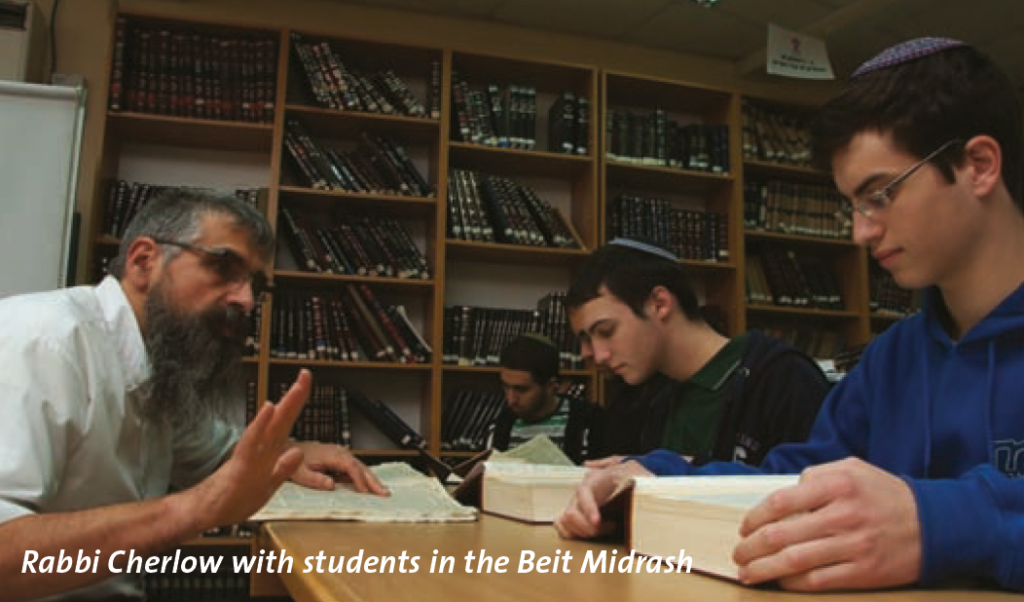
 Seated in the yeshiva’s Beit Midrash (study hall), which, on a chilly winter day was filled with floor-to-ceiling bookcases, desks and casually-dressed students learning in small groups, Horowitz – who recently completed his army service – said he “definitely” chose to learn at the right hesder yeshiva.
“This is a very special, open-minded place of learning. a place where we’re encouraged to ask questions and develop ideas,” Horowitz said, making himself heard in the noisy Beit Midrash. The yeshiva, Horowitz said, “is an outgrowth of Rav Cherlow’s moral vision. He’s very involved in what happens to the country and educates us to be involved in what’s happening and not to be silent.”
A graduate of Yeshiva Har Etzion and a retired major in the Israel Defense Forces, Rabbi Cherlow is a man of words and action. He leads by example, infusing his students with the belief that they can change the world for the better. He is one of the founders of the Tzohar Foundation, a modern Orthodox foundation that works to build bridges between the religious and secular worlds.
A member of governmental ethical committees and the Presidential Press Council of Israel, Rabbi Cherlow often lectures on halacha and its stand on such controversial issues as surrogate motherhood and civil marriage – issues Israeli society is currently struggling with.
In his top-floor office, Rabbi Cherlow, who is the Rosh Yeshiva, said his longtime experience serving on AMIT’s Spiritual Leadership Committee prompted him to join the organization’s network. The partnership will provide a pool of potential students, Cherlow said, and, thanks to AMIT’s centralized system of administration, will enable the yeshiva to devote “almost 100 percent” of its resources to educating students.
The partnership is a good match in other ways, Rabbi Cherlow emphasized. “My ideology is exactly AMIT’s ideology. AMIT represents responsibility to the Jewish People. It gives opportunities to every child to be Jewish, to have at least a traditional Jewish education, and to have the skills to succeed in life. It strives to contribute to society and the entire State of Israel.”
Students at the hesder yeshiva personify AMIT’s vision: They study Torah intensively for two years before entering the army for a minimum of 16 months (many serve longer). Once their service is completed, they study for another two years. Those who remain for the sixth and seventh years can earn a degree in education.
“We see ourselves as religious Zionists,” Rabbi Cherlow said as he entered the Beit Midrash, where the students stood and greeted him warmly before settling down for a study session. “We’re very strict with our observance of the Torah and at the same time accepting of the democratic system and the law. Serving in the army is the definition of religious Zionism, and we make no apologies,” he said, referring to those who believe Orthodox Jews should devote themselves solely to religious study and not serve in the military.
Although the Israeli government exempts full-time post-high school yeshiva students from military service, both AMIT and Rabbi Cherlow believe that all citizens should contribute to Israeli society, ideally through military service or National Service.
The fact that the yeshiva is in the heart of residential Petach Tikva, a city with religious, traditional and secular residents, is not a coincidence, Rabbi Cherlow said. “Being inclusive means first of all to live in the center of Israel, not an isolated hilltop. We invite yeshiva students with varying intellectual levels. Everyone is able and deserves the opportunity to study Torah.”
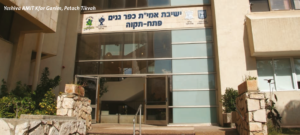
The hesder yeshiva’s students are reminded of AMIT’s commitment to inclusiveness the moment they enter the building, which it shares with Yeshivat AMIT Kfar Ganim High School and a program for more than 100 developmentally disabled children. There is also a new program for sixth-grade boys of Ethiopian descent that is designed to prepare them for secondary school. “Several of our students tutor the high school students, while some of our graduates now teach in the high school,” Rabbi Cherlow said, clearly proud of his students.
Rabbi Cherlow said his goal has always been to motivate his students to “connect their Torah studies with their careers,” regardless of which careers they choose. “I hope we are educating them and giving them the tools to serve as a bridge. We’re proud that some of our graduates are civil servants of the State of Israel and really bring the ideology and messages they got in the yeshiva to the public sphere.”
Dr. Amnon Eldar, director-general of the AMIT educational network, believes the hesder yeshiva’s inclusion in the network will strengthen the organization’s efforts to share its hashkafa, or outlook, in the classroom and beyond. AMIT’s hashkafa “believes in Klal Yisrael” and that the State of Israel “must be a Jewish and democratic state. And that there is no conflict between the two values,” Dr. Eldar insisted.
Dr. Eldar said welcoming Rabbi Cherlow’s yeshiva to the network was the “natural” thing to do. “Rabbi Cherlow has served on our Spiritual Leadership Committee for nine years. Furthermore, the fact that the Kfar Ganim middle/high school is in the same building as the hesder yeshiva “offers a unique opportunity,” Dr. Eldar said. ”The hesder students are role models and some of our students will come to learn in this yeshiva after high school.”
On a national level, Eldar hopes the Torah-driven yet open-minded hesder students will also act as role models during their IDF service and will share AMIT’s philosophy and values with soldiers who, for whatever reason, have negative feelings toward organized religion and religious people.
Like Rabbi Cherlow, Dr. Eldar would like the IDF and society as a whole to learn more about Torah Judaism and its values and to incorporate them into the decision-making process and in their everyday lives.
“We know that there are other hesder yeshivas with a different hashkafa,” Dr. Eldar said and mentioned nationalist yeshivas that instruct their students to refuse orders related to forcibly evacuating West Bank outposts or settlements. “AMIT is different.”
Rabbi Cherlow insists that the Torah is as relevant today as it was 3,000 years ago. “Torah should be at the center of the State of Israel, in all aspects of life. It’s about creating social justice. It’s about freedom of speech while recognizing the dangers of loshen hora (idle gossip). It’s about ethical issues that affect the entire society.”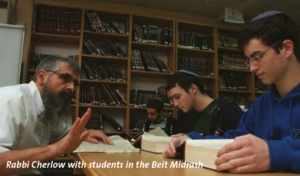
Rabbi Cherlow traces his inclusive value system to his “open-minded” parents, who immigrated to Israel from the U.S before he was born. His mother is still an active member of AMIT.
Growing up, he said, “we went to concerts and operas and all kinds of cultural events. I played piano and flute and read a lot of books.” It is this well-rounded approach to life, coupled with a deep knowledge of Jewish texts, that appeals to his students.
“He’s very out there. He talks about controversial things not many rabbis are comfortable talking about,” said Elihu Anouchi, a 20-year-old student from Cleveland, Ohio. Anouchi, who had planned to study in Israel just for a year, but who, after joining the yeshiva, decided to make aliyah, said his teachers encourage inquisitiveness. “I’ve learned that no topic is clear cut, and that I shouldn’t be afraid to discuss controversial things like genetics and controlling a baby’s gender.
“It’s exciting,” Anouchi said, “to be able to study things in the Talmud written more than 1,000 years ago that are still relevant today and that still contain the answers.”
Michele Chabin began her career editing women’s magazines in New York. In 1987 she moved to Israel, and has been a reporter there ever since. An award-winning journalist, Michele frequently contributes to the New York Jewish Week, Religion News Service, USA Today and many other publications.