

By Robert E. Sutton
Sicily is one of the most conquered places in history. Greeks, Romans, Vandals, and Ostrogoths helped sway, followed by the Byzantine empire, Muslims, Vikings, and Normans, the German Hohenstaufen and Capetian Angevin dynasties, and the kings of Aragon and Spain. And Jews have lived under all of them.
The First Jews arrived as Roman slaves during the second temple period. But the greatest Jewish influx took place in the decades immediately after 135, in the wake of the Romans expulsion of the Jews from Jerusalem, after Bar Kockba’s revolt. 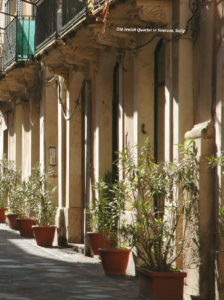
By the Middle Ages, Jewish Communities were flourishing throughout Sicily and were to be found in 52 towns across the island, including Palermo, Messina, Mazara, Taormina, Catania, Siracusa, Agrigento, and Agira, where they found work as cloth merchants, doctors, bankers, framers, tradesman, and goldsmiths. By the time of their expulsion in 1493 when the Spanish Inquisition reached the island, there are thought to have been as many as 30,000 Jews living in Sicily.
SIRACUSA
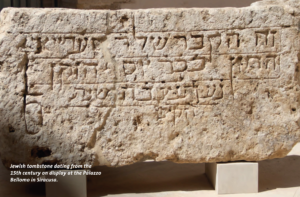
Siracusa had been a Roman city since 212 BCE when it was wrested from the Greeks, but its culture and principal language remained Greek throughout the Roman period. With the arrival of Jewish refugees, Aramaic was added to the linguistic mix. Many of the city’s Jews resided in their own neighborhood (Giudecca) on the island of Ortygia, the historical center of Siracusa, and for many centuries their own law governed their lives. The mikvah was part of it.
By definition, a mikvah is a ritual bath, used for purification. While observant men will sometimes use a mikvah before Shabbat and before Jewish holidays, it has always held special significance for Jewish women. Jewish law prescribes that women immerse themselves in the waters of the mikvah following their menstrual periods or after childbirth in order to become ritually pure.
Mikvahs are also used to make eating and cooking implement kosher when purchased from a Gentile. Conversions to Judaism require a dip in the mikvah, too. The mikvah is such an important part of Jewish tradition that a Jewish community is required to construct a mikvah before constructing a synagogue or even purchasing a Torah.
The Siracusa mikvah was unearthed in 1989 during restoration work on a medieval palazzo once owned by a Jewish family, the Bianchis. It is the oldest known mikvah to survive in Europe, dating from the Byzantine period following the fall of the
“western” Roman Empire, and features a total of five immersion pools. These include three triangular pools in the main chamber, where there is also a round pool that serves as a reservoir.
On each side of the main chamber is a small side chamber with square pools that were used by priests or other important individuals, almost exclusively male.
At the time of the Inquisition, most Jews left Sicily and pressed east toward the Ottoman Empire. Those who remained became Christians, anusim. It is believed that the Bianchi family that resided at that location during the sixteenth century were such anusim – crypto-Jews – (neofiti in Sicilian, marranos in Spain). It would seem that these converts, whatever their number, chose not to reveal the existence of the mikvah, possibly anticipating a return to Sicily and preserving the bath by covering it with dirt so that it would not be defiled by the hands of Christians.
PALERMO
Across the island, the thriving Jewish community in Palermo, Sicily’s other great metropolis, had by 1400 likely eclipsed that of Siracusa. Though the Jews of Palermo were certainly present from Roman times, it was only after the fall of the Western Empire, at the dawn of the Middle Ages, that the earliest records of them begin to emerge. They reveal that, in Sicily as elsewhere, the fate of the Jews was often determined by events shaped by the larger community among which they lived as a tiny minority.
In 598, for example, the Patriarch of Rome, known to history as Pope Gregory the Great, had sent a delegation to Panormus, as Palermo was then known, to resolve a dispute involving the city’s Jews. Local Christian priests, it seems, were trying to convert Jews and had confiscated one of their synagogues. Gregory issued a papal bull, Sicut Judeis, to put a stop to the coercion, encouraging only voluntary conversions.
When Palermo fell to Arab control in 831, the Jews, like the Christians, were considered “People of the Book.” But Jews were required to wear a distinctive badge (usually a yellow cord), pay special taxes and so forth. Jews could not hold public office or serve in the military, nor could they erect new synagogues. Unlike the Christians, however, the conquering Muslims had no interest in converting Jews. Thus, when the Muslims, in turn, fell to the Normans in 1071, certain Jewish leaders, notably the outspoken Joseph ben Samuel, initially resisted fearing the usual Christian attempts at conversion.
 But as it happened, the Normans abolished most restrictions, and a few Jews ended up in public administration. Most of Palermo’s Jews were traders, dyers, scribes specializing in translation, or goldsmiths; of particular distinction, we find David Ahitub (1286), a leading scholar, and Isaac Al’ dahav (1380), an astronomer. The Normans extended their protection to this small religious minority-perhaps 6% of the city’s residents were Jewish, and into the twelfth century, the Normans permitted Jews to be judged by their own courts and laws-halacha.
It was during the Norman period that the medieval Jewish traveler Benjamin of Tudela visited Sicily and described Jewish life, as well as providing an informal census of the Jewish population. According to Benjamin, there were at least 1,500 Jewish families (each with a male head of household) living in Palermo around 1170, which implies at least 4,000 people. By 1492, the ju rats, or notaries, of Palermo maintained there to be some 5,000 Jews in the city
Over time, the Jews began to practice ever more specialized professions, and by 1400 it appears that many of the best physicians in western Sicily were Jews.
At least a few Jewish men owned landed estates-mostly small feudal manors rather than larger baronial holdings. And while Sicily was dotted with small Jewish congregations, those in Palermo, Siracusa, Trapani and Messina were important points of reference for the more isolated ones.
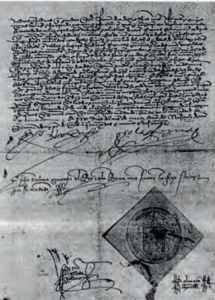
But by this time, Sicily had come under first Aragonese and then Spanish rule. When the Edict of Expulsion, declared by Ferdinand and Isabella of Spain in 1492, began to take effect in Sicily, the Spanish Viceroy was extremely reluctant to see the Jewish communities leave the island. At first he delayed the Edict and petitioned the Spanish monarchs not to enforce it; he was joined by many of the aristocracy and the business interests of Sicily. The Edict was delayed a year, but was finally implemented on January 12, 1493. On that date the Jews were expelled from Sicily. There are recorded stories of Christian friends weeping at the docks as their Jewish friends left by ship to Calabria, Greece or North Africa. Those Jews who chose not to leave were forced to convert to Christianity. Thus, the Edict effectively brought to an end any Jewish influence in Sicily.
In 2008, a small synagogue was established in Siracusa – 515 years after the Edict of Expulsion.