
By Michele Chabin
REHOVOT, ISRAEL – ALWAYS ON THE lookout for innovative and fun ways to engage her students at Yeshivat AMIT Amichai in Rehovot, Michal Jacob, the head of high school pedagogy, jumped at the chance to be one of only three schools chosen to participate in an educational
“space” program.
The VEN µS satellite is the first cooperative Earth observation program of Israel (ISA) and France (CNES) and, with the “assistance” of the students of AMIT Amichai.
The thirteen AMIT Amichai students chosen to participate in the satellite program, along with top students from two non-AMIT high schools, are learning about space through weekly afterschool symposia, field trips and meetings with professionals in the field. By the end of February, they had already attended the 12th Ilan Ramon International Space Conference, where they met with leading officials and astronauts. Ramon, the first Israeli astronaut, was killed in the Space Shuttle Columbia accident in 2003.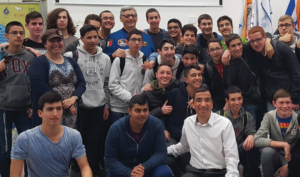
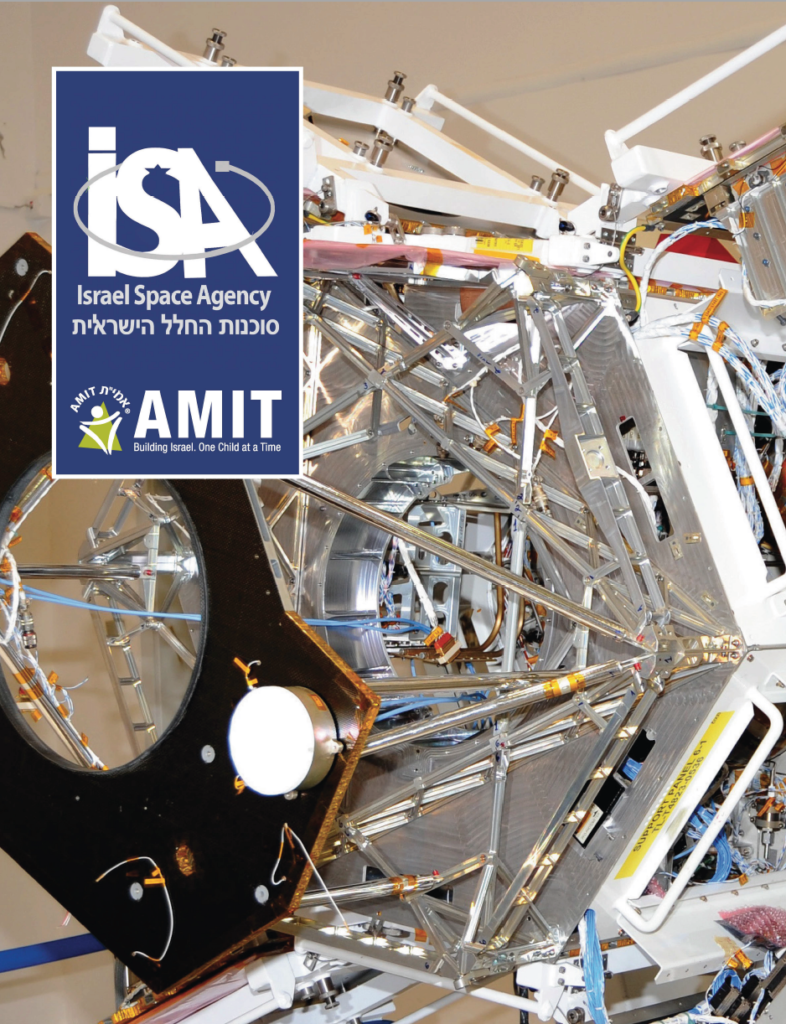
During the course of the program, the students will devise a project for the Venµs (Vegetation and Environment Monitoring) micro-satellite. The satellite is being built by the Israeli and French space agencies and scheduled for launch later this year. Venµs will perform agricultural imaging and environmental monitoring of the earth using a Super Spectral Camera.
Once the satellite photo-graphs the locations chosen by the students, the teens will analyze those images using sophisticated software.
Most of the students selected for the space program are part of an advanced science program at AMIT Amichai.
“The idea is that these kids will create projects that will be sent up into space,” said Michal Jacob, who also heads the AMIT network’s advanced math and science program.
“To be chosen, the kids need a strong background in science and math, or, in a couple of cases, a true passion needed to learn and be in this group.”
“I think this program is helping them establish a great foundation for the future. They’re meeting the top echelon in the air and space community in Israel,” she noted.
Avita! Suissa-Moyal, the Israel Space Agency’s education and community relations adviser, said the space project is one of five
the agency is supporting to enhance R&D projects related to space at high schools along with other unique educational programs that focus on STEM studies – science, technology, engineering and mathematics.
“Through this we believe that technological and scientific knowledge and ideas will ‘flow’ from the space industry and universities to the teachers and students and will help to build and develop a much-needed ecosystem for space education in high schools,” she explained.
“Ultimately,” Suissa-Moyal said, “we would like to encourage students not only to study about space but to consider it as a real profession.”
One of the skills the students are picking up is expertise in MATLAB, a high-level computer program used for compiling, executing and displaying highly advanced math projects.”
MATLAB is used in thespace industry and it’s not something kids usually have access to,” Adiz said. “It’s very difficult and students need the motivation to learn it and do the hard work. Once they know the program, they can work in the real world.”
Rabbi Shimon Shushan, AMIT Amichai’s principal, said the school has a “quality population” of students, “Our students are gifted and we want to help bring them to the next step in their education. The space program presents just such a challenge.”
Participating in such a high-level science program “reinforces the AMIT network’s core values that you can be a religious young man and serve in the army and live a modern life anchored in Torah values,” the principal said. “It’s proof that you can study physics and math and science and believe in God.”
In Jacob’s airy office, Amir Glick, a shy 15-year-old, explained why he decided to apply to the satellite program.
“When I heard about the program I thought it might be for me-or maybe not,” he admitted, “but then I realized this is a once-in-a-lifetime opportunity. My parents told me they wish they’d had a chance to experience a program like this when they were my age.”
Matan Eliahu, also 15, waxed poetic over the space program, calling it “a gift.”
“When you gaze up at the starry night you see these beams of light. It’s so much bigger than we are. There are galaxies and huge stars beyond that pitch-black sky. The fact that I’m small compared to this huge universe made we want to discover the undiscovered and to understand this unknown domain we call space.”
Eliahu said the participants are learning about different aspects of space, the solar system, Kepler’s laws of planetary motion and how satellites work.
“Hopefully, this summer the Venµs satellite will be launched, and we’ll be able to explore the geological features of earth from the photos it takes,” he said excitedly.
Eliahu recalled how, during the conference held in memory of Han Ramon, “we were able to meet with two American astronauts and a French astronaut. They told us about the challenges they face in their jobs and that being an astronaut is not an easy thing.”
The interaction with the astronauts “taught me that they are very persistent. They didn’t give up. The space program is giving me knowledge about the world, and we’re meeting all kinds of people. They give me hope that I can be like this and to never give up,” Eliahu said.
Michele Chabin, a frequent contributor to AMIT magazine, also reports for USA Today, the NY Jewish Week and Religion News Service among other publications. She has lived in Israel for 30 years.