
By Gloria Averbuch
Growing up, Ron Berant saw how long and hard his physician father worked. “Being a doctor was the last thing I wanted to do,” he concluded.
That all changed when he became a volunteer for Magen David Adom, Israel’s national ambulance and emergency medical organization. At age 17, he assisted in an emergency childbirth. “I remember coming out of the home holding the baby in my arms. I realized the impact you can have on someone’s life. It’s a very strong feeling to know that you can make such a difference.”
Today, Dr. Ron Berant, now 45, is a pioneering attending physician at Schneider Children’s Medical Center of Israel, the only standalone comprehensive hospital of its kind in the country and in the Middle East exclusively for children, recognized as one of the leading pediatric institutions in the world. He is a graduate of AMIT Ginsburg Bar Ilan Gush Dan high school for boys, an honors fellowship graduate in pediatric emergency medicine, and a tutor and lecturer at Sackler Faculty of Medicine at Tel Aviv University.
Berant sees an equal mission in caring for patients as well as teaching and mentoring others. In
Israel, “The physician’s role is much more than just taking care of patients. You have to be a ‘jack of all trades’, a clinician plus an educator and administrator,” he said. In fact, as he sat to be interviewed on his day off, he oversaw a computer repair, and then received a call asking if he could assist using his ultrasound expertise in a surgical procedure on a young patient. He agreed without hesitation.
 The Art of Instant Diagnosis
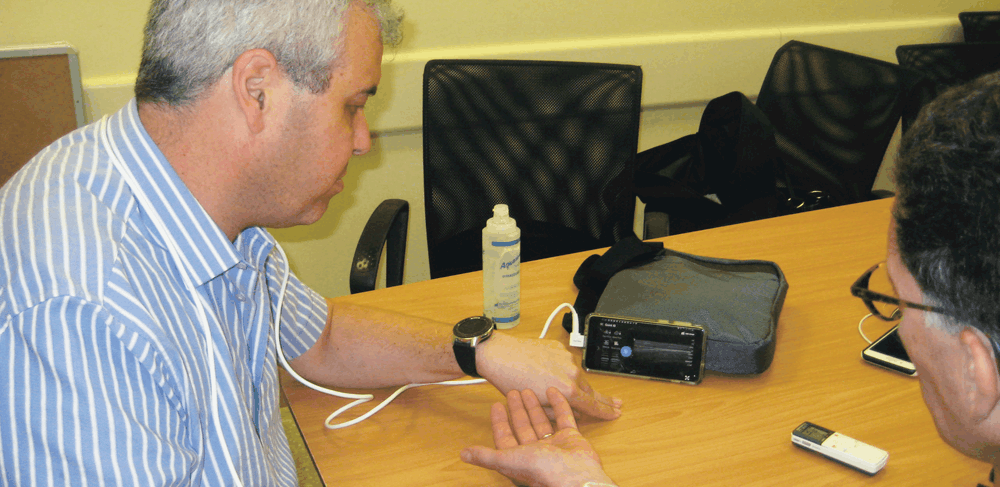
It is that special ultrasound technology that Berant has brought to Schneider and to Israel that makes him so sought after. The technology is called Point-of-Care Ultrasound (POCUS). It refers to the use of trained medical professionals using diagnostic ultrasound wherever a patient is located. It is a non-invasive, fast, and accurate way to provide treatment at the point of care, whether at the bedside or elsewhere, without the need to rely on a radiology department. In 2014, Berant became the first Israeli graduate of the Pediatric Emergency Medicine (PEM) Fellowship Training Program in POCUS at The Hospital for Sick Children in Toronto. Today, he is the lead physician in Israel in this technology.
“In the emergency room department, you don’t need to have the bottom-line diagnosis right away, but you need to know the next steps. Point-of-Care Ultrasound enables us to come to the correct next steps as quickly and as accurately as possible,” he explained.
Life and death emergencies happen often at Schneider. In one that is typical, a sick child was rushed into the ER with her heart barely beating. As doctors stood ready to infuse fluids to fight a suspected infection, Dr. Berant stepped in to view her heart via ultrasound. He quickly diagnosed cardiogenic shock, in this case suspected as infection-related; however, it was a viral infection, not bacterial. The cardiac intensive care unit was called in to treat her. The fluids the staff had stood ready to inject would have overwhelmed the child’s system, jeopardizing heart function with the additional volume. She likely would have died. “Because we were able to diagnose that child within three minutes and provide the most appropriate care, it probably saved her life,” said Berant.
Spreading the Word
In addition to conducting lectures and workshops in POCUS, Berant spreads the word through Camp Ultrasound. The annual program, which he started in 2015, includes physician learners from all over Israel and instructors from the United Sates, Canada, and Europe. “Would you mind lending me your kids?” he asks parents during the Passover vacation. The children spend two days at Schneider, enjoying a play center and serving as models for the physicians doing ultrasound training. The camp culminates in events like a bowling party.
In the last five years, the use of POCUS has dramatically spread throughout all ERs in the country. It has entirely changed the medical landscape in both pediatric and adult medicine. “I’m happy to say I have had a small share in the way we take care of patients in Israel,” said Berant. In addition to ultrasound through mobile carts and laptop computers, Berant, who has a talent for exploring and understanding technology, has the latest: an ultrasound app on his mobile phone. He attaches a transducer to his phone, and remarkably can now conduct an ultrasound anywhere, anytime simply by reaching into his pocket.
AMIT Education Set the Standard
Berant, a father of three and married to Orit, an MBA accountant, comes from a family of achievement and service. He cites as a mentor his father, Michael, a renowned cardiologist in Israel and at Schneider. His mother, Ety Berant, is a PhD in psychology; his brother, Jonathan, also a graduate of AMIT Ginsburg Bar Ilan Gush Dan, is a PhD in computer science and linguistics and an award-winning researcher and lecturer at Tel Aviv University; and his sister, Daphna, is a physician in residency at Schneider.
In addition to the influence of his family, the roots of Ron Berant’s professional achievements emanate from his early education. “Going to AMIT Gush Dan was pretty obvious,” he said. He grew up in Ramat Ilan, 200 meters from where he could see the school right in front of him. It was the only high school to which he aspired. At that time, the building was housed in Bar-Ilan University, where he was allowed to flex his intellectual muscle. This included permission as an 11th-grader to do a special project with a university biology professor in which Berant harvested cardiology cells to study the effect on the heart of a particular chemotherapy.
“AMIT really helped me with its spirit of open-mindedness. It trained all of us how to think. It wasn’t just about attaining a certain amount of knowledge; you came out being open to different trains of thought. School needs to give you tools. AMIT gave us the tools to find and fulfill our potential.”
Berant cites two AMIT faculty members in particular who contributed to his rich education. One was his counselor, Tzipi Spiegel, “who was attentive, and really listened and heard the students.” The other was his Gemara teacher, Gideon Sapir, currently a law professor at Bar-Ilan University and a past candidate for the Israeli Supreme Court. “He expanded our train of thought,” said Berant.
Finally, he said, AMIT taught him a critical skill: to fail and then to succeed. “I failed in physics, so when physics wasn’t right for me, they allowed me to succeed and excel in my interest. Now, I’m leading in that field.”
Like Father Like Son
AMIT Gush Dan boasts three generations of Berant boys. In addition to Ron and Jonathan, Berant’s eldest son is currently a 9th-grader at the school. And like his father, he is preparing to become a volunteer for Magen David Adom. On the wall at AMIT are the yearbook pictures of all graduates. “That’s my picture on the wall, and that’s your uncle,” Berant told his son with a smile. “Remember that we are always watching you, so behave.”
For Dr. Ron Berant, a professional calling was born in youthful experience, punctuated by the birth of a baby he helped deliver. Of his medical career he stated, “It’s really worth all the time and effort you put into it. I’ve been blessed, and am thankful for what I do.”