

BY ANAT ROSENBERG
Four years ago, Sara Tancman experienced something no woman should ever have to go through. In the middle of her fifth month of pregnancy with twins, Tancmatn felt pangs of abdominal pain and went to her HMO’s clinic for women. The doctor on call told her to calm down, that everything was fine, and explained to her that sometimes pregnant women can get overly emotional. Tancman followed her instincts, which were telling her something was wrong, and proceeded from the clinic to a hospital emergency room, where she delivered stillborn twins.
Tancman’s tragic loss and the fact that her health concerns were dismissed by the on-call physician, unfortunately, are all too common in Israel, the United States, and elsewhere. Women take to Facebook groups to lament their treatment by doctors or ask for recommendations for clinicians who have a good bedside manner in addition to medical expertise. And just recently, at least two books were published on this phenomenon, including “Doing Harm: The Truth About How Bad Medicine and Lazy Science Leave Women Dismissed, Misdiagnosed, and Sick,” by Maya Dusenbery and “Ask Me About My Uterus: A Quest to Make Doctors Believe in Women’s Pain,” by Abby Norman.
After her experience, Tancman started reading about pain and medicine, and learned that gender plays a big role when it comes to the intersection of the two. The indifferent medical treatment she received also prompted her to want to change the system in Israel.
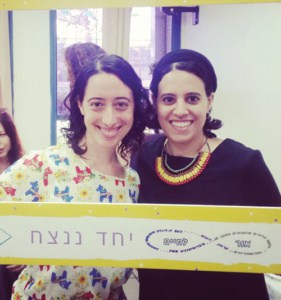 An alumna of AMIT Renanim Junior and Senior Science and Technology High School for Girls in Ra’anana, Tancman always knew she wanted to do something that would benefit women.
“When I was in university, I was involved in different projects with women, working with religious women in the army and working with Haredi women,” she said. “I was always interested in my body and learning about it, but I was an analyst in a government office. I always knew that, at some point, I wanted to work with women, but I didn’t know what I wanted to do until my experience.”
Her AMIT education also gave her some of the tools she is using now to confront what happened to her, and to work with the Health Ministry, HMOs, and doctors to take a different approach to Israeli women’s health.
“One of the things about Renanim was that they gave us a lot of options and encouraged us to choose our own path,” she said. “We were encouraged to ask questions, and not necessarily have the answer to everything, which is not a given. I have a lot of friends that went to different ulpanot and religious schools for girls, and some of them felt like you were supposed to have an answer for everything, and that certain questions weren’t acceptable. I didn’t feel that way.”
After her terrible loss, Tancman said, “I was able to ask questions and challenge the situation and see what I could do to change it.”
About a year after her harrowing experience, Tancman’s husband, Liran, sold CyActive, the startup he co-founded, to PayPal for a reported $60 million. That windfall helped Sara establish Keren Briah in 2016 (the name in Hebrew plays on the double meaning—“healthy” and “creation”—of the word briah). It is a nonprofit dedicated to enhancing Israeli women’s health by focusing on women’s needs and on ailments that affect them disproportionately—and increasing public awareness about them. Its work also recently landed Tancman on TheMarker’s list of 20 female trailblazers in medicine, a year after Globes named her one of the most promising Israelis under 40.
Since its creation, the foundation has launched several projects related to women’s health, including a survey of 6,500 women in Israel from different socioeconomic and ethnic backgrounds to find out more about what is important to them during a gynecological examination. The survey gave the women a voice and room to air their concerns without judgment.
“When I started the project, I thought it would be focused on logistics and things like making sure that there’s a curtain in the examination room or that there was a place to hang your clothing—things that sound technical but can make a big difference,” Tancman said.
“I learned from that survey what was most important to women,” she continued. “They do want privacy, but what was most important was communication with the doctor, getting answers to questions, respecting their opinion, warning them before the insertion of a device. That was when the project became a lot more complicated, because those things aren’t as easy to change as putting hangers in rooms and curtains.”
In order to change those bigger issues, Tancman decided to focus some of her attention on educating the next generation of doctors, specifically interns and residents in hospitals, by developing lectures and a simulation of a gynecological exam that she said “will hopefully be part of every doctor’s training.”
Tancman also partnered with several doctors, the student union at Tel Aviv University’s medical school, and the gender studies department, to create a course on gender in medicine. The subjects range from talks on sexual assault to the different medical treatment of women in the Arab, Haredi, and other sectors in Israel.
While the course is not officially part of the curriculum, Tancman said she was surprised by the high turnout for the evening lectures focusing on how women are perceived in medicine, how stereotypes affect their treatment, and medicine from a gender point of view.
Another part of her mission is to expand what the term “women’s health” encompasses in Israel. “Israel is very focused on fertility for a lot of reasons,” she said. “That means that fertility treatments are generally pretty good [and funded by the government], but women’s health is basically fertility and pregnancy.” She added that very little attention is paid to other women’s conditions such as menopause, endometriosis and other painful diseases, or almost anything unrelated to gynecology.
“I think part of the problem is what’s considered something that deserves medical attention and what deserves research,” she said. “What’s a sickness and what is health? I think that a lot of those norms were based on the male experience.”
Another enormous problem Tancman’s foundation is up against is Israel’s broken medical system—hospitals are understaffed, doctors and nurses are underpaid and often go on strike, and well-off Israelis are increasingly turning to private medical care. The understaffing means that patients get less time with doctors, and that time pressure leads to stereotyping that has adverse effects on the patient, Tancman said.
While she and her foundation cannot fix the system singlehandedly, she believes part of Keren Briah’s success has been to encourage women to speak up. “Part of the reason that doctors are willing to listen to me is because so many women share their stories with me,” she said. “I’m coming with hard data and I’m coming with a lot of voices behind me, which may not have been possible 10 years ago, before Facebook.”
The foundation also launched what Tancman calls “an accelerator for women’s activism in women’s health,” which helps fund groups—such as a group of women who have endometriosis—dedicated to improving women’s health in Israel. For the first time ever, with the support of Tancman’s foundation, that group recently took part in a worldwide march to raise awareness about the disease.
Tancman and Keren Briah are also working on other projects related to women’s health, including heart disease and other illnesses that affect women differently than men. “Now that I’ve gotten started, I realize how much more needs to be done,” she said. For every project that we do, there are five other issues that need to be addressed.”