

BY ANAT ROSENBERG
When Elad Amsalem first met the elementary-school-age children he would be teaching, they didn’t quite know what to make of him. When they laughed nervously, he saw it as an opportunity to teach them about what it means to accept someone who is different from them—and for that, Amsalem was recognized in May as teacher of the year by Israel’s Council of Youth and Children Organizations and the Education Ministry.
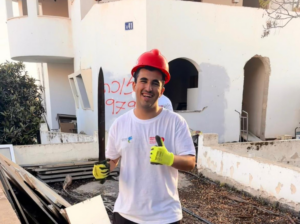
Amsalem, an alumnus of Yeshivat AMIT Kfar Ganim who currently attends the AMIT Orot Shaul Hesder Yeshiva in Ra’anana, was born a “normal” child, as he puts it. When he was about 6 months old, his parents noticed that he had trouble moving his right hand and limped when he started walking. Doctors told his parents that the entire right side of his body was paralyzed, and from a young age, “I understood that I wouldn’t be like everyone else,” he wrote recently in an Israeli newspaper.
“I have difficulty with basic things that are simple for everyone else, but for me they are a challenge,” Amsalem continued. “I can’t tie my own shoelaces, I need help with simple activities like cutting vegetables, writing, taking a book off a shelf, not to mention carrying something heavy.”
As a child, he spent a great deal of time thinking about the future and about all of the things he wouldn’t be able to do because of his “disability.” He thought about what it means to “fit in” among other children and his peers.
Amsalem’s parents, however, decided that from Day 1 he would live a “normal” life and in 1st grade they signed him up for an extracurricular activity: basketball. They insisted he believe in his ability to succeed, something that AMIT teachers and principals also work hard to instill in all their students.
Now, at age 19, Amsalem agrees with their approach. “Today I am a student at AMIT Orot Shaul Hesder Yeshiva and I also give lectures to students and youth groups about my experience in an effort to create a change in education and values,” he said. “In every lecture I devote a few minutes to describing life with a disability, and also to our obligation to integrate and accept children or young people living with disabilities as equal members of our society.”
Amsalem’s high school, Yeshivat AMIT Kfar Ganim in Petach Tikva, lives up to this obligation on a daily basis. The school currently has about 700 students enrolled in grades 9–12; 30% of each grade consists of students considered outside of the mainstream, whether autistic or requiring other special education needs. In addition, 10% of the student body at AMIT Kfar Ganim is of Ethiopian descent, more than any other high school in Petach Tikva. The school prides itself on its diversity and inclusivity.
For Amsalem, the journey toward teaching began in 10th grade, when he dreamed of becoming a Bnei Akiva youth group leader so that he could share his wisdom about accepting the “other.” He was passed over for a leadership role and took the rejection hard. But he didn’t give up.
At age 16, Amsalem joined the youth organization Yedidei Oz in the city of Shoham. The organization is a nonprofit that provides social activities, meetings, and classes to impart values and Zionism to Israeli children between ages 6 and 9.
He started as a youth counselor for elementary-school-age children and, over time, he became responsible for the organization’s branch in that city. Running the branch includes leading the training team, which comprises 15 adult instructors, and overseeing 100 children.
“I was afraid that I would not be able to handle it, but I decided to take on the challenge and soon the branch became my second home,” he told Israel Hayom.
Shlomi Castro, director general of the Council of Youth and Children Organizations in Israel, said that Elad and his activities are an inspiration to others. “His unceasing giving and active involvement in his city demonstrate why youth organizations are so significant in the community fabric,” Castro said.
Amsalem also looked for other ways to share his story and found a website called Herzl Lectures, which are like Ted Talks for teenagers, in which they have to appear onstage for 10-12 minutes and recount their life story. Over several months, he developed his lecture, which describes the challenges, hardships, and triumphs and how he contends with them every day.
The children listened and expressed great interest in his story. “I was so surprised, and I received such great responses from the teenagers and adults in the audience that it gave me the strength to keep lecturing,” he said.
In his lecture, Amsalem explains, “I may look different, strange, and even disabled, but my parents put the disability aside and, from a young age, they believed in me. Today, as an adult, I understand my parents’ decision not to treat me as ‘different.’ It’s true that physically I am ‘disabled,’ but I don’t let my disability win.”
He sees his encounters with youth as his mission in life. “Together with the students we are saying, ‘It is time to accept the other.’ It is time to change the public discourse, especially among young people, in order to integrate people with disabilities into Israeli society and accept them as equals,” he said.
Amsalem was awarded the teacher of the year prize at a ceremony at the Yitzhak Rabin Center. Fittingly, the person who bestowed the honor upon him was one of his pupils, a 7-year-old boy named Nachshon, who said that Elad sets a personal example for him of what a person can achieve.