
Many educators like to talk about inclusion in schools, but there’s a difference between discussing the concept in theory and implementing it in reality. That’s something that Rabbi Hagai Gross, the principal of Yeshivat AMIT Kfar Ganim in Petach Tikva, knows all too well. His school currently has about 700 students enrolled in grades 9–12; 30% of each grade consists of students considered outside of the mainstream, whether autistic or requiring other special education needs. In addition, 10% of the student body at AMIT Kfar Ganim is of Ethiopian descent, more than any other high school in Petach Tikva.
To be sure, there are challenges to maintaining such diversity. However, in the eight years since he took over the reins at Kfar Ganim, Gross has managed to transform it into a school that parents are clamoring to get their kids into, despite the presence of six competing schools in the area. That’s because it offers the most cutting-edge, Jewish values–based education—including the most advanced courses such as a cyber track run with an elite intelligence unit in the Israeli army.
Kfar Ganim has a 96% bagrut (matriculation exam) pass rate, with 80% of special education students also graduating successfully. The school also has garnered national awards for educational excellence, for promoting co-existence, and for inclusion.
So, what’s the secret to Kfar Ganim’s success? “We convinced parents that they are getting something and giving something back to society by sending their children here,” Gross said.
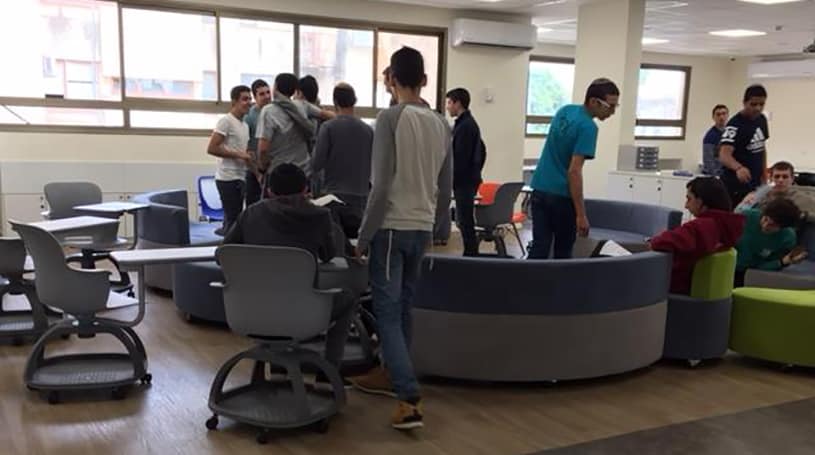
That was evident during a recent visit to the school, which includes regular frontal teaching classrooms, a newly opened Gogya-style classroom, as well as a variety of therapy rooms.
A group of 9th-grade boys with autism worked in a classroom/kitchen, where their task was to prepare breakfast for one another as a means of strengthening their social skills. They were chopping vegetables and slicing bread and cheese for each other. One boy named Yonatan said that the class “helps me create connections with the other boys.”
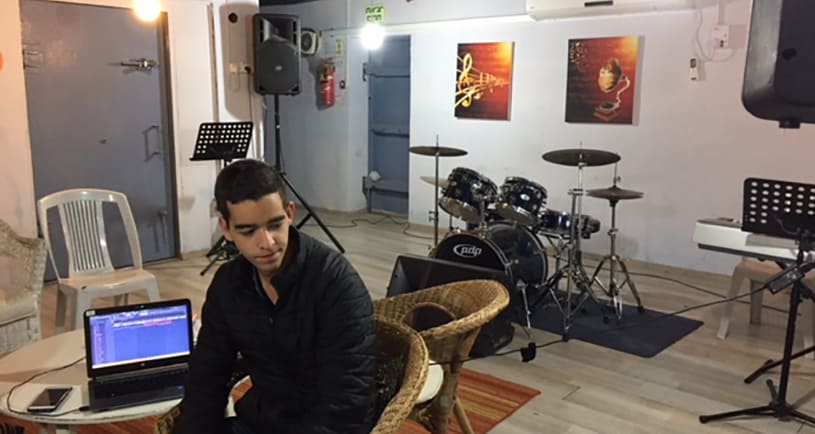
Gross then showed us a sensory room, with special lighting and cushions, that also caters to the autistic students or others with limited communication skills. There is an art therapy room, a video therapy room, a drama class, where students learn to work together and express themselves artistically. There is also a music therapy room, where we met a 12th-grade student named Ohad, who was working with Miri, the school’s music therapist, to compose a piece on his laptop. Ohad plays keyboard, and his dream is to become a DJ or music producer one day.
In another room, which simulates an office space, students with special needs learn secretarial skills like photocopying, filing, binding—practical skills that will enable them to find work in an office setting.
Meanwhile, Kfar Ganim is also incorporating AMIT’s Gogya pedagogical philosophy through the use of a new, transparent classroom with modular furniture. Students in the 8th and 11th grades are taking part in the pilot program featuring the modern learning space. Each class has a task to complete, and it’s up to the students to decide how to do that, whether as a group or as individuals. They have 40 computers at hand as well as their teacher, who serves as more of a guide.
The class that was there during our visit was enthusiastic about the new space and the learning opportunities it will afford them. Most of all, they were excited about their school, which several students emphasized is teaching them to be not just good students, but good people as well.