

Prakash Nair, the architect and planner behind AMIT’s Gogya center.
They say that behind every successful man, there’s a woman—and in the case of visionary architect and planner Prakash Nair, that happens to be true. While Nair was serving as director of operations for school construction in New York City, a post he held for more than a decade, his wife persuaded him to quit and launch his own consulting company, telling him, as he recalled, “Hopefully there’s a market somewhere for somebody who wants to do schools differently.”
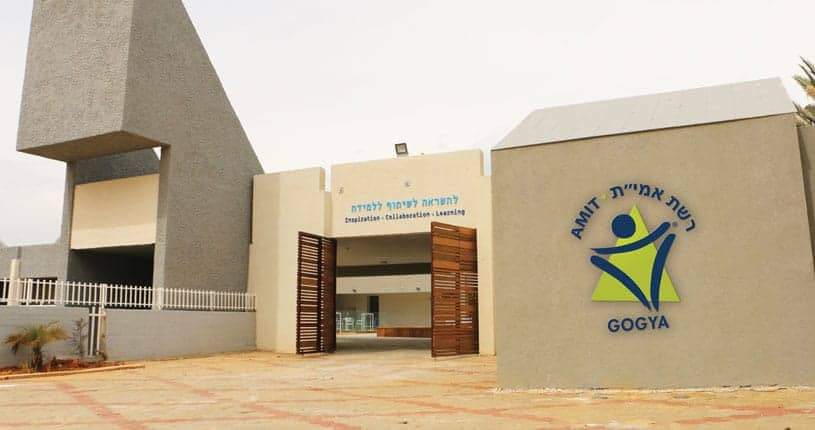
Almost two decades later, it seems there’s a market all over the world for educators who want to improve their schools and transform the learning process for their students. Nair and the company he co-founded, Fielding Nair International, have built and redesigned schools in 47 countries around the world, from Belgium to Beijing, over the last 15 years. One of those projects, the AMIT network’s Gogya center in Ra’anana, which opened its doors in 2014, has already had a sweeping effect on Israel’s educational landscape.
“AMIT is having a real impact in terms of presenting both to the Education Ministry and to others that change is possible,” Nair said at AMIT’s annual assembly in New York in June. More than 17,000 people have been trained at the state-of-the-art facility, where teachers become students again and learn to teach in radically new ways.
It is exactly this type of change that Nair had hoped to engender when he left his job in New York. From 1989 to 1999, the years he oversaw school construction there, Nair said the city spent more than $10 billion on building 100 schools and renovating 600 schools, and yet the children’s education didn’t improve. He set out to explore why, embarking on what he now calls his “journey of redemption.”
“The notion that you put a bunch of kids, sorted by age, in a room with one adult—and somehow that is education—is mind-boggling,” Nair said, “because it has nothing to do with the research of how children actually learn.… What we’re saying is, there has to be a better way of doing this, and there is—it’s called learning communities.”
These “learning communities” depart from traditional educational models in that students are more involved in the process—they are active participants as opposed to passive listeners—and teachers become facilitators. The schools themselves also look different: Nair and his firm eliminate the long hallways and drab, box-like classrooms where students sit in rows facing a lone teacher at the front of the room. They introduce color and modular furniture into classes so that students can move around and collaborate more easily; they connect learning spaces to nature (one of their projects even included a tree house); they provide quiet nooks where children can read, hang out with friends or take part in other activities together.
As Nair puts it, they move schools away from the “cells and bells” system that drains children of their creativity and toward a method that inspires collaborative learning, in which children learn the skills they need to thrive in the 21st century.
“Students start their day in a cell, the bell goes off and then they move to another identical cell,” Nair said of the traditional school system. “And, somehow, we’ve all accepted that this is okay.”
However, Nair added, it’s wrong to assume that children will learn to think outside of the box when they are sitting in a box all day long. “Why would a student want to be trapped in a box for 12 years of his or her life? This is a kind of inhumane treatment that we don’t even give our prisoners. Prisoners in a high-security prison have more space per square foot than students have.”
In Israel, the schools don’t just resemble boxes, some are imposing brutalist structures that are cold and unwelcoming—and hardly conducive to learning. Nair’s association with AMIT began several years ago, when the Network’s Director General, Amnon Eldar visited his home in Tampa, Florida. Eldar thought they would be talking about buildings, “but it ended up being a very intense conversation about education,” Nair said.
Nair then traveled to Israel, where he met with hundreds of AMIT teachers and conducted workshops to introduce them to the concept of learning communities. Then, in the U.S., the teachers went on “learning tours” of schools in Florida, New York and Michigan to “give them an experience of schools that have already embarked on the journey.”
“Prakash taught us about the essence of the change, explaining that it’s like app development,” Eldar said. “You can develop the most cutting-edge app with new and innovative content, but if you put the app onto an old-fashioned, non-smartphone, the application is totally pointless. The same is true in the world of education, where to have meaningful pedagogical innovation and change, you must enable this by providing the proper environment. Prakash opened our eyes to the new world of pedagogical architecture. Thanks to our work with Prakash, AMIT is the leader in this area in Israel.”
In addition to the teacher-training hub in Ra’anana, Nair’s firm is also working on an AMIT campus in that city, which will house kindergarten through 12th grade.
“The world has changed rapidly and dramatically,” Nair said. “You cannot put children through that factory model school and expect them to be prosperous with the skills you need today. You need to be critical thinkers, you need to be problem solvers, you need to be able to think on your feet, you need to be able to change jobs in a heartbeat—all the kinds of things that schools are actually destroying. Kids come into school creative and they leave school with all their creativity sucked out of them.”
The way to remedy that, he believes, is through transforming education and educational spaces. “Our children have this hidden potential, this latent power that’s just waiting to be unleashed,” Nair said. “We need to give them the opportunity to do that.” —AR