

BY DEBRA KAMIN
When Rama Burshtein, the ultra-Orthodox female film director, was shooting her debut picture “Fill the Void” in 2011, she cried every morning as she walked to the set from her Tel Aviv apartment.
Burshtein—who grew up secular in the Tel Aviv bedroom community of Kfar Saba and became
ultra-Orthodox at the age of 27—had been making films for religious Israeli women like herself for two decades, films that were shot on shoestring budgets and shown at special female-only screenings during Hanukkah and Sukkot. But “Fill the Void,” an intimate, warmly woven story of desire and duty within Tel Aviv’s ultra-Orthodox community, was her first film for the outside world, and her first experience as a director on set with both men and women. She was conflicted every day, she says, with how to adhere to Jewish law while practicing her craft, and she struggled immensely.
Despite her misgivings, the film was a runaway success—it swept the Ophir Awards, Israel’s version of the Oscars, earned rave reviews at the Venice Film Festival, where it premiered, and went on to represent Israel as its submission for Best Foreign Language Film at the 2012 Academy Awards.
Now Burshtein is back, with her warmhearted, comedy-infused follow-up, “The Wedding Plan,” which opened across the United States in May and has been greeted with the same accolades.
And this time around, she isn’t crying at all.
“This is the difference between the first film and the second,” she said in a phone interview just before the film’s U.S. debut. “I was feeling a lot more comfortable.” That wasn’t necessarily a good thing, Burshtein added, because the discomfort of her earlier filmmaking experience both brought out her creativity and forced her to work harder. “It was a different kind of spiritual work,” the second time around, she said, a lot of which was centered on Burshtein grappling with the weight of sky-high expectations. “I wasn’t crying, I was playing a kind of make believe. I am not naive.… I always will feel that my talent is a gift and it can be taken away at any second.”
“The Wedding Plan,” which originally opened in Israel under the title “Through the Wall,” centers around thirtysomething Michal, who after years of searching for a mate is finally about to tie the knot and realize her dreams of becoming a Jewish wife and mother. But then her fiancé dumps her just one month before the wedding. In a brilliantly executed scene, Michal decides to take a phenomenal leap of faith, keep her reservation at the wedding hall and trust that G-d will bring her a husband before her scheduled walk down the aisle.
It’s a soapy premise, and one that may appear strange to secular viewers unacquainted with the deep mysticism and faith in G-d that underlies
ultra-Orthodox life. But on screen, in the deft hands of Noa Koler, a relatively unknown Israeli actress who handles Michal’s complex, anguished and resoundingly optimistic character with flair and charm, it works.
“Ms. Burshtein asks viewers to take a leap of faith as well with a borderline surreal finale, which finds Michal, woozy in close-ups during a fast, trying to comprehend what’s happening around her,” wrote Ben Kenigsberg in The New York Times. “It’s a mystical touch—another tipoff that this ordinary-sounding movie is actually pretty special.”
“Fill the Void” was groundbreaking in the portal it offered viewers into the female ultra-Orthodox world, and “The Wedding Plan” digs even deeper by continuing to offer viewers intimate access into the cloistered community but doing so with humor and genuine sweet romance.
Burshtein’s work has created a quiet revolution for Israeli filmmaking, opening a space for stirring, emotionally rich portrayals of religious women that go deeper than ever before.
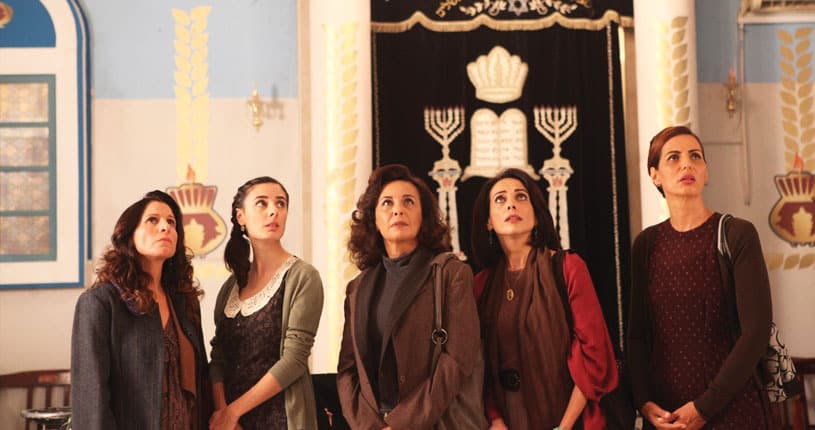
“The Women’s Balcony.” (Credit: Menemsha Films)
Accompanying “The Wedding Plan” to the U.S. box office this season is “The Women’s Balcony,” a mellow, approachable film that draws viewers in with its warm ensemble cast and then offers a sharp analysis of religious fundamentalism run amok.
It’s a timely topic, no doubt, and one as old as the hills—indeed “The Women’s Balcony,” which follows a close-knit congregation of Mizrahi Orthodox Jews in Jerusalem, has been likened to a modern-day telling of “Lysistrata.”
The film opens with a joyful bar mitzvah celebration at a synagogue, where the festivities come to a crashing halt when the open-air women’s balcony suddenly collapses. The rabbi’s wife is injured and the aging rabbi can no longer cope with the crisis and continue to lead his congregation.
With the rabbi out of commission, the men of the congregation welcome a new ultra-Orthodox leader, Rabbi David, to the helm. He is charismatic, engaging and immediately has the men transfixed. But trouble ensues when Rabbi David suggests that the women’s balcony collapsed as punishment for the women’s lack of modesty, and that rather than repair the balcony, the female members of the congregation should instead be relegated to a cordoned-off inner room.
Screenwriter Shlomit Nehama, who grew up in an Orthodox Jerusalem community like that of the film, has said she aspired “to tell the story of the moderate people who are forced to deal with growing religious extremism.”
She brought the idea to director Emil Ben-
Shimon, and together the pair began building a story of a community in Jerusalem with religious women at its center.
“All the time we are reading newspaper articles and news about rabbis who say unkind things about women,” Ben-Shimon said. “We wanted to say something on this subject.”
The film was a box-office hit in Israel and has garnered positive reviews across the U.S., something that surprised first-time screenwriter Nehama. “I was sure this was a very local story that no one who doesn’t understand the local culture would identify with,” she told JTA.
Ben-Shimon admits that when he was working on the film, he was unaware that he was handling such a flash-point issue. Since the film’s release, issues of women and their place in religious life in Israel have reignited, most recently over Prime Minister Benjamin Netanyahu’s reneged agreement to create an egalitarian prayer space at the Western Wall, widely viewed as a slap in the face to Reform and Conservative Jewry.
And “The Women’s Balcony,” suddenly, is being embraced by more liberal sects of Judaism as a stirring example of how gender segregation can go wrong.
“People have told me, many people, that they used to be against the Reform movement and the idea of men and women praying together, and now after they see the film they feel more liberal, and think maybe it’s not such a problematic thing,” Ben-Shimon said.
Clearly the film’s honest, straightforward portrayal of devout women resonates with viewers regardless of gender or level of religious observance, and allows them to understand the soul of these protagonists and connect to their basic humanity. It’s a promising change for Israeli filmmaking—and if the reception of the projects in the U.S. is any indication, one that may go on to eventually impact the way religious women are portrayed in films across the globe.
Burshtein agrees. She said of her protagonist, Michal, “She is so many women…. This is why people are so attached to her.”
Debra Kamin is an American journalist in Tel Aviv.