

By Tikvah Wiener
Co-Founder and Director, I.D.E.A. Schools Network
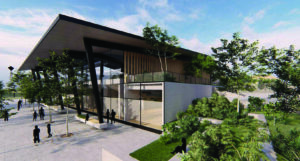
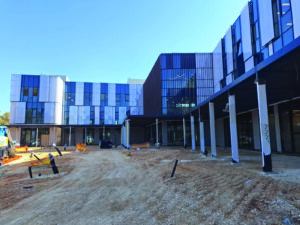
In the beginning of July, I had the opportunity to visit AMIT’s center for educational innovation, GOGYA, located in Ra’anana, Israel. The name “GOGYA” comes from the word “pedagogy,” and the GOGYA center is where principals and teachers from the AMIT schools gather to reimagine education for the 21st century.
There are 110 AMIT schools and programs throughout Israel, with 70% of the schools located on the social, economic or geographic periphery of the country. Part of AMIT’s mission is to empower the most underserved groups in Israel and to connect all of Israel’s populations: secular, religious, sabras, and recent immigrants.
Five years ago, AMIT embarked on a process of change, altering the culture in its schools so that principals and teachers would be empowered to constantly innovate and to implement new types of learning in the classroom. The GOGYA center has been crucial in this process. The AMIT website describes the center as “[u]ltra-modern, with glass-walled classrooms, an abundance of natural sunlight, creative workrooms and modular furniture,” a building that is “the embodiment of GOGYA’s philosophy and spirit” and that “has the look and energy of a high-tech startup.”
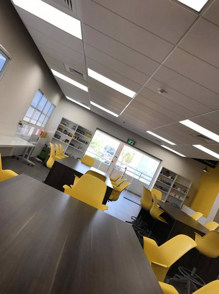
The GOGYA Center’s Maker Space
It makes sense that educators learning to implement 21st-century pedagogies do so in a location that’s set up to encourage those models. The building even has a maker space.
A well-designed space can only spark innovation, however, if it’s accompanied by well-thought-out structures that give those being encouraged to change the support they need to do so. AMIT has given much thought to those structures. The organization began by inviting a group of principals to form a Research and Design team to decide how they would bring change to their schools. Once they had undergone a change process, those principals each selected a group of seven teachers from their schools to form R and D teams. Those teachers in turn embarked on a two-year journey of learning that showed them the changing relationship between teacher and student and introduced them to the latest research about how people learn.
Over their two years of professional development at the GOGYA center, principals and educators study:
- The way they teach, re-imagining the role the teacher plays in the classroom so that the student is at the center of learning
- What they teach, re-examining curriculum and academic content
- The way they assess, thinking about new and creative ways to provide feedback and assess students’ abilities and learning
- Climate and conversation, examining the culture in the school and classroom and creating an environment that is constantly dynamic
- Identity, looking at the goals of the school and how educators are both fulfilling the individual mandate of their particular schools, as well as the AMIT vision of students who love Israel, who are ethical and kind people and who have 21st-century skills
- Structure, asking how schools are using time, space and even people to advance their missions and visions. They also explore who teaches together and ask what classes can be interdisciplinary or multi-age.
Professional development at the GOGYA center enables the principals and teachers to come together at the building and learn from experts and collaborate. The cohorts have trained with project-based learning (PBL) experts from the high-tech Schools in San Diego, a series of public charter schools that focus on equity, deep learning and beautiful work. AMIT educators have also received extensive and rigorous training from the Buck Institute of Education (BIE), creators of the Gold Standard of PBL. AMIT has even translated BIE course materials into Hebrew. Professional development has also included visiting progressive schools in America to learn from their best practices. One of their favorite trips was to Bloomfield Hills High, in Michigan, one of the top-rated and most innovative public schools in America.
The results of AMIT’s approach to change have been impressive. Teachers and principals are energized, and there’s an excitement around growth and innovation. In the second year of the teachers’ professional development, they start to plan the community of practice they’ll bring back to their schools — and they get to choose furniture and other classroom gadgets that will create the kind of learning environment they’ve discovered they want to create. AMIT strategically has the teachers choose their furniture only in year two, once they’ve received training in pedagogy and understand how flexible learning spaces will work in tandem with the new educational models they’ve adopted. In fact, even then, teachers must write a plan explaining how their classroom redesign will inform their pedagogical practices.
When I was at GOGYA, a group of teachers was excitedly in the midst of choosing the kinds of couches, moveable desks, tables and bookcases, and various personal whiteboards they wanted for their classrooms.
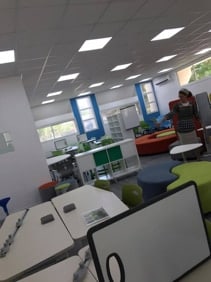
Educators in AMIT schools select furniture that encourages student-centered learning
Not only has AMIT thoughtfully approached how they train educators, they’ve included all stakeholders in their culture change program. They involved Israel’s Ministry of Education as well as parents in their process, and have their administrators and teachers meet with the politicians and parents six times a year. As a GOGYA educator explained to me, “Everyone has to know what’s going on.”
So, what’s come of all this training and change? Already some amazing projects. One group of students in an AMIT school studied three poets and decided which one they wanted to name a street after. They had to write and present their recommendation to their town’s mayor.
Another group of students organized a blood drive, while another learned about statistics through sports. One boys’ school asked students to engage in Design Thinking to solve a problem in their synagogue, and one school explored why it’s important to read, surveying students, meeting with experts, and then preparing research on their findings.
It’s always energizing to connect with educators interested in creating learning spaces and employing educational models that will engage students, prepare them for the world, and empower them to take ownership of their learning. That AMIT is doing so for students in underserved communities in Israel, and in a way that connects all of Israel’s diverse populations, makes their work all the more impressive.
Learn more about The Idea School at www.theideaschool.org