
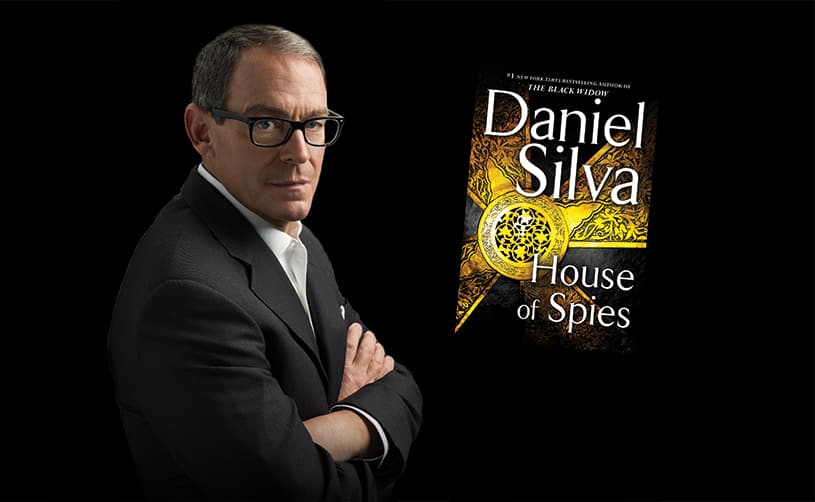
Daniel Silva, the No. 1 New York Times best-selling author, just released “House of Spies,” the next installment of his series featuring Gabriel Allon, the Israeli spy, assassin and art restorer. Silva appeared at an AMIT event and book-signing in New York ahead of its release, and then spoke with AMIT about the new thriller, current events, including ISIS attacks and how he’s able to figure out where they will strike next, his writing process and what he’ll be tackling in his next book, which can be summed up in one word: Russia.
AMIT: You have said that, at first, you didn’t think Gabriel Allon, or an Israeli protagonist, would work for your series. Why did you decide to make him Israeli in the first place as opposed to American or British?
DANIEL SILVA: It’s important to remember that I did not intend him to be a continuing character. He was supposed to appear in one book and one book only. In fact, he was going to be a second-tier character in that novel [“The Kill Artist”]. The more flesh I added to the bones, the stronger he became. He just rose to the top of that novel.
AMIT: Do you think that some of the popularity of your books has to do with people needing a superhero in today’s times?
Speaker 2: Of course. A different kind of superhero. I think that a lot of the popularity of the series resides in the fact that there are two distinct sides to Gabriel Allon. He’s also an art restorer. He brings that sensibility to the story. I tell my stories and craft my stories in a way that makes the espionage model appeal to people who might not necessarily pick up an espionage novel. I know that I have readers who read no one else in this genre but me. If you look at my new novel, “House of Spies,” specifically, the way I wrote a manhunt for an ISIS mastermind, I wrote it in a unique and different way.
AMIT: Speaking of ISIS, do you think that all the insanity around the world is a mixed blessing for you in terms of providing fodder for your novels?
DS: Let’s just say I have no shortage of topics about which to write. That is not a good thing, as we say. I’m very proud about this novel and its companion piece, “The Black Widow,” in that I really managed, in two years, to capture the rise of ISIS and its evolution into an international terrorist group. Hopefully, the beginning of the end of ISIS. In my novel, I write about the death of the caliphate and the elimination of an ISIS terror mastermind. On the week that it comes out, Mosul has been reclaimed and it is quite possible that Islamic State leader Abu Bakr al-Baghdadi has been killed. I really managed with this novel to catch history in the act.
AMIT: People have said that you’re quite prescient about what ISIS is up to or where they’re going to attack next. How do you keep track of that? Is it just following the news closely? Is it talking to intelligence people?
DS: All of the above. I used to work in the region, lived in Egypt, heard and felt bombs going off that were carried out by forerunners of Al-Qaida. This is something I’ve been covering for a very long time. In preparation for beginning this book, I became convinced looking at the evidence, looking at trends, that the next series of terrorist attacks carried out by ISIS in the West would be in the United Kingdom. I wrote my opening sequence of the novel accordingly. As I was finishing the novel, it all came true.
AMIT: Going back to what you said about ISIS’ physical caliphate being replaced by a cyber caliphate—is that going to play a larger role in your next work?
DS: No, in fact, I know that I will not be writing about ISIS in the next book.
AMIT: Can you tell us what you will be writing about?
DS: Let’s just say that I’ve been following the Russia story as it relates to President Trump very closely.
AMIT: So, Russia will play a larger role in your upcoming works?
DS: I’m going to definitely write more about Russia. I think if you look back at the evolution of Russia from semi-friend of the United States to adversary, when it comes to fiction I was the first one to recognize and write that Vladimir Putin and this new Russia were going to be a problem for the West, in my book from several years ago, “Moscow Rules.” The book that I wrote that dealt with Russian meddling in Western electoral politics was called “The English Girl.” Great Britain was the backdrop, but it could have been any country in the West because Russia has been at this for a long time. I am not at all surprised that Russia tried to meddle in our politics, in our elections. Regardless of what happened vis à vis the Trump campaign, that operation paid huge dividends because our politics are in turmoil right now and Russia is loving it.
AMIT: Is the fact that Trump leaked intel that Israel gave him to the Russians something that Gabriel Allon would have been annoyed about?
DS: Yes. Gabriel would have been very annoyed about it. It’s very interesting that it happened. If you look back at “The Black Widow,” the Israelis manage to insert an agent into ISIS. Gabriel went to extraordinary lengths to protect the identity of the agent, to protect the agent herself so she would not be killed in a U.S. air strike. We can see the care with which we the services work together, at least in the fictional sense, in “The Black Widow.” To have a president boasting in the Oval Office about this great intelligence that he was getting from the Israelis, Gabriel would have been a little miffed about that.
AMIT: Were you watching TV when you were mentioned during Attorney General Jeff Sessions’ testimony to the Senate Intelligence Committee regarding the Russia probe, when Sen. Tom Cotton of Arkansas asked him if he likes spy fiction?
DS: No, I was working. I keep my phone in another room and I don’t see emails on the computer that I work on. I go pick up my phone, it’s exploding with people telling me, ‘You’re in the hearing.’ It wasn’t a Watergate moment, but it was nice to be part of that very historic hearing.
AMIT: Going back to TV news, as a former executive producer for “Crossfire,” “Capital Gang” and “Reliable Sources,” how do you feel about today’s media landscape? Has it changed dramatically?
DS: It has, in that CNN had opinion people on its air back in the ’90s, but in those days, they were always paired with someone from the other side. Now you have a situation where one network tilts one way, another network tilts another way. We have no single source of news that we can coalesce around as a country, as a people. Ultimately, that is bad for our democracy. That is a long way of saying that I am distressed by our media landscape.
AMIT: MGM TV recently acquired the rights to your Gabriel Allon books. What else can you tell us about that? Is there somebody that you can picture playing Gabriel Allon?
DS: I would answer that question in this way: When I write Gabriel Allon, I see Gabriel Allon. I don’t picture an actor, I never have. In terms of what’s going on with the television series, right now we are talking to writers and producers and show-runners, setting the vision of the series, getting the basic elements of the storyline that we’re going to pursue. Getting those first scripts done, and casting will take place after that is done.
AMIT: Would you be concerned casting an Israeli actor to play Gabriel Allon with what’s going on with Gal Gadot and “Wonder Woman” being banned in Arab countries or you haven’t gotten that far yet?
DS: I have not gotten that far.
AMIT: Your writing deadlines are very tight as you publish a novel every year. Can you describe your process? How do ideas for your books start germinating in your mind?
DS: It starts with a very basic notion—I want to write a book about this. It’s the process of, like a painting, laying down the base layers of the idea and working at it day in and day out. I wish there was some easy description of how I go about it. Never do I see a book, the beginning, middle and end, finished in my head. It’s a process. It’s a bit like driving down the road at night with your headlights on. You sort of see as much of the story as is illuminated by the headlights. Sometimes it’s raining and you don’t see very much. Sometimes it’s really foggy and you can’t see anything at all. Sometimes, you can put the high beams on and see very far down the road. I don’t outline my stories. I see roughly about a third of a book and then I get going and start writing as quickly as I can. I leave room to surprise myself and I think that’s very important.
AMIT: What are you reading right now? Do you have much time to read other authors?
DS: Actually, I love Ali Soufan’s book “Anatomy of Terror: From the Death of Bin Laden to the Rise of the Islamic State.” That is what I’m reading right now. It is a great, great book.
This interview has been condensed for clarity and length.